Edgar Degas法国, 1834–1917
L'Orchestre de l'Opéra
关于这幅画
The Orchestra at the Opera (c. 1870) is an oil-on-canvas painting by the French artist Edgar Degas (1834–1917).
The musicians depicted in the orchestra pit of the Salle Le Peletier the home of the Paris Opera (from 1821 until it burnt down in 1873) are mostly portraits of friends of Degas, foremost among them pictorially the bassoonist and composer Désiré Dihau (1838–1909), who commissioned the painting, at work on his instrument, and the cellist Louis-Marie Pilet (1815–1877) on his string instrument.
The painting was handed over, without further retouching possible, to its owner (Dihau), who exhibited it in Lille, which caused Degas' family, until then doubtful about the art of their "Raphael", to remark: "It is thanks to you that he has finally produced and completed a work, a real painting".
继续阅读
Blurring the distinction between portraiture and genre pieces, Degas painted his bassoonist friend, Désiré Dihau, in The Orchestra at the Opera as one of fourteen musicians in an orchestra pit, viewed as though by a member of the audience. Above the musicians can be seen only the legs and tutus of the dancers onstage, their figures cropped by the edge of the painting. Art historian Charles Stuckey has compared the viewpoint to that of a distracted spectator at a ballet, and says that "it is Degas' fascination with the depiction of movement, including the movement of a spectator's eyes as during a random glance, that is properly speaking 'Impressionist'."
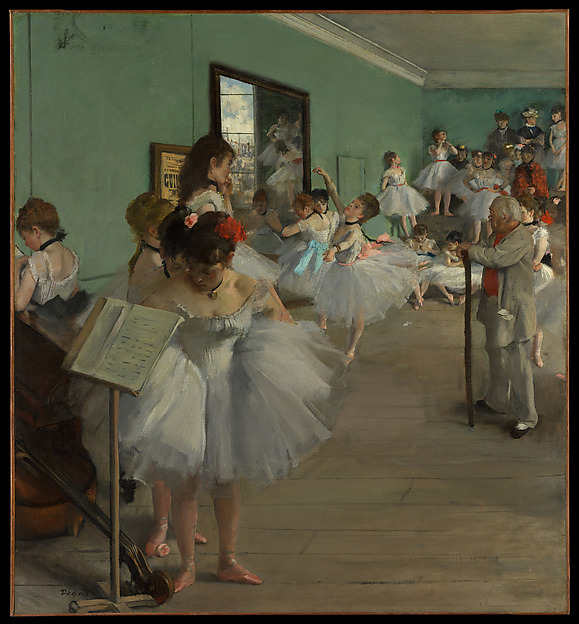
The painting is the first instance in Degas' work where dancers from the ballet appear. He would depict dancers frequently for the rest of his career, and it is for his ballet pictures that he remains best known.
作品信息
- 馆藏编号
- RF 2417
与此同时,在Edgar Degas的生活中
完整生平late 1860s
The turn to modern life: racecourses, milliners, laundresses
By the late 1860s Degas had moved from history painting to an original observation of contemporary life: racecourse scenes let him paint horses and riders in a modern setting, and then he turned to women at work — milliners and laundresses.
late 1860s
Begins modelling in wax
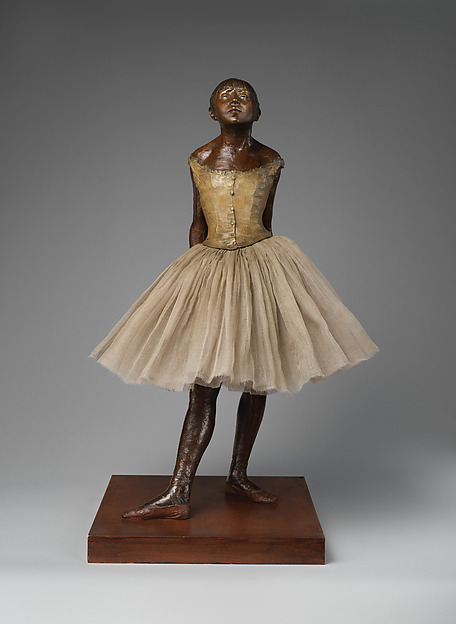
Degas modelled small wax figures of dancers, bathers and jockeys for himself, in place of studies. He never worked in bronze or stone; he valued wax for its changeability, and his sculptor friend Bartholomé encouraged him.
1870
A volunteer in the war; a flaw in his eyesight
When the Franco-Prussian War broke out Degas volunteered; at the first shooting practice it turned out that he saw poorly with his right eye. It was the first sign of the macular degeneration that left him almost blind at the end of his life; he was transferred to the artillery and served there to the end of the war.
early 1870s
Meets Durand-Ruel
Degas met the dealer Durand-Ruel, later the most prominent of the trusted dealers with whom he planned his strategy at auctions.
1870s
From “de Gas” back to plain “Degas”
The archives disproved the legend of an ancient noble line: the artist's paternal ancestors were bakers, and the name “de Gas” was invented by his father, who commissioned a false genealogy. In the 1870s Edgar returned to the plain spelling, Degas.