 Franz Marc德国, 1880–1916
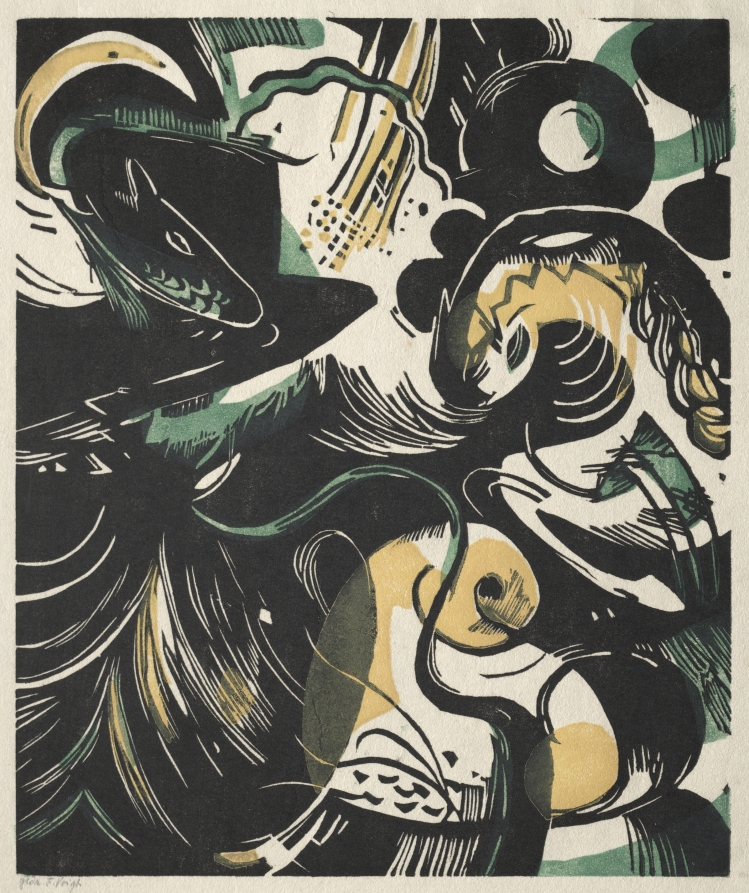
Genesis II

关于作品
Like other members of Der Blaue Reiter in Munich, Franz Marc focused on depicting animals, which symbolized joyous rebirth. Genesis II was made to illustrate the creation story in the book of Genesis; he planned to include it in an illustrated Bible. Here, three horses emerge from a background of chaos and movement. His Tiger is less joyous and more threatening than the bounding horses; with clenched teeth, the tiger leers toward a cowering animal behind it. After enthusiastically enlisting in the German army, Marc died in battle at Verdun, France, on March 4, 1916. His wartime death—and that of fellow artist August Macke—had a profound impact on the Munich Expressionists, whose vision of an earthly paradise quickly dissolved.
克利夫蘭藝術博物館
作品信息
- 馆藏编号
- 1959.228
已收入目录
出处
- 克利夫蘭藝術博物館
- 图片: 克利夫蘭藝術博物館 — Museum open access
与此同时,在Franz Marc的生活中
完整生平December 1911 – January 1912
The first Blue Rider exhibition
Several of Marc's works are shown at the first Blue Rider exhibition at the Thannhauser Galleries in Munich, which has been called the apex of German Expressionism.
1912
The Blue Rider exhibition tours Germany
The exhibition travels to Berlin, Cologne, Hagen and Frankfurt; in Berlin the gallery owner Herwarth Walden shows Marc alongside Paul Klee, Alfred Kubin and Alexej von Jawlensky, and in 1912 the collection is also shown in Wuppertal.
1913
Married: Maria Marc
1914
Called up at the start of the First World War
At the outbreak of war in 1914 Marc, like August Macke, is mobilised and sent to the front; early biographers thought he had volunteered, but conscription was practically impossible to avoid.
4 March 1916
Killed at Verdun
Marc is on a list of notable artists the government meant to withdraw from combat for their own safety, but the reassignment order does not reach him in time: at the Battle of Verdun a shell splinter strikes him in the head. Some accounts say he died instantly, others that he was mortally wounded.
1916年3月4日
Died