Max Ernst法国, 1891–1976
Forest and Sun

About the painting
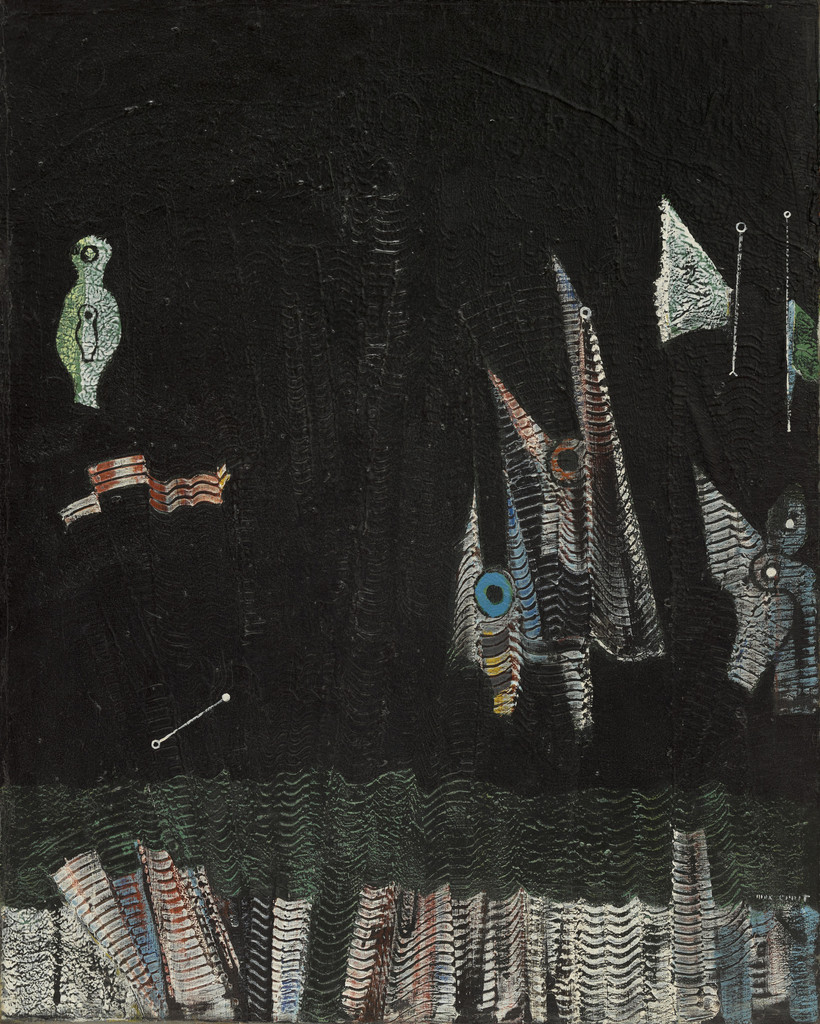
Among his many recollections of childhood, Max Ernst often recounted his fear and fascination with the forest that surrounded his home. He wrote of feeling “delight and oppression and what the Romantics called ‘emotion in the face of Nature.’” By expressing his thoughts in these terms, Ernst linked himself with the spiritual landscape tradition of Romanticism, which conceived of an invisible realm at work in the natural world.
Read on
This dark and mysterious forest scene dates to one of the most creative periods of Ernst’s career. Spurred by the Surrealist leader André Breton’s proclamation of “pure psychic automatism” as an artistic ideal, he developed the innovative technique of frottage, his term for the method of reproducing a relief design (like the surface of a piece of wood) by laying paper or canvas over it and rubbing it with a pencil, charcoal, or another medium. In Forest and Sun Ernst used this technique to create a petrified forest, which he imbued with a sense of primordial otherworldliness. By scraping away almost-dry paint on the canvas (a process he called grattage), the artist produced the encircled sun at the center of the composition. Ernst painted six variations of the forest and sun theme. As in the other five canvases, the tree trunks suggest a letter in the artist’s name: in this case, a capital M.
芝加哥藝術博物館CC BY 4.0
作品信息
- 馆藏编号
- 2007.276
What it shows
行踪录
在展 · 展厅 396
芝加哥藝術博物館 · 2026年9月28日 — 现在 · 已核实
在展 · 展厅 395
芝加哥藝術博物館 · 2026年8月19日 — 2026年9月28日 · 已核实
出处
- 芝加哥藝術博物館: the museum's own open data · 5天前获取
- 图片: 芝加哥藝術博物館 — © the artist or rights holder
与此同时,在Max Ernst的生活中
完整生平1925
A contract with Jacques Viot and a studio in Montmartre
Back in Paris Ernst signed a contract with Jacques Viot that let him paint full-time, and in 1925 he took a studio at 22 rue Tourlaque in Montmartre. The contract ended in June with Viot’s mysterious disappearance.
1926
“Histoire naturelle”: a portfolio of frottages
At Jeanne Bucher’s press Ernst published Histoire naturelle, a portfolio of drawings in the frottage technique, with an introduction by Hans Arp.
1926
The first large show at Galerie van Leer
In 1926 the Paris gallery van Leer held Ernst’s first large exhibition; in place of a preface the catalogue printed poems by Paul Éluard, Benjamin Péret and Robert Desnos.
1926
Diaghilev’s ballet and Breton’s scandal
In 1926 Ernst and Joan Miró designed Romeo and Juliet for Sergei Diaghilev’s company; Breton, indignant at the work with the Ballets Russes, made a scandal at the premiere, and in La Révolution surréaliste he and Aragon accused Ernst and Miró of belittling the idea of surrealism. The next issue, however, carried two of Ernst’s works with an apologia by Éluard.
1927
Married: Marie-Berthe Aurenche
1929
The collage novel “La Femme 100 têtes”
In 1929 appeared the graphic novel La Femme 100 têtes, some 150 drawings with the artist’s text and an address to the reader by André Breton. One of its characters was Loplop, the chief of the birds, who appeared in Ernst’s work again and again.