 Nicolas Poussin法国, 1594–1665
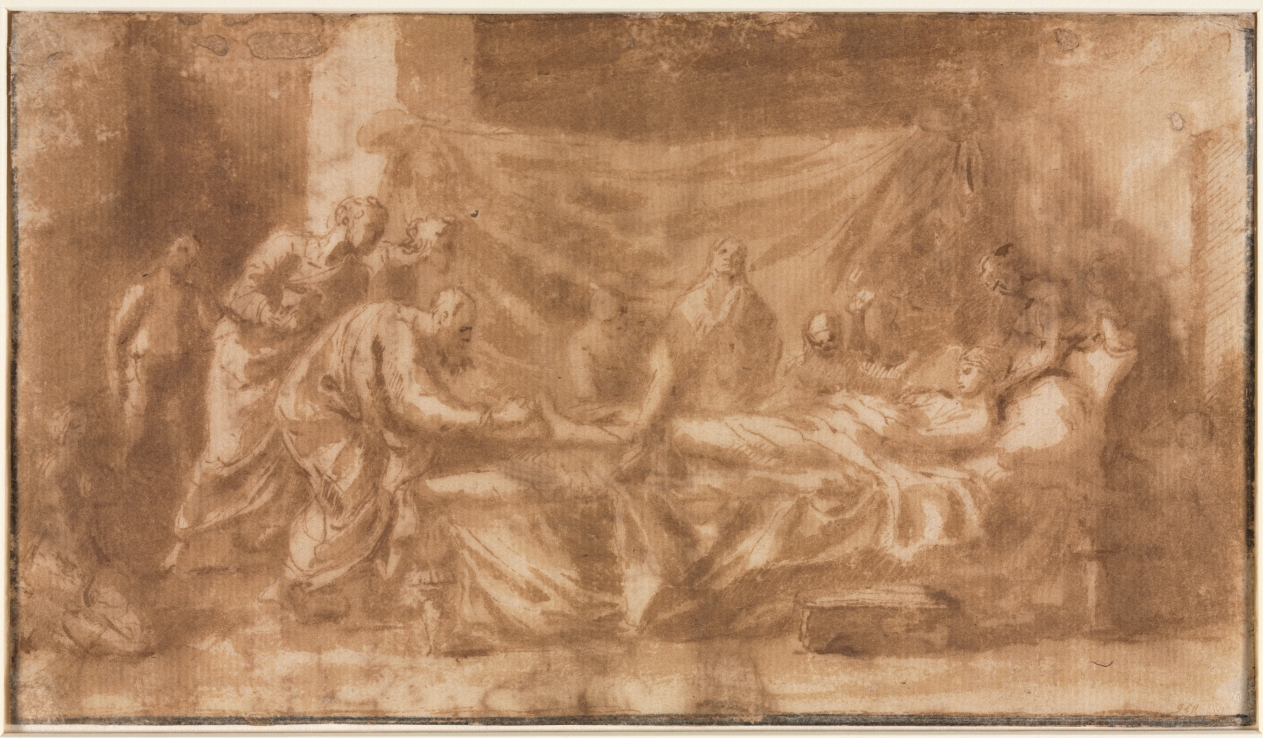
Extreme Unction (recto)

作品信息
- 馆藏编号
- 1983.197.a
已收入目录
出处
- 克利夫蘭藝術博物館: the museum's own open data · 5天前获取
- 图片: 克利夫蘭藝術博物館 — Museum open access
与此同时,在Nicolas Poussin的生活中
完整生平1641
An avalanche of royal commissions
In Paris he was swamped with commissions: “The Institution of the Eucharist” for the chapel of the château of Saint-Germain-en-Laye, “The Miracle of St Francis Xavier” for the Jesuit novitiate, ceilings and vaults for the Grande Galerie of the Louvre, an allegory for Richelieu’s study, designs for tapestries and title pages for the royal printing house. For a man accustomed to working slowly and carefully it was too much.
1641–1642
Vouet’s partisans reproach his Christ with resembling Jupiter
The partisans of Simon Vouet, Poussin’s old friend, also criticised his Christ in the sky in “The Miracle of St Francis Xavier”: too much pride, resembling Jupiter more than a God of Mercy. Poussin answered that he could not and should not imagine a Christ looking like a gentle father — when he was on earth among men, it was difficult to look him in the face.
1641–1665
Post: Premier peintre du Roi
autumn 1642
Finds a pretext and leaves for Rome for good
Increasingly unhappy with court intrigue and the weight of commissions, in the autumn of 1642, while the king and court were in Languedoc, Poussin found a pretext to leave Paris and returned to Rome permanently.
1642–1644
Richelieu, Louis XIII and Urban VIII pass away
Richelieu died in 1642, Louis XIII in 1643 and Pope Urban VIII in 1644; his successor Innocent X was less interested in art patronage and preferred Spanish culture, and the Barberini left for France. But Richelieu’s successor, Cardinal Mazarin, began to collect Poussin’s works.
1643
Chantelou comes to Rome and commissions masterpieces
Paul Fréart de Chantelou came to Rome in 1643 and stayed several months; he commissioned from Poussin some of his most important works, including the second series of “The Seven Sacraments” and “Landscape with Diogenes”.