 Edvard Munch挪威, 1863–1944
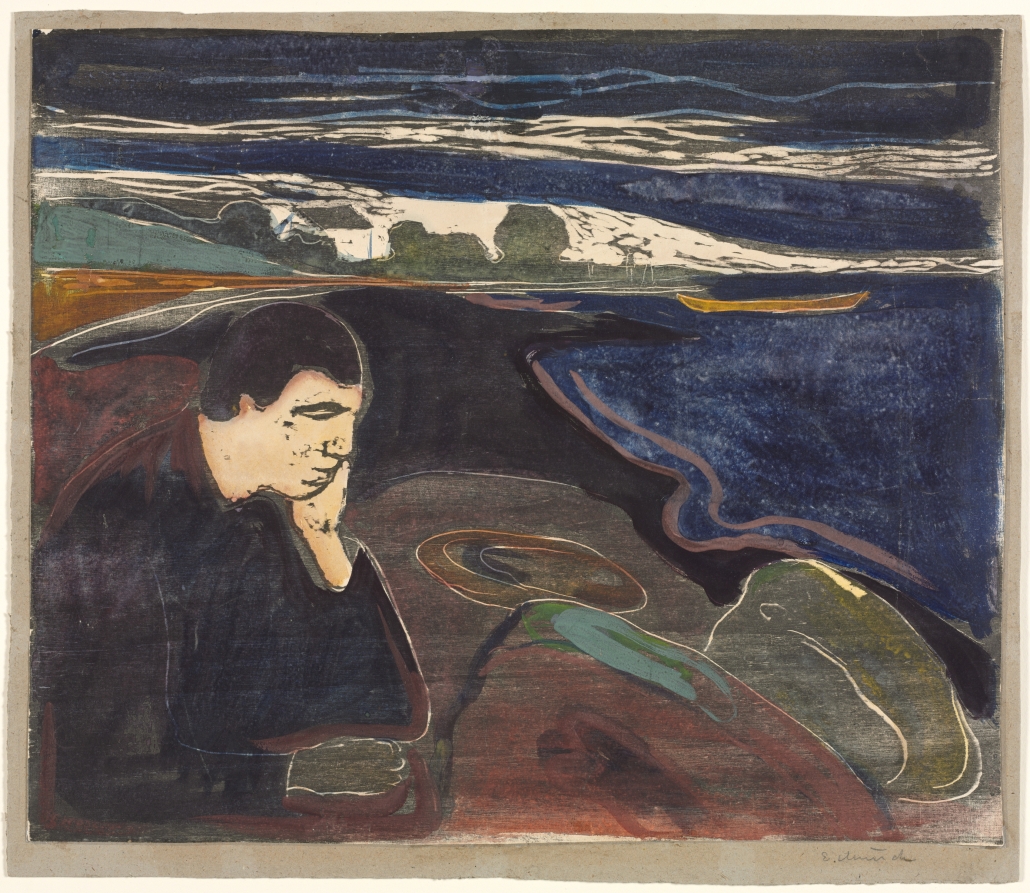
Evening, Melancholy I

关于作品
Evening, Melancholy I depicts the jilted, tormented art critic Jappe Nilssen, Munch's friend, on the shore of Åsgårdstrand, a fishing village south of Oslo. Munch chose heavily grained blocks of wood, allowing the pattern of the board to add texture to the scene, and he exploited the handmade aspect of the technique by carving blocks crudely. He also experimented so that each impression is unique, using black ink on the woodblock and watercolor and gouache to color the sheet extensively. An example of how method can reinforce meaning, the simplified shapes, flattened space, and dark hues create a visual correspondence to the figure's deep depression.
克利夫蘭藝術博物館
作品信息
- 馆藏编号
- 1959.82
已收入目录
出处
- 克利夫蘭藝術博物館: the museum's own open data · 7天前获取
- 图片: 克利夫蘭藝術博物館 — Museum open access
与此同时,在Edvard Munch的生活中
完整生平1894
Turn to Copper Engraving
He began engraving on copper on his own, without formal training, working in etching, drypoint, and aquatint, and created many masterpieces in the medium.
1896
Meetings with Gauguin and the Symbolists in Paris
During an important stay in Paris he met Gauguin, Émile Bernard, Maurice Denis, and Symbolist poets, notably Mallarmé. At this time he turned to etching, woodcut, and lithography.
May 1896
Exhibition at the Maison de l'Art Nouveau
Siegfried Bing showed 60 of Munch's works, including "The Kiss," "The Scream," "Madonna," and "The Sick Child." The exhibition introduced the French public to the artist's work.
1898
Beginning of the Affair with Tulla Larsen
An affair began with Tulla (Mathilde) Larsen, a wealthy young Norwegian woman. Initially warm, the relationship in time began to weigh on Munch because of Tulla's ardor and possessiveness.