Jasper Johns美国, 1930
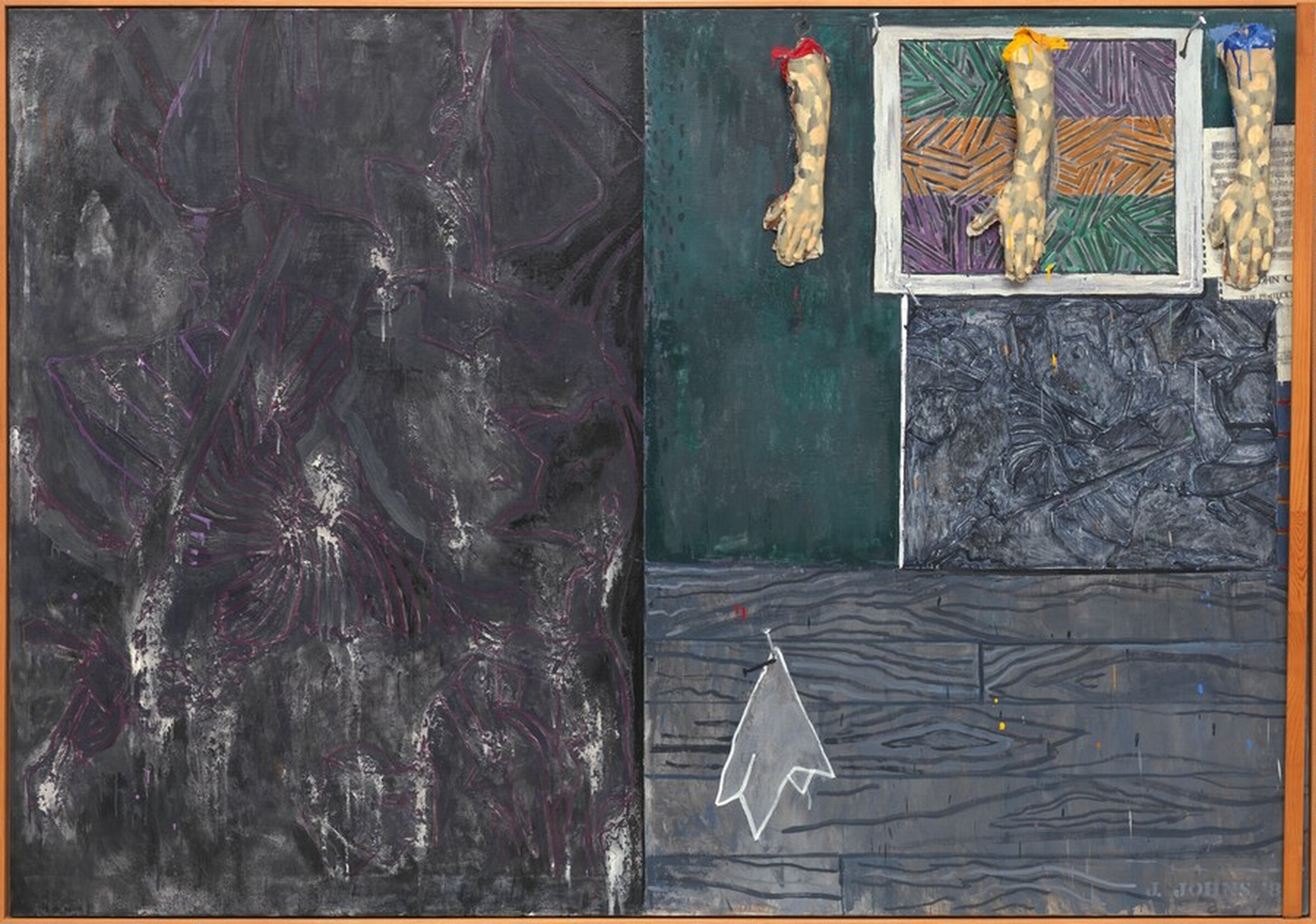
Corpse and Mirror II

About the painting
In his work from 1972 to 1983, Jasper Johns used a distinct arrangement of crosshatched marks, traditionally considered a graphic method of adding depth and volume to an image or conveying the illusion of light in space. Johns first glimpsed this pattern on a passing car, recalling: “I only saw it for a second, but knew immediately that I was going to use it. It had all the qualities that interest me—literalness, repetitiveness, an obsessive quality, order with dumbness, and the possibility of a complete lack of meaning.” Emphasizing the flatness of the painting, Johns’s cross-hatching is gestural without being emotive; in this sense, the technique extends his larger critique of overtly expressionist models of painting. Johns forged a new model of painterly abstraction, using a schema that is repeatable and ordered but not strictly geometric or reductive.
芝加哥藝術博物館CC BY 4.0
作品信息
- 馆藏编号
- 7.1976
已收入目录
出处
- 芝加哥藝術博物館: the museum's own open data · 7天前获取
- 图片: 芝加哥藝術博物館 — © the artist or rights holder
与此同时,在Jasper Johns的生活中
完整生平1967–1980
Artistic adviser to the Merce Cunningham Dance Company
Johns had long supported the Merce Cunningham Dance Company, helping to raise funds and attention and assisting Rauschenberg with set and costume designs in the 1950s, and from 1967 to 1980 he served as its artistic adviser.
1972
A home and studio on Saint Martin
Having visited the Caribbean island of Saint Martin since the late 1960s, Johns bought property there in 1972 and later built a home and studio principally designed by Philip Johnson.
1972年6月30日–1972年10月8日
Exhibition: Documenta 5
1973–1987
A farmhouse with a glass-walled studio at Stony Point
From 1973 to 1987 Johns kept a rustic 1930s farmhouse with a glass-walled studio in Stony Point, New York.
1976
The book “Foirades/Fizzles” with Samuel Beckett
At the Atelier Crommelynck in Paris, where his intaglios were printed for Petersburg Press from 1975 to 1990, Johns collaborated with Samuel Beckett on Foirades/Fizzles, a book of five text fragments by Beckett in French and English with 33 intaglios by Johns.
![Flags II [trial proof], Jasper Johns, 1967-1970](https://api.nga.gov/iiif/9f010b4d-1f11-4448-bf9a-ccc0c4ba4a2a/full/!2400,2400/0/default.jpg)