Pierre-Auguste Renoir法国, 1841–1919
Albert Cahen d'Anvers
可否一睹真容?
可以,正在迎客
正对公众展出。由谁担保,见下文。
- 核实
- 此状态始于
- 出处
- 博物馆
关于这幅画
Pierre-Auguste Renoir depicted the self-assured composer Albert Cahen d'Anvers, a former pupil of César Franck, nonchalantly smoking a cigarette at a friend's home. Traditionally, portraits of men were somber, but Renoir combined decorativeness with fidelity to his sitter's appearance. Facial hair was regarded as a powerful indicator of male sexuality, and Renoir shows Cahen d'Anvers's curled mustache echoing the wallpaper's curves, his ruffled red hair referring to the potted plant's feathery leaves. Cahen d'Anvers's authority and status are suggested through his alert, commanding gaze and details such as his elaborate cigarette holder and cravat. Renoir hoped that success in portraiture would lead to success in the wider potential market attracted by the Salon. Twenty years into his career, he had become so disenchanted with Impressionism that he called the movement a "blind alley."
继续阅读
He modified his style, combining the loose, painterly effects of early works such as *La Promenade* with Renaissance painting's firm contours and weighty forms. He began receiving portrait commissions, often from wealthy Jewish patrons. Only a year after making this portrait, however, his uncertainty about achieving his aims through portraiture and his increasing anti-Semitism meant that portraiture no longer appeared so promising to him.
J·保羅·蓋蒂博物館
作品信息
- 馆藏编号
- 88.PA.133
已收入目录
出处
- J·保羅·蓋蒂博物館
- 图片: J·保羅·蓋蒂博物館 — Open Content
与此同时,在Pierre-Auguste Renoir的生活中
完整生平1879
Triumph at the Salon of 1879
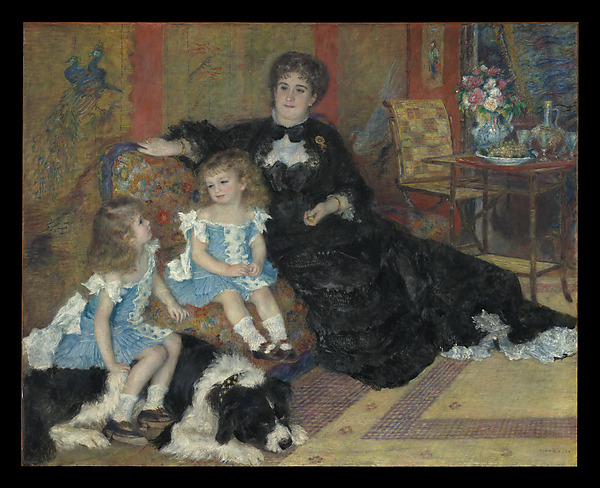
Presenting "Portrait of Madame Charpentier and Her Children" and the full-length "Portrait of the Actress Jeanne Samary," Renoir won universal recognition, and with it financial independence.
1880
Meeting Aline Charigot
Renoir met the young seamstress Aline Charigot — his future wife. His happiness with her colored the works of his so-called "Ingres" period.
1881
Algeria, Madrid, Italy
Renoir traveled to Algeria, the land of Delacroix, then to Madrid to see the works of Velázquez, and to Italy, where he saw Titian in Florence and Raphael in Rome. The journey convinced him that with Impressionism he had "reached the limit," and turned him toward classicism.
1881年7月6日
Daughter born: Lucienne Bisson
1882
Pneumonia
Renoir suffered a bout of pneumonia that permanently damaged his respiratory system, and spent six weeks convalescing in Algeria.
1883–1890
The "Ingres" period
Impressed by the classics of the Italian Renaissance and by Ingres, Renoir effectively broke with Impressionism: his lines became crisp, his colors more restrained and cooler. The artist himself called this period "sour"; it includes "Dance in the Country," "Dance in the City" and "Dance at Bougival."