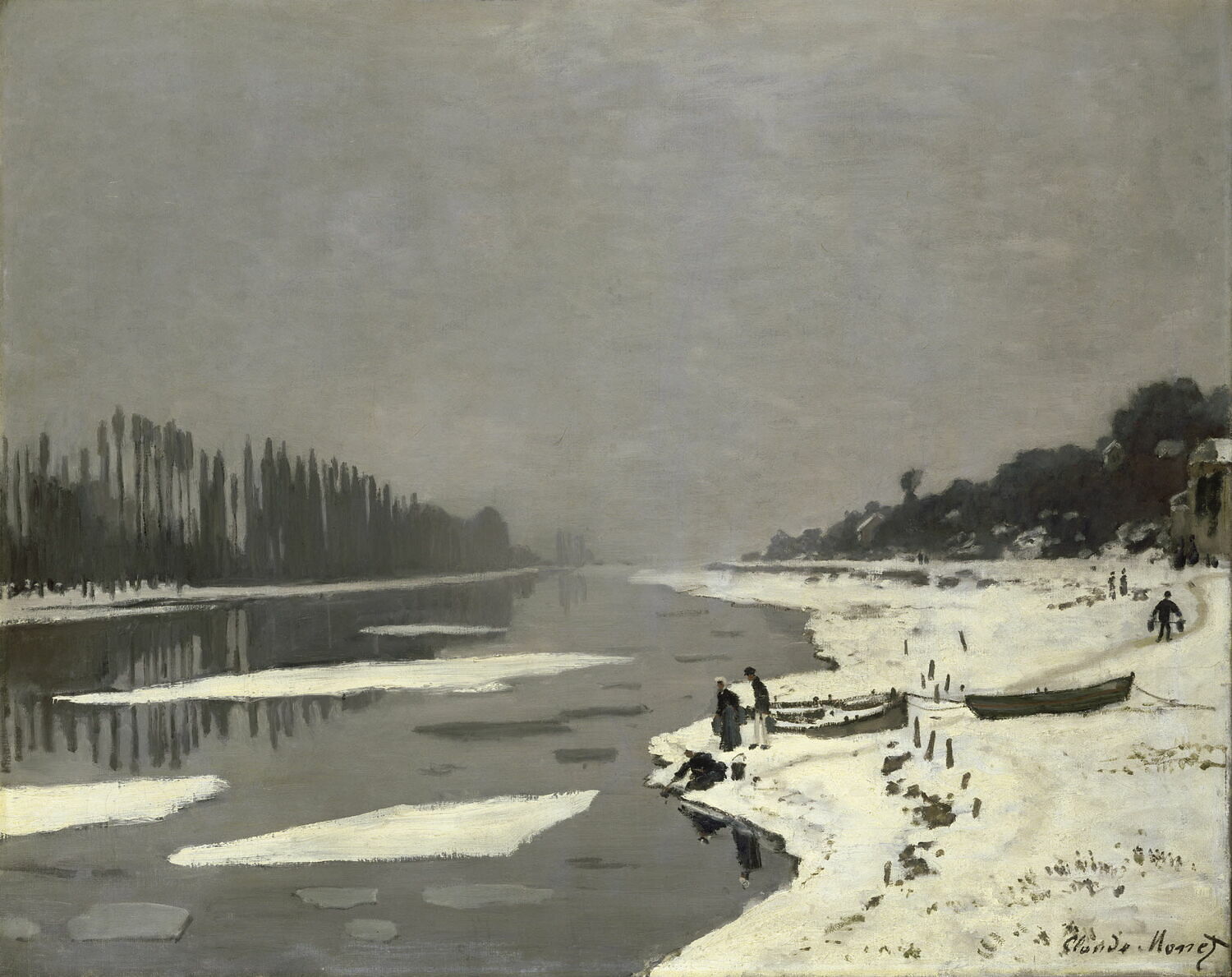
Claude Monet法国, 1840–1926
Sunrise (Marine)
可否一睹真容?
可以,正在迎客
正对公众展出。由谁担保,见下文。
- 核实
- 此状态始于
- 出处
- 博物馆
关于这幅画
In the muted palette of the emerging dawn, Claude Monet portrayed the industrial port of Le Havre on the northern coast of France. The brilliant orange of the rising sun glimmers amid the damp air and dances on the gentle rippling water, lighting up its iridescent blues and greens. Barely discernible through a cool haze, pack boats on the left billow smoke from their stacks. Painted during the spring of 1873 as the country struggled to rebuild following the Franco-Prussian war, this *Sunrise* might also metaphorically suggest a new day dawning in France. *Sunrise* exemplifies Monet's plein air, or "outdoor," approach to painting. The informal and spontaneous brushstrokes establish this picture as one of the first works, along with the famous *Impression: Sunrise* at the Marmottan Museum in Paris, in the Impressionist style that was to make him famous. The ephemeral play of light, water, and air would remain Monet's subject for the rest of his career.
J·保羅·蓋蒂博物館
作品信息
- 馆藏编号
- 98.PA.164
与此同时,在Claude Monet的生活中
完整生平1870年6月28日
Married: Camille Doncieux
28 June 1870
Marriage to Camille Doncieux
Monet married his model Camille Doncieux shortly before the outbreak of the Franco-Prussian War.
1870–1871
London exile
Evading conscription during the Franco-Prussian War, Monet lived in London, where he studied Constable and Turner, met Pissarro and Whistler, and became acquainted with his first and principal dealer, Paul Durand-Ruel — an encounter decisive for his career.
May 1871
Zaandam: 25 paintings
Leaving London, Monet settled in Zaandam in the Netherlands, where he painted twenty-five pictures (the police suspected him of revolutionary activity). During this period he also made his first visit to Amsterdam.
1874
First Impressionist exhibition
At the exhibition, organized on the initiative of Monet and his associates as an alternative to the Salon, "Impression, Sunrise" was shown. The critic Leroy mockingly dubbed the participants "impressionists" — and so the term Impressionism was born.