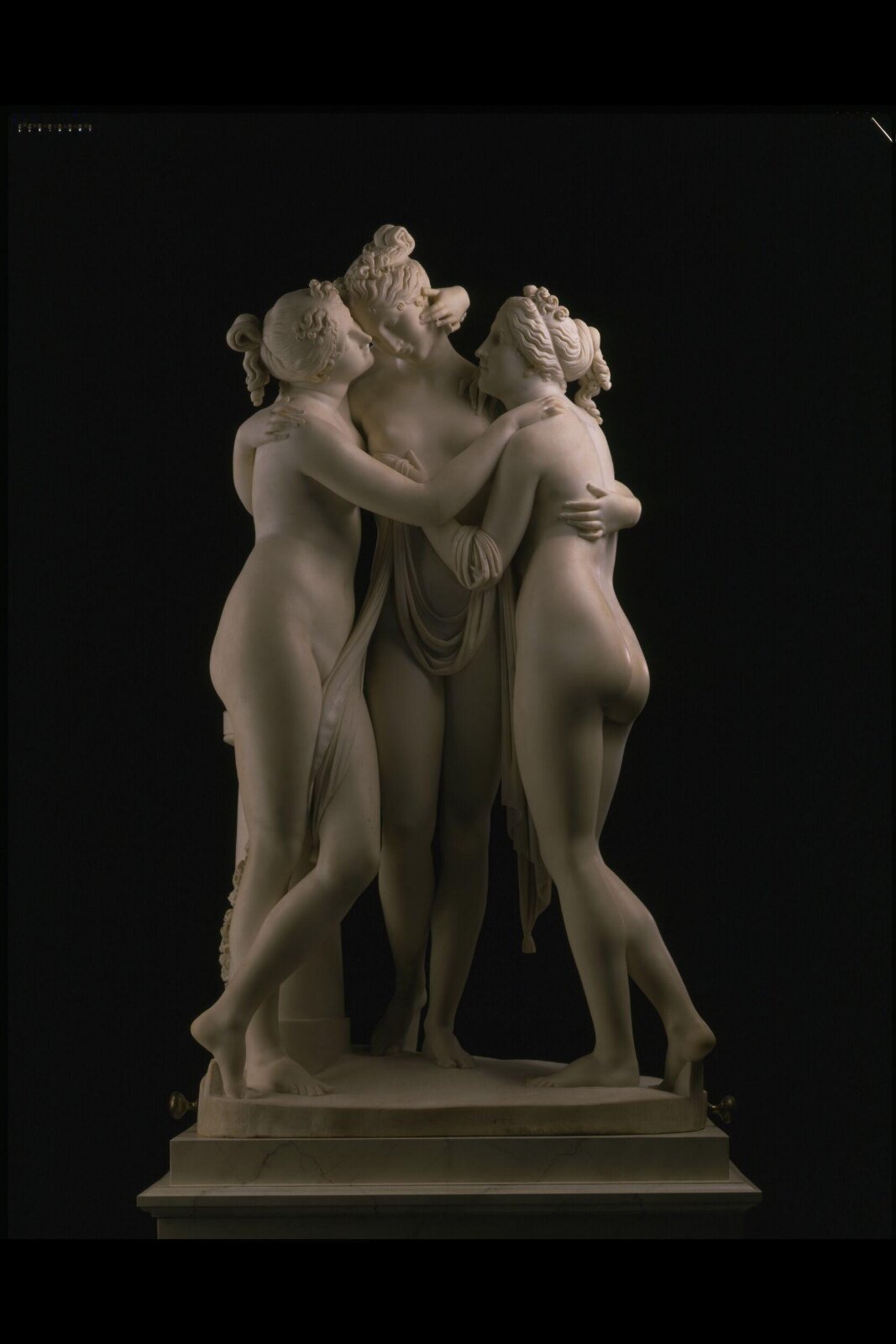
 Антонио КановаИталия, 1757–1822
The Three Graces
Можно ли лицезреть?
Неизвестно: музей хранит молчание

Музей Виктории и Альберта
Лондон, Великобритания
Хозяин известен. Выставлена ли она сейчас, музей не сообщает, а гадать мы не обучены.
- В этом положении с
- Источник
- Данные самого музея
О скульптуре
Словами музея — на английском
Object Type
Читать дальше
This marble figure group was made for the Sculpture Gallery at Woburn Abbey, Bedfordshire, and was originally housed in a specially designed Temple of the Graces. It was commissioned from Antonio Canova (1757-1822) by John Russell, 6th Duke of Bedford, who visited the sculptor in his studio in Rome in 1814, and was captivated by the group of the Three Graces which Canova had carved for the Empress Josephine, the estranged wife of Napoleon Bonaparte. She had died in May of that year, and the Duke offered to buy the group from Canova, but Josephine's son claimed it, and that version is now in the Hermitage, St Petersburg. The Duke commissioned a second version from Canova; this was begun in 1814, finished in 1817, and installed at Woburn in 1819. It cost 6,000 zechinni, equivalent to £3000. Canova came over to England to supervise the installation. In the Temple it was displayed on a pedestal adapted from an earlier marble plinth, with a rotating top.
Subject Depicted
The Three Graces, celebrated in classical literature and art, were the daughters of Jupiter (or Zeus in Greek mythology), and companions to the Muses. Thalia (youth and beauty) is accompanied by Euphrosyne (mirth), and Aglaia (elegance). Canova had first depicted the Graces in a painting of 1799, and other drawings and a relief of the subject are also known to have been executed by him at around the same time. In 1810 he modelled a terracotta sketch (Musée de Lyon, France), and in 1812 the Empress Josephine ordered a full-size marble.
Materials & Making
Canova's marble group is based ultimately on his earlier drawings of the subject, and a closely comparable terracotta sketch model (see above). The immediate model for the marble used in the studio was the full-size plaster group, which still exists in the Canova Museum at Possagno, Italy. This has points on it which were used to transfer the composition from the plaster to the marble.
Canova was responsible for the original design of the group, but his assistants would roughly block out the marble. The sculptor himself completed the final carving, and ensured the surface of the stone was finished in such a way as to suggest the soft flesh of the figures and the harmonious relationships between the three heads, for example. The slightly earlier version, now in St Petersburg and similarly supervised by the sculptor though differing in some details, exhibits a high quality of carving. Copies were made in marble during the 19th century after the sculptor's death; these however do not exhibit the same sensitive handling of the marble.
Музей Виктории и Альберта
Сведения
- Инвентарный номер
- A.4-1994
В каталоге
Источники
- Музей Виктории и Альберта: открытые данные самого музея · получено 6 дней назад
- Изображение: Музей Виктории и Альберта — © Музей Виктории и Альберта
А тем временем в жизни художника
Вся жизнь целиком1791–1818
Почётный член многих академий Европы и Америки
Канова был избран почётным членом многих академий: Флоренции (1791), Стокгольма (1796), Вероны (1803), Венеции (1804), Сиены (1805), Лукки (1806), Санкт-Петербурга (1804), Женевы (1804), Дании (1805), Граца (1812), Марселя (1813), Монако (1814), Нью-Йорка (1817), Антверпена и Вильнюса (1818), а также Филадельфии.
1815
Миссия в Париже: вернуть вывезенные шедевры
В 1815 году папа Пий VII назначил Канову полномочным министром и поручил вернуть произведения искусства, вывезенные Наполеоном в Париж. В Лувре он встретил сопротивление директора Вивана Денона и из-за размеров вещей и неясности, где они находятся, вынужден был оставить крупные работы — в том числе «Брак в Кане» Веронезе.
1815
Лондон: Хейдон и мраморы Элгина
В 1815 году Канова побывал в Лондоне и встретился с Бенджамином Хейдоном; по его совету Британский музей приобрёл мраморы Элгина, а по просьбе Кановы гипсовые копии отправили во Флоренцию.
1816
Маркиз д’Искья и запись в «Золотую книгу»
Вернувшись в Рим в 1816 году с частью возвращённых произведений, Канова получил от папы титул маркиза д’Искья, запись в «Золотую книгу» римской знати (папа собственноручно вписал его имя) и ежегодную пенсию в 3000 крон.
1816
Первый президент Папской археологической академии
В 1816 году Канова был назначен первым президентом вновь созданной Папской Римской археологической академии.
11 июля 1819
Закладывает камень собственного храма в Поссаньо
После того как в 1814 году его предложение поставить в соборе Святого Петра статую Религии отвергли, Канова решил построить собственный храм: он сам спроектировал, оплатил и отчасти построил здание, соединив мотивы Парфенона и Пантеона. 11 июля 1819 года он заложил первый камень в красном папском облачении при всех наградах и затем каждую осень приезжал в Поссаньо руководить рабочими.