Вифредо ЛамКуба, 1902–1982
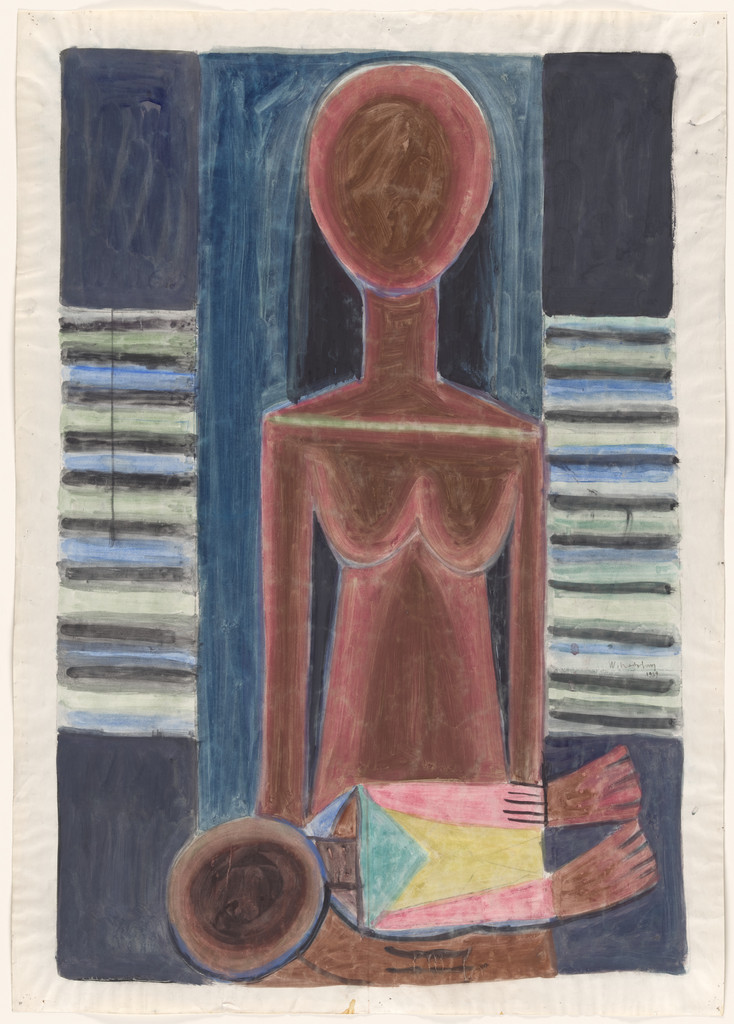
Study for "The Jungle"
Можно ли лицезреть?
Да, принимает

Чикагский институт искусств
Зал397Чикаго, США
Выставлена для публики.
- Проверено
- В этом положении с
- Источник
- Данные самого музея
О работе
Как и многие сюрреалисты, Вифредо Лам покинул Францию после оккупации Парижа. В марте 1941 года он сел на корабль в Марселе и прибыл в Гавану где-то в конце июля или начале августа. Однако для Лама это не было изгнанием, каким оно было для Андре Бретона или Андре Массона, которые оба отправились в Соединённые Штаты. Лам возвращался домой, и с этого момента он заново открыл художественную вселенную, к которой его долгое пребывание в Европе в каком-то смысле его готовило. Рождённый от отца-китайца и матери африканского и испанского происхождения, он покинул Кубу в 1923 году ради Испании, где получил формальное академическое образование, а в 1938 году в конце концов переехал в Париж, где решающей оказалась его встреча с Пабло Пикассо. Он усвоил модернистский интерес к африканскому искусству, что ничуть не мешало ему непосредственно откликаться на особые афрокубинские традиции его родины. Это богатое наследие продолжало пронизывать его творчество и после 1952 года, когда он вновь сделал Париж своим основным местом жительства.
Читать дальше
Лам не только черпал вдохновение в тропической природе, которая захлестнула его по возвращении на Кубу, но и достиг родины в благоприятный момент — когда кубинские учёные начинали изучать афрокубинскую религию и культуру, что щедро поддерживало его собственную склонность к «примитивному». На Кубе новаторские исследования афрокубинской культуры вели Фернандо Ортис и Лидия Кабрера, с обоими из которых Лам познакомился. Как писала Валери Флетчер, «поскольку рабство было по-настоящему отменено лишь в 1886 году, африканские религии, языки, мифологии, ритуалы, музыка и танцы оставались на Кубе особенно сильными» (Valerie Fletcher, «Wifredo Lam», в: Washington, D.C., Hirshhorn Museum and Sculpture Garden, Crosscurrents of Modernism, Four Latin American Pioneers: Diego Rivera, Joaquín Torres-García, Wifredo Lam, Matta, 1992, кат. выст., с. 179). Кроме того, Лам мог опираться и на семейные воспоминания: его крёстная, Мантоника Уилсон, была жрицей религии сантерия, происходящей от йоруба.
Таким образом, после 1941 года в творчестве Лама произошла трансформация; Херардо Москера утверждал, что это изменение было
не формальным: художник всегда оставался в долгу перед Пикассо, Гонсалесом, Матиссом, африканским геометризмом и классической традицией западного искусства. Важным было изменение направления. ... под импульсом сюрреализма он начал развивать свой личный мир таким образом, что это привело к более интроспективному обращению с этими формами. Новое открытие Кубы привело к выходу на поверхность всего африканского в его собственном культурном формировании, к появлению его карибского мировоззрения (Weltanschauung) и его связи с природной и социальной средой. (Gerardo Mosquera, «Modernity and Africania: Wifredo Lam on His Island», в: Barcelona, Fundació Joan Miró, Wifredo Lam, 1993, кат. выст., с. 178)
Лам также выигрывал от того, что сюрреализм в своём отношении к поэзии, обществу и политике был гораздо теснее связан с движениями негритюда на Антильских островах, чем с негрофилией, модной в Париже в 1920-х и начале 1930-х годов. На Мартинике Бретон, Лам и Массон, плывшие из Франции в 1941 году, встретили поэта Эме Сезера, который вместе с несколькими другими только что основал журнал «Тропики» (Tropiques; выходил в Фор-де-Франсе с 1941 по 1945 год). Сюрреалист «до появления термина», Сезер получил поэтическое образование с упором на сочинения Артюра Рембо и Лотреамона, и корни его были во многом те же, что и у Бретона. Бретон, в свою очередь, был впечатлён качеством текстов в первом номере «Тропиков» и оказал его авторам всестороннюю поддержку. Как позднее объяснила жена Сезера Сюзанна, сюрреализм был «натянутым канатом нашей надежды» (см. её эссе «1943: Le Surréalisme en nous», Tropiques 8-9 [Oct. 1943), с. 18).
Особого внимания заслуживает вклад Бенжамена Пере в номер «Тропиков» 1943 года — предисловие к поэме Сезера «Дневник возвращения в родную страну» (Cahier d'un retour au pays natal), которая была проиллюстрирована Ламом. Этот текст красноречиво проливает свет как на творчество Лама, так и на поэму Сезера. «Впервые», — писал Пере, —
тропический голос звучит на нашем языке не затем, чтобы быть посредником экзотической поэзии — безделушки дурного вкуса и заурядного интерьера, — а чтобы вырваться наружу подлинной поэзией, исходящей из гниющих стволов орхидей и электрических бабочек, пожирающих падаль ...
Его поэзия обладает державной притягательностью великих хлебных деревьев и навязчивым акцентом барабанов вуду. В ней чёрная магия, тяжёлая от поэзии, противопоставлена — вплоть до бунта — религиям работорговцев, где вся магия мумифицирована, а вся поэзия мертва навеки. (цит. по: Tropiques 6-7 [Feb. 1943], с. 60)
Этот этюд принадлежит к серии работ, связанных с «Джунглями» — шедевром Лама и его главным высказыванием о повторном открытии африканской Кубы. Бергманы купили работу непосредственно у Лама, которого посетили в Гаване в 1956 году. В письме Эдвину Бергману от апреля 1956 года Лам назвал работу «etude for La Jungle» — путаным двуязычным названием, вероятно, возникшим из-за неудачной попытки перевода, поскольку Лам не говорил по-английски. 13 ноября того же года Лам написал, что картина отправлена в Чикаго, но не ответил на просьбу Эдвина Бергмана, содержавшуюся в более раннем письме от 21 августа, сообщить о её «значении и символике». «Об этой картине мне почти нечего сказать, — писал Лам, — потому что в других письмах, которые я вам писал, я объяснил материалы, которые в ней использовал» (более ранняя переписка, ныне утраченная, определяла картину для таможенных целей).
«Джунгли», судя по всему, были написаны за двадцать дней, между декабрём 1942 и январём 1943 года (см. Antonio Nuñez Jiménez, «Genesis de la jungle», Plástica latinoaméricana: Revista de la Liga de Arte de San Juan [Mar. 1983], с. 18, цит. по: Julia P. Herzberg, «Wifredo Lam: The Development of a Style and World View, the Havana Years, 1941-1952», в: New York 1992-93, с. 50, прим. 36). Работы, предшествовавшие им, включают пятьдесят подготовительных гуашей, отправленных Пьеру Матиссу в октябре 1942 года для первой нью-йоркской выставки Лама, и этюды, последовавшие за этими гуашами, выполненные между октябрём и декабрём. В письме Эдвину Бергману от 28 июня 1956 года Лам назвал этот этюд работой «периода „Джунглей“», и он тесно связан с двумя другими работами, вероятно, относящимися к этим месяцам: «Женщина» (1942, частная коллекция; New York 1992-93) и «Без названия» (1942, Мэриленд, д-р Альберто Мартинес-Пьедра; New York 1992-93).
Хотя Лам описывал работу из коллекции Бергманов как «одну из подготовок к La Jungle» (письмо Эдвину Бергману от апреля 1956 года), с которой её роднит общее близкое сходство, точного соответствия её сюжету в более крупной работе нет. В центре этюда, судя по двум лицам, трём рукам и множеству ног, по-видимому, стоит несколько фигур, но Лам, возможно, задумал лишь одного «гибрида» — распространённый мотив в его творчестве. Самая центральная из фигур держит в левой руке ножницы, а в правой — свои волосы; руки её свободно спущены по бокам. Вторая фигура, чуть позади первой и слева, заводит гротескно увеличенную руку за голову, чтобы схватить плод в форме яичка. Законченный сам по себе, этюд связан и с фигурой, несущей гигантские ножницы, и с более центрально расположенной фигурой в длинной маске в окончательном варианте.
Если в «Джунглях» ножницы подняты вертикально у верхнего края картины, то в этом этюде большие лезвия, похожие на крабьи клешни, с тонко завитыми отверстиями для пальцев удерживаются в угрожающем горизонтальном положении. Явная угроза кастрации в этюде уточняется деталью — большим пальцем, торчащим между лезвиями ножниц. Несмотря на округлые груди и длинные волосы, в этих фигурах есть некоторая путаница пола. Их тела переплетены с плотной завесой буйной растительности: стебли растений повторяют их конечности, листья и плоды — их коленные чашечки, груди и ягодицы. Фотографии сада Лама в гаванском пригороде Марианао показывают происхождение некоторых растительных деталей — высоких стволов и шаровидных плодов папайи (см. Fouchet 1976, с. 15, рис. 1-n).
Лам тревожно сопоставил в этой картине плодородие природы с угрозой оскопления. То, как его образность служит проекцией мужских страхов и желаний, находит параллель в одной из первых великих картин «примитивизированной» сексуальности — «Авиньонских девицах» Пикассо, изображении пяти проституток (1907, Нью-Йорк, Музей современного искусства; New York, The Museum of Modern Art, Pablo Picasso: A Retrospective, 1980, кат. выст., с. 99, ил.). Эта картина, несомненно, была важным источником для «Джунглей»; Лам и в самом деле предполагал сходную идентичность для собственных фигур. Противопоставляя свои «Джунгли» джунглям Анри Руссо, Лам пояснял:
Он был потрясающим художником! Но он не из моей естественной цепи. Он не осуждает то, что происходит в джунглях. Я осуждаю. Посмотрите на моих чудовищ, на жесты, которые они делают. Та, что справа, подставляет бедро, непристойная, как великая проститутка. Посмотрите и на ножницы, которыми размахивают. Моей идеей было изобразить дух чёрных в том положении, в котором они оказались. Я показал через поэзию реальность принятия и протеста. (цит. по: Fouchet 1976, с. 199)
Сексуальная эксплуатация, о которой говорит Лам, в то время, когда Куба была площадкой для развлечений Запада, служит для него также аллегорией культурной и политической эксплуатации:
Я решил, что моя живопись никогда не станет эквивалентом псевдокубинской музыки для ночных клубов. Я отказался писать ча-ча-ча. Я всем сердцем хотел писать драму моей страны, но полностью выражая негритянский дух, красоту пластического искусства чёрных. Таким образом я мог действовать как троянский конь, извергающий галлюцинирующие фигуры, способные поражать, тревожить сны эксплуататоров. (цит. Флетчер в: Washington, D.C. 1902, сс. 170-81)
Сексуализированная образность выражает и материальную эксплуатацию Кубы, и угрозу оскопления, исходящую для Запада от более «примитивного» общества.
Отношения Лама с его кубинскими современниками подчёркивают радикальность его образности. Некоторые из его сюжетов не были новыми: такие художники, как Марсело Поголотти, в 1930-е годы в модернистской манере обращались к откровенно политическим темам, особенно к эксплуатации работников сахарного тростника, а Марио Карреньо в 1943 году написал «Рубщиков сахарного тростника» (Нью-Йорк, Музей современного искусства; New York 1992-93, с. 52, ил.) в динамичной, футуристической манере. Лам сотрудничал со своими современниками над проектами в Гаване, но отказался участвовать в выставке «Современные кубинские художники» в Музее современного искусства в Нью-Йорке в 1944 году — по-видимому, из-за личной размолвки с Хосе Гомесом Сикре, автором книги о кубинской живописи, сопровождавшей выставку (см. Giulio V.
Blanc, «Cuban Modernism: The Search for a National Ethos», в: New York 1992-93, с. 67; и José Gómez Sicre, Cuban Painting of Today, Havana, 1944; книга Сикре не была каталогом выставки; список работ выставки «Modern Cuban Painters» был опубликован с эссе Альфреда Барра-младшего в Museum of Modern Art Bulletin 11, 5 (1944], сс. 8-14). Но обращение Лама к афрокубинским темам — таким как фигуры, вдохновлённые сантерией, представленные в этой и других работах Бергманов, — открыло новую перспективу, как утверждал Херардо Москера, и повлияло на ряд художников, в частности на Рене Портокарреро в его серии «Чертёнок» (Diablito) (Mosquera, в: Barcelona 1993, сс. 173-82).
Чикагский институт искусств · перевод ART WIKICC BY 4.0
Словами музея — на английском
Like many of the Surrealists, Wifredo Lam left France after the Occupation of Paris. He boarded a ship in Marseilles in March 1941 and arrived in Havana sometime in late July or early August. For Lam, however, this was not the exile that it was for André Breton or André Masson, both of whom went to the United States. Lam was returning home, and from this moment he rediscovered an artistic universe for which his long sojourn in Europe had, in a sense, been preparing him. Born of a Chinese father and a mother of African and Spanish origin, he had left Cuba in 1923 for Spain, where he had acquired formal, academic training, and eventually moved to Paris in 1938, where his encounter with Pablo Picasso was decisive. He absorbed the modernist interest in African art, which did not hamper him in any sense from responding directly to the particular Afro-Cuban traditions of his homeland. This rich legacy continued to imbue his work, even after 1952, when he once again established his main residence in Paris.
Читать дальше
Not only did Lam draw inspiration from the tropical nature that overwhelmed him on his return to Cuba, but he also reached his homeland at a propitious moment, at a time when Cuban scholars were beginning to study Afro-Cuban religion and culture, thus richly encouraging his own predisposition toward the "primitive." In Cuba, groundbreaking research on Afro-Cuban culture was being carried out by Fernando Ortiz and Lydia Cabrera, both of whom Lam came to know. As Valerie Fletcher has written, "Because slavery had not effectively ceased until 1886, African religions, languages, mythologies, rituals, music, and dance remained particularly strong in Cuba" (Valerie Fletcher, "Wifredo Lam," in Washington, D.C., Hirshhorn Museum and Sculpture Garden, Crosscurrents of Modernism, Four Latin American Pioneers: Diego Rivera, Joaquín Torres-García, Wifredo Lam, Matta, 1992, exh. cat., p. 179). Lam may have drawn, furthermore, upon family memories, for his godmother, Mantonica Wilson, was a priestess of the Yoruba-derived religion Santeria.
There was, then, a transformation in Lam's work after 1941; Gerardo Mosquera argued that this change was
not a formal one: the artist was to continue always to be in debt to Picasso, Gonzàlez, Matisse, African geometricism and the classical tradition of Western art. What was important was the change of direction. ... under the impulse of Surrealism he began to develop his personal world in such a way that it led to a more introspective handling of those forms. The rediscovery of Cuba brought about the eclosion of everything African in his own cultural formation, the emergence of his Caribbean Weltanschauung and of its relationship with his natural and social environment. (Gerardo Mosquera, "Modernity and Africania: Wifredo Lam on His Island," in Barcelona, Fundació Joan Miró, Wifredo Lam, 1993, exh. cat., p. 178)
Lam also benefited from the fact that Surrealism was far more closely allied to the Negritude movements in the Antilles, in its attitude to poetry, society, and politics, than to the negrophilia fashionable in Paris in the 1920s and early 1930s. In Martinique, Breton, Lam, and Masson, on their voyage from France in 1941, had met the poet Aimé Césaire, who had, with several others, just founded the review Tropiques (published in Fort-deFrance from 1941 to 1945). A Surrealist "avant Ia lettre,'' Césaire's poetic formation, with its emphasis on the writings of Arthur Rimbaud and Lautréamont, had much the same roots as that of Breton. Breton, in turn, was impressed by the quality of the texts in the first issue of Tropiques and lent his full support to its contributors. As Césaire's wife, Suzanne, later explained, Surrealism was the "tight-rope of our hope" (see her essay "1943: Le Surréalisme en nous," Tropiques 8-9 [Oct. 1943), p. 18).
Especially noteworthy is Benjamin Péret's contribution to a 1943 issue of Tropiques in the form of a preface to Césaire's poem "Cahier d'un retour au pays natal," which was illustrated by Lam. This text eloquently illuminates Lam's work as well as Césaire's poem. "For the first time," Péret wrote,
a tropical voice resounds in our language, not to mediate an exotic poetry, trinket of bad taste and mediocre interior, but to burst out in an authentic poetry issuing from the rotting trunks of orchids and the electric butterflies devouring carrion ...
His poetry has the sovereign allure of the great breadfruit trees and the obsessive accent of the voodoo drums. In it, black magic heavy with poetry is opposed to the point of rebellion against the religions of the slavers where all magic is mummified, all poetry dead forever. (quoted in Tropiques 6-7 [Feb. 1943], p. 60)
This study belongs to a series of works related to The Jungle, Lam's masterpiece and major statement about his rediscovery of African Cuba. The Bergmans bought the work directly from Lam, whom they visited in Havana in 1956. In a letter to Edwin Bergman of April 1956, Lam called the work "etude for La Jungle," a confusing bilingual title probably resulting from an inadequate attempt at translation, for Lam did not speak English. On November 13 of that year, Lam wrote that the painting had been sent to Chicago, but was not responsive to Edwin Bergman's request, in an earlier letter of August 21, for information about its "meaning and symbolism." "About this picture I have very little to say," Lam wrote, "because in other letters that I have written to you I have explained the materials that I have used in it" (earlier correspondence, now lost, had identified the picture for customs purposes).
The Jungle was apparently painted in twenty days, between December 1942 and January 1943 (see Antonio Nuñez Jiménez, "Genesis de la jungle," Plástica latinoaméricana: Revista de la Liga de Arte de San Juan [Mar. 1983], p. 18, cited in Julia P. Herzberg, "Wifredo Lam: The Development of a Style and World View, the Havana Years, 1941-1952," in New York 1992-93, p. 50 n. 36). The works leading up to it include fifty preparatory gouaches, shipped to Pierre Matisse in October 1942 for Lam's first New York exhibition, and studies subsequent to these gouaches, executed between October and December. In a letter to Edwin Bergman of June 28, 1956, Lam referred to this study as being "of the period of The Jungle," and it is closely related to two other works probably dating from these months: Woman (1942, private collection; New York 1992-93) and Untitled (1942, Maryland, Dr. Alberto MartinezPiedra; New York 1992-93).
Although Lam described the Bergman piece as "one of the preparations for La Jungle" (letter to Edwin Bergman of April 1956), to which it bears a close general resemblance, there is no exact counterpart to its subject in the larger work. There appear to be several figures standing in the center of the study—judging from the two faces, three arms, and multiple feet—but Lam may have intended only one "hybrid," a common motif in his work. The most central of the figures holds a pair of scissors in her left hand and her hair in her right hand, with her arms draped at her sides. The second figure, slightly behind the first and to the left, reaches a grotesquely enlarged hand behind her head to grasp testicle-shaped fruit. Complete in its own right, the study is related both to the figure carrying giant scissors and to the more centrally placed long-masked figure in the final version.
While in The Jungle the scissors are held upright at the upper edge of the painting, in this study the big, crab-claw blades with the finely curled finger holes are held in a threatening horizontal position. The clear threat of castration in the study is made more specific with the detail of the thumb protruding between the blades of the scissors. In spite of the spherical breasts and long hair, there is a certain confusion of gender in these figures. Their bodies are entangled with the dense screen of exuberant vegetation, the plant stems echoing their limbs, the leaves and fruit their kneecaps, breasts, and buttocks. Photographs of Lam's garden in the Havana suburb of Marianao show the origins of some plant details in the tall trunks and globular fruit of the papaya (see Fouchet 1976, p. 15, figs. 1-n).
Lam disturbingly juxtaposed in this picture the fecundity of nature with the threat of emasculation. The way in which his imagery acts as a projection of male fears and desires finds a parallel in one of the first great pictures of "primitivized" sexuality, Picasso's Demoiselles d'Avignon, an image of five prostitutes (1907, New York, The Museum of Modern Art; New York, The Museum of Modern Art, Pablo Picasso: A Retrospective, 1980, exh.cat., p. 99, ill.). The latter painting was clearly an important source for The Jungle; Lam indeed suggested a similar identity for his own figures. Contrasting his Jungle with that of Henri Rousseau, Lam explained:
He was a formidable painter! But he doesn't belong to my natural chain. He doesn't condemn what happens in the jungle. I do. Look at my monsters, the gestures they make. The one on the right offers her haunch, obscene like a great prostitute. Look also at the scissors being brandished. My idea was to represent the spirit of the Blacks in the situation in which they found themselves. I showed, through poetry, the reality of acceptance and of protest. (quoted in Fouchet 1976, p. 199)
The sexual exploitation to which Lam refers, at a time when Cuba was the playground for the West, also acts for him as an allegory for cultural and political exploitation:
I decided that my painting would never be the equivalent of the pseudo-Cuban music for nightclubs. I refused to paint cha-cha-cha. I wanted with all my heart to paint the drama of my country, but by thoroughly expressing the Negro spirit, the beauty of the plastic art of the Blacks. In this way I could act as a Trojan horse that would spew forth hallucinating figures with the power to surprise, to disturb the dreams of the exploiters. (quoted by Fletcher in Washington, D.C. 1902, pp. 170-81)
The sexualized imagery expresses both the material exploitation of Cuba and the threat of emasculation posed to the West by the more "primitive" society.
Lam's relationship with his Cuban contemporaries highlights the radical nature of his imagery. Some of his subjects were not new: artists such as Marcelo Pogolotti had treated explicitly political themes during the 1930s in a modernist manner, especially the exploitation of the sugarcane workers, and Mario Carreno painted Sugarcane Cutters in 1943 (New York, The Museum of Modern Art; New York 1992-93, p. 52, ill.) in a dynamic, Futurist style. Lam collaborated with his contemporaries on projects in Havana, but refused to exhibit in the "Modern Cuban Painters" show at The Museum of Modern Art, New York, in 1944, apparently as a result of a personal difference with José Gómez Sicre, the author of the book on Cuban painting that accompanied the show (see Giulio V.
Blanc, "Cuban Modernism: The Search for a National Ethos," in New York 1992-93, p. 67; and José Gómez Sicre, Cuban Painting of Today, Havana, 1944; Sicre's book was not an exhibition catalogue; a checklist of the show "Modern Cuban Painters" was published with an essay by Alfred Barr, Jr., in the Museum of Modern Art Bulletin 11, 5 (1944], pp. 8-14) . But Lam's embrace of Afro-Cuban themes, such as the Santeria-inspired figures featured in this and other Bergman works, opened up a new perspective, as Gerardo Mosquera has argued, and influenced a number of artists, notably René Portocarrero in his Little Devil (Diablito) series (Mosquera, in Barcelona 1993, pp. 173-82).
Чикагский институт искусствCC BY 4.0
Сведения
- Инвентарный номер
- 2018.328
В каталоге
Выходы в свет
Выставлена · Зал 397
Чикагский институт искусств · 28 сент. 2026 г. — сейчас · Проверено
Была выставлена
Чикагский институт искусств · 19 авг. 2026 г. — 28 сент. 2026 г. · Проверено
Источники
- Чикагский институт искусств: открытые данные самого музея · получено 7 дней назад
- Изображение: Чикагский институт искусств — © автор или правообладатель