 Альбрехт ДюрерГермания, 1471–1528
Melencolia I
Можно увидеть?
Сейчас не выставлена
Где сейчас «Melencolia I»? Собрание: Миннеаполисский институт искусства, Миннеаполис. Сейчас не выставлена. Проверено 29 сентября 2026 г.

Миннеаполис, США
Числится в собрании, но в залах её сейчас нет.
- Проверено
- Этот статус с
- Источник
- Музей
О работе
Словами музея — на английском
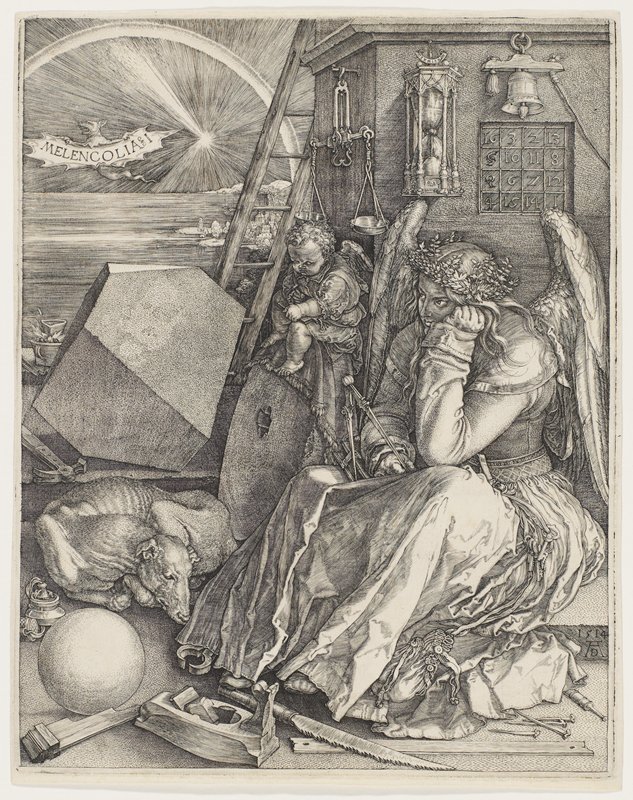
By any measure, Melencolia I is an arresting image. A magnificent, laurel-crowned angel sits brooding in the foreground. In its hand and strewn about are the tools and materials of physical creation—from hammer and nails to an alchemical crucible (vessel). Sitting on a millstone is a putto, scribbling away on a tablet. Models of ideal geometric forms, such as a sphere and a polyhedron, occupy the left side of the image, along with a sleeping dog. To the right we face the base of a windowless building, perhaps a tower. From it hang a weighing scale, an hourglass, and a bell whose pull-cord extends out of the image. A magic square is carved into the wall, and a ladder leans against the far side of the structure. In the background we see to a distant horizon. In the sky are a rainbow and a comet. A bat-like creature flies through the sky holding a banner reading MELENCOLIA I.
Читать дальше
Little was written about Dürer’s engraving originally, but over time it became one of the most frequently discussed images in the history of art. In 1568, the pioneering art historian Giorgio Vasari wrote:
Then, having grown both in power and courage, as he saw that his works were prized, Albrecht executed some copper engravings that astonished the world. He also set himself to making an engraving, for printing on a half sheet of paper, of a figure of Melancholy, with all the instruments that reduce those who use them, or rather, all mankind, to a melancholy humor; and in this he succeeded so well that it would not be possible to do more delicate engraving with the burin.
We may never know the engraving’s full meaning, but we can be certain that it touches upon many of Dürer’s central interests: the role of the artist as creator; the relationships among the physical, intellectual, and spiritual realms; the study of the natural world; mathematics; esoteric knowledge; and self-awareness.
In essence, the engraving became a manifesto on knowing the unknowable and making the unmakeable.
Миннеаполисский институт искусства
Сведения
- Инвентарный номер
- 2012.16
В каталоге
Источники
- Миннеаполисский институт искусства
- Изображение: Миннеаполисский институт искусства — общественное достояние
В жизни художника
Вся жизнь целиком1507–1528
Место работы: Нюрнберг
1512
Император Максимилиан I — главный покровитель
С 1512 года главным покровителем Дюрера стал император Максимилиан I. Для него Дюрер с учениками создал «Триумфальную арку» — гигантскую ксилографию 295 × 357 см из оттисков 192 досок, задуманную по образцу древнеримских арок.
3 января 1512
Привилегия Нюрнберга против подделок
Городской совет Нюрнберга дал Дюреру привилегию на распространение его гравюр: подделывателям грозило наказание.
1513–1516
Три года без живописи
Жалуясь, что живопись в сравнении с гравюрой не окупает затраченного времени, Дюрер с 1513 по 1516 год не написал ни одной картины.
1514
Смерть матери
В год «Меланхолии» и «Святого Иеронима в келье» умерла мать художника, Барбара Хольпер.
1515
Пожизненная пенсия от императора
Вечно стеснённый в деньгах Максимилиан не мог вовремя платить и предлагал освободить художника от городских налогов, но против выступил Совет Нюрнберга. По ходатайству Дюрера император назначил ему пожизненную пенсию в 100 гульденов в год из сумм, которые Нюрнберг вносил в имперскую казну.

![Lot and His Daughters [reverse], Альбрехт Дюрер, ок. 1496/1499](https://api.nga.gov/iiif/7565a449-f82a-414b-9bda-c93f55a51b4d/full/!2400,2400/0/default.jpg)