ART WIKI32 963 em exposição
MapaColeçãoArtistasMuseusExposiçõesRevista
Entrar

ART WIKI

Onde está a obra-prima, e a que horas se abre a porta.

Coleções: Art Institute of Chicago, Galeria Nacional de Arte, Galeria Tretiakov, Getty Villa, Harvard Art Museums, Hermitage, Hirshhorn Museum and Sculpture Garden, Instituto de Artes de Minneapolis, Museu de Arte de Cleveland, Museu de Arte Moderna, Museu do Louvre, Museu Estatal de Amesterdão, Museu J. Paul Getty, Museu Metropolitano de Arte, Museu Nacional de Arte da Dinamarca, Museu Pushkin, Museu Russo, Museu Smithsoniano de Arte Americana, Museu Vitória e Alberto, Museu Whitney de Arte Americana, National Museum of Asian Art, National Portrait Gallery, Catálogo Estatal do Fundo Museológico da Rússia (274 museus), Europeana (19 museus), Wikidata (6 museus), Paris Musées (12 museus) e Joconde, a base de museus do Ministério da Cultura de França (495 museus). As imagens pertencem aos titulares dos direitos.

Secções

  • Mapa
  • Pesquisa
  • Coleção
  • Obras-primas
  • Em exposição agora
  • Artistas

Mais

  • Museus e galerias
  • Exposições
  • Revista
  • De onde vêm os dados
  • Privacidade e cookies
InícioMapaCatálogo
  1. Coleção/
  2. National Gallery/
  3. Willows beside a Stream
Willows beside a Stream, J. M. W. Turner, 1805
Joseph Mallord William Turner, retratoJoseph Mallord William TurnerReino Unido, 1775–1851

Willows beside a Stream

1805 · Painting · 116.2 × 86 cm

Será possível contemplá-la?

Desconhecido

National Gallery

Londres, Reino Unido

O proprietário é conhecido; não se sabe se hoje está exposta.

Neste estado desde
29 de set. de 2026
Fonte
O museu
No mapaPágina do museu

Pormenores

1805 · aos 30 anos
17751851
Número de inventário
NG2706

No catálogo

PinturasPintura britânicaNeoclassicismoRomantismoSéculo XIX

Fontes

  • Wikidata
  • Imagem: National Gallery — J. M. W. Turner · Public domain · Wikimedia Commons

Entretanto, na vida de Joseph Mallord William Turner

A vida inteira
  1. 1802–1803

    Paris and the Swiss Alps in a year of peace

    In the only year without war in Europe between 1793 and 1814 (the Peace of Amiens, 1802–1803) a consortium of noblemen sponsored a visit to Paris, where he saw old master paintings in the Louvre, and then he toured the Swiss Alps; his Alpine sketches later let him represent “the sublime” in paintings such as “Snow Storm: Hannibal and his Army Crossing the Alps” (1812).

  2. 1804

    Opens his own gallery

    Distrustful of dealers, he opened his own gallery so that he could sell directly and group the pictures he wanted seen together, something he could not control at the Royal Academy exhibitions; his father left his barbershop to help in the gallery and studio. For over a decade the gallery was a regular feature of the London exhibition season.

  3. 1804

    His mother dies in Bethlem Hospital

    His mother, Mary Marshall, whose symptoms of mental disorder grew worse, had to be placed by his father in St Luke’s Hospital for Lunatics; she was later moved to Bethlem Hospital, commonly known as “bedlam”, where she died in 1804.

  4. summer 1805

    Summer 1805: along the Thames

    In the summer of 1805 he systematically sketched places along much of the Thames, from Oxford to the Thames Estuary; these intense months of observation so inspired him that for the next five or six years he presented many river-themed paintings in each of his annual gallery shows, based on his sketchbooks.

  5. 1806–1819

    Work on the “Liber Studiorum”

    For nearly twelve years he worked on about 70 mezzotints — the “Book of Studies”, inspired by Claude’s Liber Veritatis and meant as a manifesto of British landscape art; commercially it failed because of poor handling of sales and distribution, but it did elevate the prestige of landscape painting.

  6. 1807–1811

    A floating studio at Hammersmith

    Inspired by the Thames, he rented houses on or very near the river: in Isleworth (1804–1806) and in Hammersmith (1807–1811), where he converted a boat into a floating studio; fishing and boating were two of his favourite activities.
Mais obras de Joseph Mallord William Turner

Todas as obras
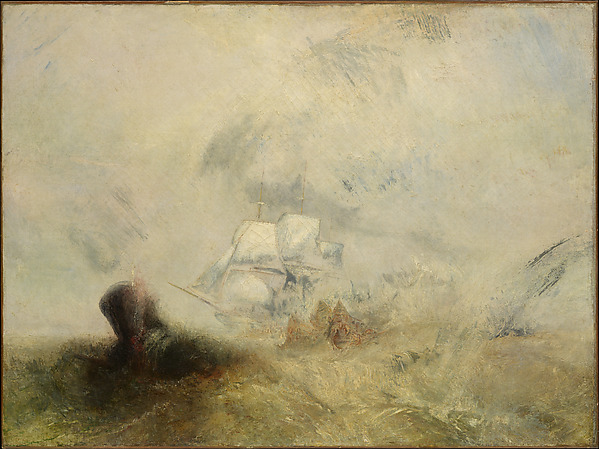
Whalers, Joseph Mallord William Turner, ca. 1845

Whalers

ca. 1845 · Museu Metropolitano de Arte

The Junction of the Thames and the Medway, Joseph Mallord William Turner, 1807

The Junction of the Thames and the Medway

1807 · Galeria Nacional de Arte

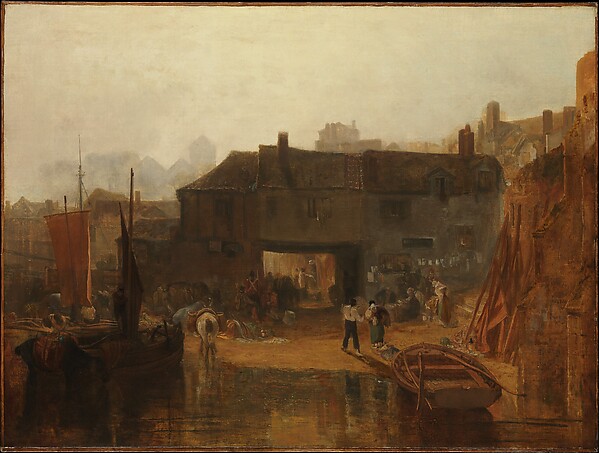
Saltash with the Water Ferry, Cornwall, Joseph Mallord William Turner, 1811

Saltash with the Water Ferry, Cornwall

1811 · Museu Metropolitano de Arte

Mortlake Terrace, Joseph Mallord William Turner, 1827

Mortlake Terrace

1827 · Galeria Nacional de Arte

Rotterdam Ferry-Boat, Joseph Mallord William Turner, 1833

Rotterdam Ferry-Boat

1833 · Galeria Nacional de Arte

Venice: The Dogana and San Giorgio Maggiore, Joseph Mallord William Turner, 1834

Venice: The Dogana and San Giorgio Maggiore

1834 · Galeria Nacional de Arte

Keelmen Heaving in Coals by Moonlight, Joseph Mallord William Turner, 1835

Keelmen Heaving in Coals by Moonlight

1835 · Galeria Nacional de Arte

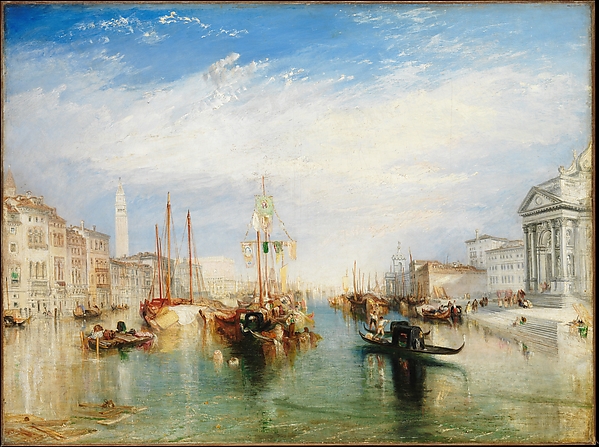
Venice, from the Porch of Madonna della Salute, Joseph Mallord William Turner, ca. 1835

Venice, from the Porch of Madonna della Salute

ca. 1835 · Museu Metropolitano de Arte

Da coleção: National Gallery

Página do museu
Virgin of the Rocks, Leonardo da Vinci, 1490s

Leonardo da Vinci

Virgin of the Rocks, 1490s

Long Grass with Butterflies, Vincent van Gogh, 1890

Vincent van Gogh

Long Grass with Butterflies, 1890

Farms near Auvers, Vincent van Gogh, 1890

Vincent van Gogh

Farms near Auvers, 1890

A Wheatfield, with Cypresses, Vincent van Gogh, 1889

Vincent van Gogh

A Wheatfield, with Cypresses, 1889

Head of a Peasant Woman, Vincent van Gogh, 1885

Vincent van Gogh

Head of a Peasant Woman, 1885

Manchester Madonna, Michelangelo, c. 1494

Michelangelo

Madona de Manchester, c. 1494

The Entombment, Michelangelo, c. 1500s

Michelangelo

O Sepultamento de Cristo, c. 1500s

The Grand Canal, Venice, Claude Monet, 1908

Claude Monet

The Grand Canal, Venice, 1908