John ConstableReino Unido, 1776–1837
Stoke-by-Nayland
Será possível contemplá-la?
Sim, recebe visitas

Art Institute of Chicago
Sala220Chicago, Estados Unidos
Exposta ao público. Quem o garante vem indicado abaixo.
- Verificado
- anteontem
- Neste estado desde
- 19 de ago. de 2026
- Fonte
- Os dados da própria coleção do museu
About the painting
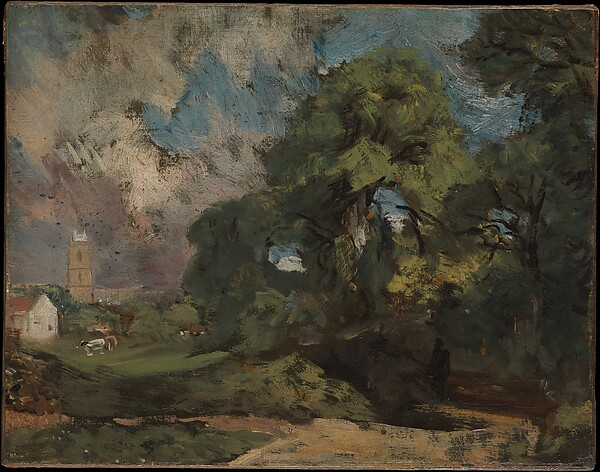
Stoke-by-Nayland is a c.1836 landscape painting by the British artist John Constable. It features a view near the village of Stoke-by-Nayland in Suffolk close to the border with Essex. It is located in what became known as Constable Country, as it featured so often in the artist's work. St Mary's Church can be seen on the left.
A large oil sketch, it was prepared on the same scale as Constable's earlier "six-footers". He tended to produce a full-size oil sketch before completing his finished version. Constable likely intended to work it up into a finished painting to display at the Royal Academy Exhibition of 1837. However he died before the Exhibition took place. The sketch is now in the collection of the Art Institute of Chicago, having been acquired in 1922.
In the museum's words
John Constable produced this full-size oil sketch near the end of his life, for an unrealized painting. It depicts the artist’s favored subject matter: the countryside of his youth in Suffolk, England. He wrote to a friend of this work: “What say you to a summer morning? July or August, at eight or nine o’clock, after a slight shower during the night.” To achieve the effect of sparkling wetness and the freshness of earth and air, Constable painted as much with a palette knife as with a brush, flecking the surface with white highlights as he sketched and scraped the picture into existence.
Art Institute of ChicagoCC BY 4.0
Pormenores
- Número de inventário
- 1922.4453
What it shows
No catálogo
Fontes
- Art Institute of Chicago: the museum's own open data · obtido há 5 dias
- Imagem: Art Institute of Chicago — CC0
Entretanto, na vida de John Constable
A vida inteira1828–1837
A widower with seven children
For the rest of his life Constable dressed in black and brought up his seven children alone; according to Leslie he was “a prey to melancholy and anxious thoughts”. Several of the children also painted, notably Lionel.
1835
A last lecture to the Academy’s students
In 1835 Constable gave his last lecture to the students of the Royal Academy, praising Raphael and calling the Academy the “cradle of British art”; it was cheered most heartily.
1836
Lectures at the Royal Institution: three theses
In a series of lectures at the Royal Institution in 1836 Constable proposed three theses: landscape painting is scientific as well as poetic; imagination alone never can produce art that bears comparison with reality; and no great painter was ever self-taught.
31 March 1837
Death in the night, probably of heart failure
Constable died on the night of 31 March 1837, apparently of heart failure (another account names dyspepsia), and was buried beside Maria.
31 de março de 1837
Died



![Vallon à Helmingham [Helmingham Dell], Constable, John, 1e quart du XIXe siècle (peint à l'été 1823 (selon Beckett)) (1823)](https://collections.louvre.fr/media/cache/large/0000000021/0000065616/0000312650_OG.JPG)