Mia RosenthalEstados Unidos
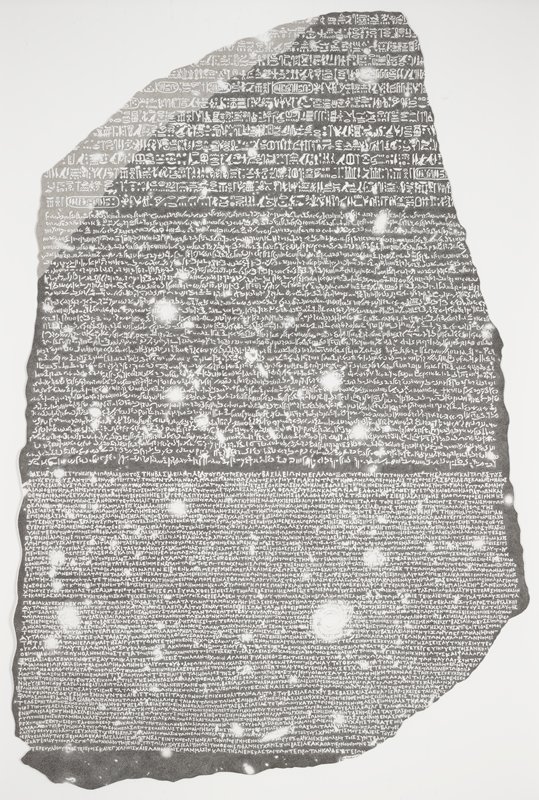
Rosetta Deep Field
Será possível contemplá-la?
De momento, não recebe

Instituto de Artes de Minneapolis
Minneapolis, Estados Unidos
Pertence à coleção, mas de momento não está exposta.
- Verificado
- Neste estado desde
- Fonte
- Os dados da própria coleção do museu
Sobre a obra
Mia Rosenthal's meticulous drawing is on a piece of paper shaped to mimic the silhouette of the object it represents: the Rosetta Stone. This object is a stone slab dating from 196 BCE bearing a decree (a message) issued in Egypt about King Ptolemy V. It bears three sections of language, inscribed on the surface: Egyptian hieroglyphs (for temple priests), Demotic (cursive used for daily purposes by the people), and Ancient Greek (the language of the Greco-Macedonian rulers at the time). When the stone was located in 1799 hieroglyphics had not been translatable into other languages. The stone provided a key to their meaning by showing an example of translation in its form. Rosenthal, who is fascinated by deep history, carefully drew the stone and its intricate surface after seeing it in person by working from a reproduction on a souvenir tea towel from the British Museum gift shop.
Read on
She then superimposed an image from the Hubble Telescope's pictures of the ultra deep field which shows an estimated 10, 000 galaxies, including some that formed after the big bang. By combining two ways of imaging the world -- stone and language and transitory glimpses into unfathomable time—Rosenthal looks at the ways that humans try to understand their world, whether micro or macrocosmic.
Instituto de Artes de Minneapolis
Pormenores
- Número de inventário
- 2021.89.4
No catálogo
Fontes
- Instituto de Artes de Minneapolis: the museum's own open data · obtido há 7 dias
- Imagem: Instituto de Artes de Minneapolis — © Minneapolis Institute of Art