William HogarthInglaterra, 1697–1764
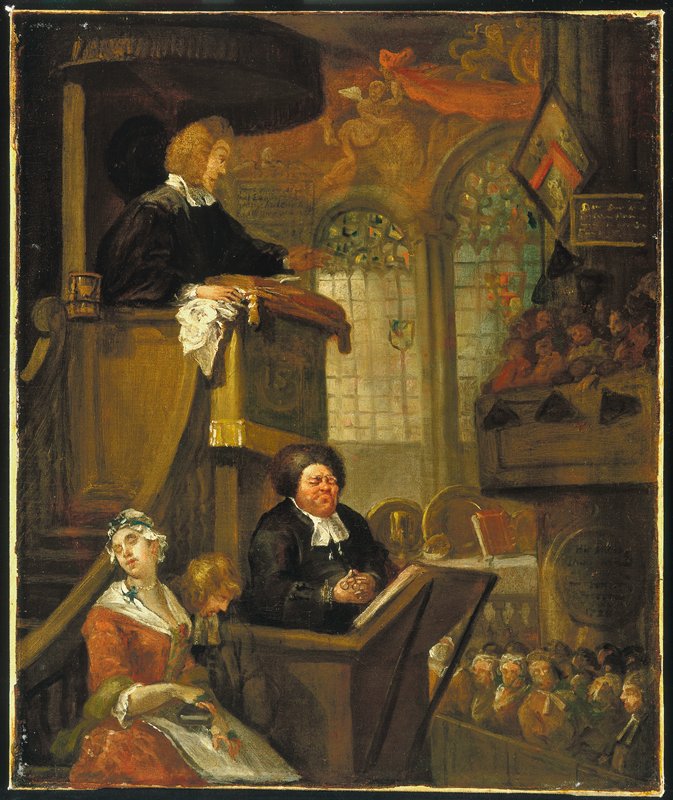
Plate four, from A Harlot's Progress
Será possível contemplá-la?
De momento, não recebe

Art Institute of Chicago
Chicago, Estados Unidos
Pertence à coleção, mas de momento não está exposta.
- Verificado
- Neste estado desde
- Fonte
- O museu
Sobre a obra
Hogarth engraved these six copper plates (1964.254–59) with a burin, a sharp metal tool used to incise swelling lines directly into a flattened copper surface. He worked in reverse of the final printed images, which were produced by inking the plates and running them through a roller press with dampened sheets of paper on top. The small cross at the bottom of each plate was added when Hogarth issued the second state, released over a decade after the first, much copied edition. The prints on view nearby are early second state impressions, made before the addition of other changes and noticeable wear.
Art Institute of ChicagoCC BY 4.0
Pormenores
- Número de inventário
- 1964.257
No catálogo
Fontes
- Art Institute of Chicago
- Imagem: Art Institute of Chicago — CC0
Entretanto, na vida de William Hogarth
A vida inteira1712–1764 · Local de trabalho
London
1735
Founds the St Martin’s Lane Academy
In 1735 Hogarth founded the St Martin’s Lane Academy in London — in essence a drawing studio that grew out of a circle of painters, draughtsmen and engravers who met at Slaughter’s coffee house on St Martin’s Lane. It became a forerunner of the Royal Academy of Arts and spread new artistic ideas in England.
25 June 1735
“Hogarth’s Act”: copyright for engravings
When the success of the two series produced numerous pirated copies, Hogarth lobbied Parliament for a law protecting engravers: the Engravers’ Copyright Act, known as “Hogarth’s Act”, became law on 25 June 1735 — the first copyright law to cover visual works and to recognise the authorial rights of an individual artist.
1743 · Local de trabalho
Paris