Vasily KandinskyFrança, 1866–1944
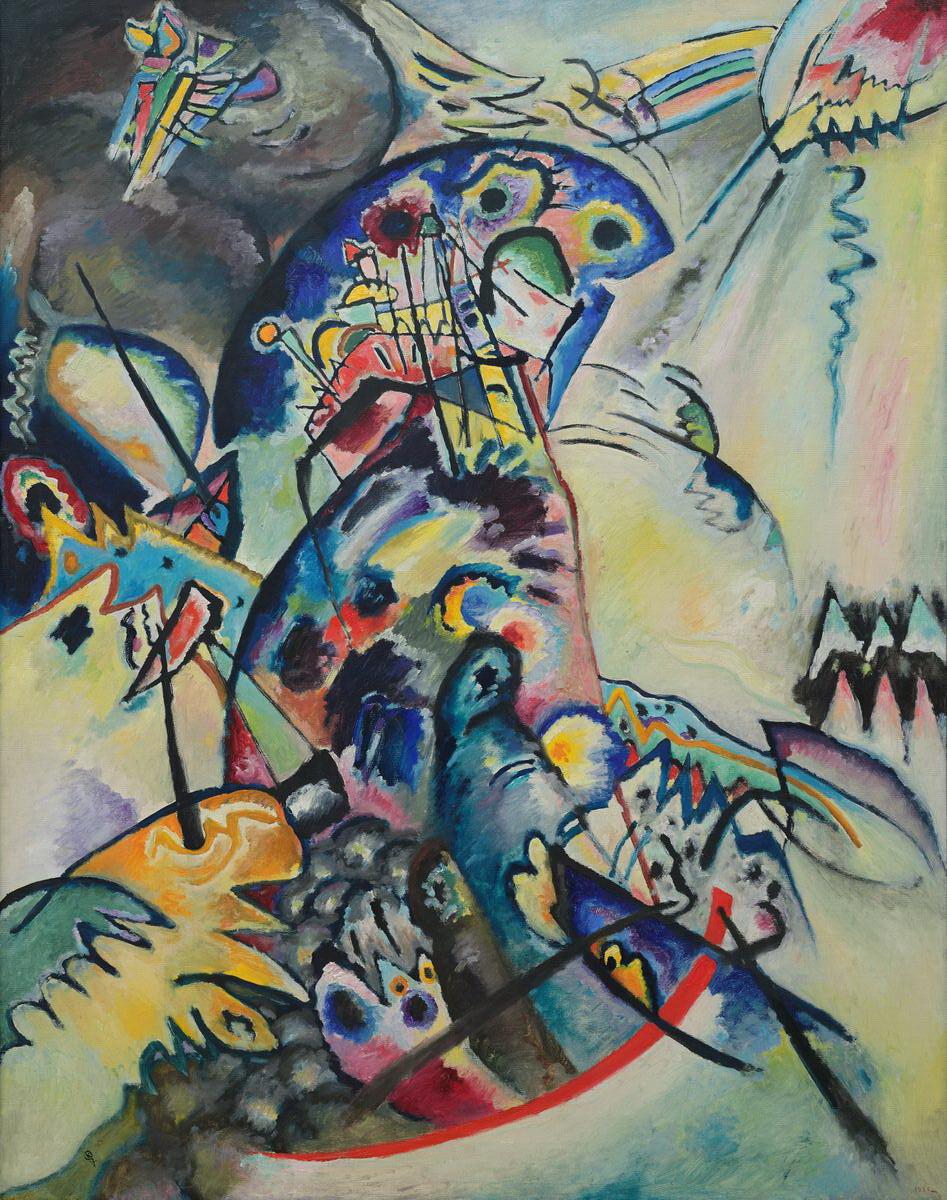
Landscape
Será possível contemplá-la?
Desconhecido

Hermitage
São Petersburgo, Rússia
O proprietário é conhecido; não se sabe se hoje está exposta.
- Fonte
- O museu
Sobre a pintura
Nas palavras do museu — em russo
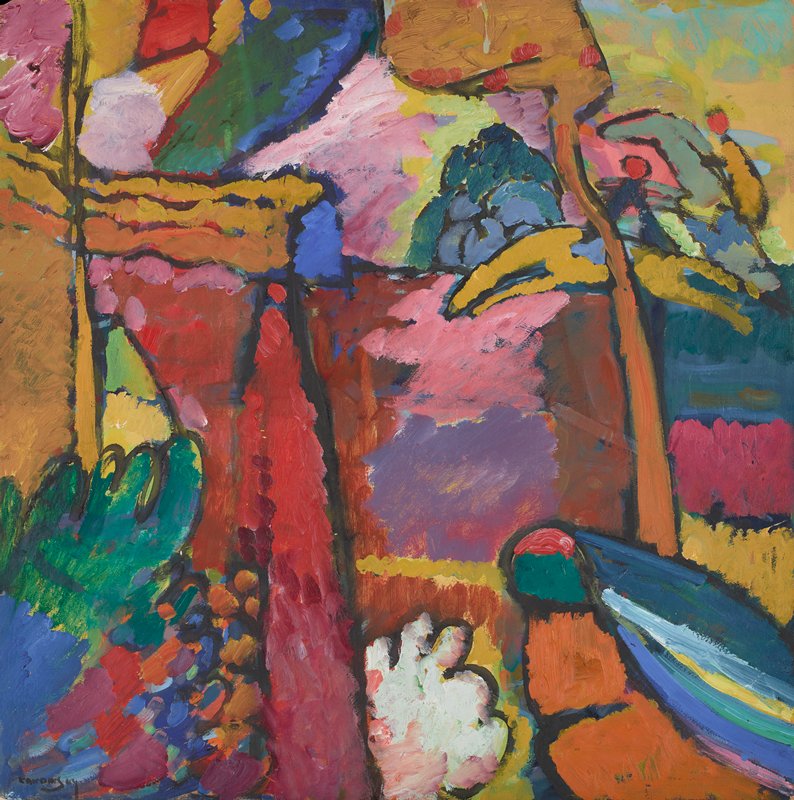
В архиве Кандинского можно увидеть развитие композиционной схемы, разрабатывающей идею столкновения двух диагоналей. Окончательный вариант появился в 1913 году. Художник обострил композиционное решение, выбрав для пейзажа почти квадратный формат. Одна диагональ - линейная, идущая от правого нижнего угла наверх - представляет собой очертание склона горы. Все формы приближены к ясно читаемым геометрическим формам. Другая диагональ, колористическая, делит композицию на спокойную светлую правую нижнюю часть и более интенсивную верхнюю левую. На пересечении этих диагоналей расположен замок. Его высокие башни, как и изображение леса или дождя, помещены справа в виде группы вертикальных черных линий и переданы крайне условно.
Continuar a ler
Основные сюжетные элементы пейзажа расположены на значительном пространственном отдалении от зрителя, что создает эффект напряжения между спокойным простирающимся вперед склоном горы и активным дальним планом. От реального пейзажа, который существовал, судя по топографически точному названию картины, осталась только «Формула», передающая взаиморасположение основных элементов. Картина впервые была показана Кандинским на Третьей выставке Кружка современного искусства в музее Стеделик в Амстердаме в ноябре-декабре 1913 года. В числе немногих отобранных Кандинским произведений «Пейзаж. Дюнаберг в окрестностях Мурнау» был переправлен в годы Первой мировой войны из Баварии в Москву. Здесь, как вспоминала жена художника Нина Кандинская, картина украшала гостиную в квартире живописца, и, следовательно, сам он считал это произведение удавшимся. Автор: Михаил Дединкин
Hermitage
Pormenores
- Número de inventário
- ГЭ-9098
No catálogo
Fontes
- Hermitage
- Imagem: Hermitage — Museum open access
Entretanto, na vida de Vasily Kandinsky
A vida inteira1910–1911
The treatise “Concerning the Spiritual in Art”
The treatise defended and promoted abstract art and affirmed that all forms of art are equally capable of reaching spirituality; colour in a painting can be autonomous, apart from the depiction of an object. Kandinsky distinguished three kinds of painting: impressions, improvisations and compositions.
1910–1912
The Izdebsky Salons and the Knave of Diamonds
With the Neue Künstlervereinigung Kandinsky took part in two international Izdebsky Salons in Russian cities, from December 1910 to May 1911; in 1910 and 1912 he also exhibited with the Knave of Diamonds.
1911
The birth of the Blue Rider
After the earlier association dissolved Kandinsky formed the Blue Rider with August Macke, Franz Marc, Albert Bloch and Gabriele Münter. The group issued an almanac and held two exhibitions; the war ended further plans.
1911
His first solo exhibition
His first solo exhibition took place in the same years, when the Blue Rider was being born.
1911
Divorce from his first wife
Kandinsky was divorced from Anna Chemyakina; his relationship with Münter was nevertheless never formalized.
1914
The war: back to Russia via Switzerland and Sweden
The outbreak of World War I ended the Blue Rider's plans for further almanacs and exhibitions and sent Kandinsky back to Russia via Switzerland and Sweden; he returned to Moscow in 1914.
_MET_DP236124.jpg?width=1280)