 Jean-Léon GérômeFrança, 1824–1904
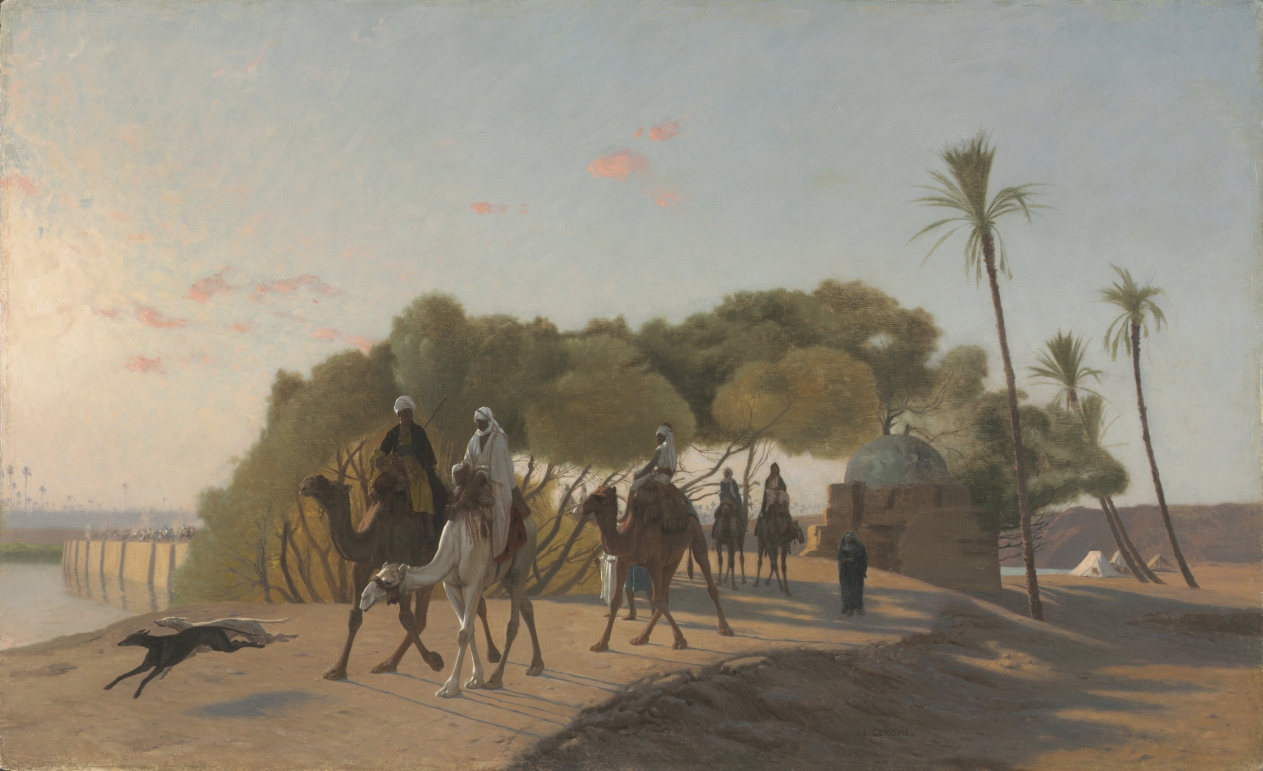
Leaving the Oasis
Será possível contemplá-la?
De momento, não recebe

Cleveland, Estados Unidos
Pertence à coleção, mas de momento não está exposta.
- Verificado
- Neste estado desde
- Fonte
- O museu
Sobre a pintura
Leaving the Oasis repeats several themes in Gérôme's art—camel caravans, oases, and expansive desert landscapes. As an academic realist, Gérôme painted everyday scenes in a meticulous and polished style. Here he carefully rendered the unique forms of the figures' dress and the camels' physical features, as well as the colors of the changing sky and the violet shadows cast by the airborne dogs and the legs of the camels. Although the picture's smoothness and detail suggest a photographic image, Gérôme actually composed his paintings in the studio, basing them on memories and sketches from his visits to the Near East. Following his first trip to Egypt in 1856, he developed into a major figure among 19th-century "Orientalists"—artists who specialized in representing Near Eastern life, culture, and landscapes.
Museu de Arte de Cleveland
Pormenores
- Número de inventário
- 1977.126
No catálogo
Fontes
- Museu de Arte de Cleveland
- Imagem: Museu de Arte de Cleveland — Museum open access
Entretanto, na vida de Jean-Léon Gérôme
A vida inteira1870s
Rising popularity in the United States
In the 1870s Gérôme’s works were particularly sought after by wealthy Americans: over his career he sold American patrons 144 paintings, nearly a quarter of his output; among his American students was Thomas Eakins.
1880
“Arguably the world’s most famous living artist”
His paintings were so widely reproduced that by 1880 he was arguably the world’s most famous living artist; with Meissonier and Cabanel he is counted among the three most successful artists of the Second Empire.
1884
A year of losses: father, brother-in-law and father-in-law
In 1884 Gérôme’s father died and his mother moved to Paris; soon afterwards his brother-in-law Albert Goupil and Albert’s father Adolphe died too. Gérôme took the loss of Albert very hard: they were friends, he sold his works through him and took him along on his travels.
1884
Against the Manet memorial exhibition
As a professor Gérôme spoke out sharply against the Manet memorial exhibition at the École des Beaux-Arts, calling Manet an apostle of decadent fashion and of the “art of the fragment”, but he lacked the means to prevent it. After visiting it he remarked drily that it was not as bad as he had thought.
1889–1890
Influenza during the Paris epidemic
In 1889–1890 an influenza epidemic raged in Paris and the artist fell victim to it; even American newspapers reported on his health, since he was extremely popular in the United States. He recovered and declared that he would like to die at work.
1891
His son Jean dies
In 1891 Gérôme’s son Jean, who had shown artistic inclinations, died of consumption at the age of twenty-seven; in his memory the artist made the statue “Grief” (La Douleur).