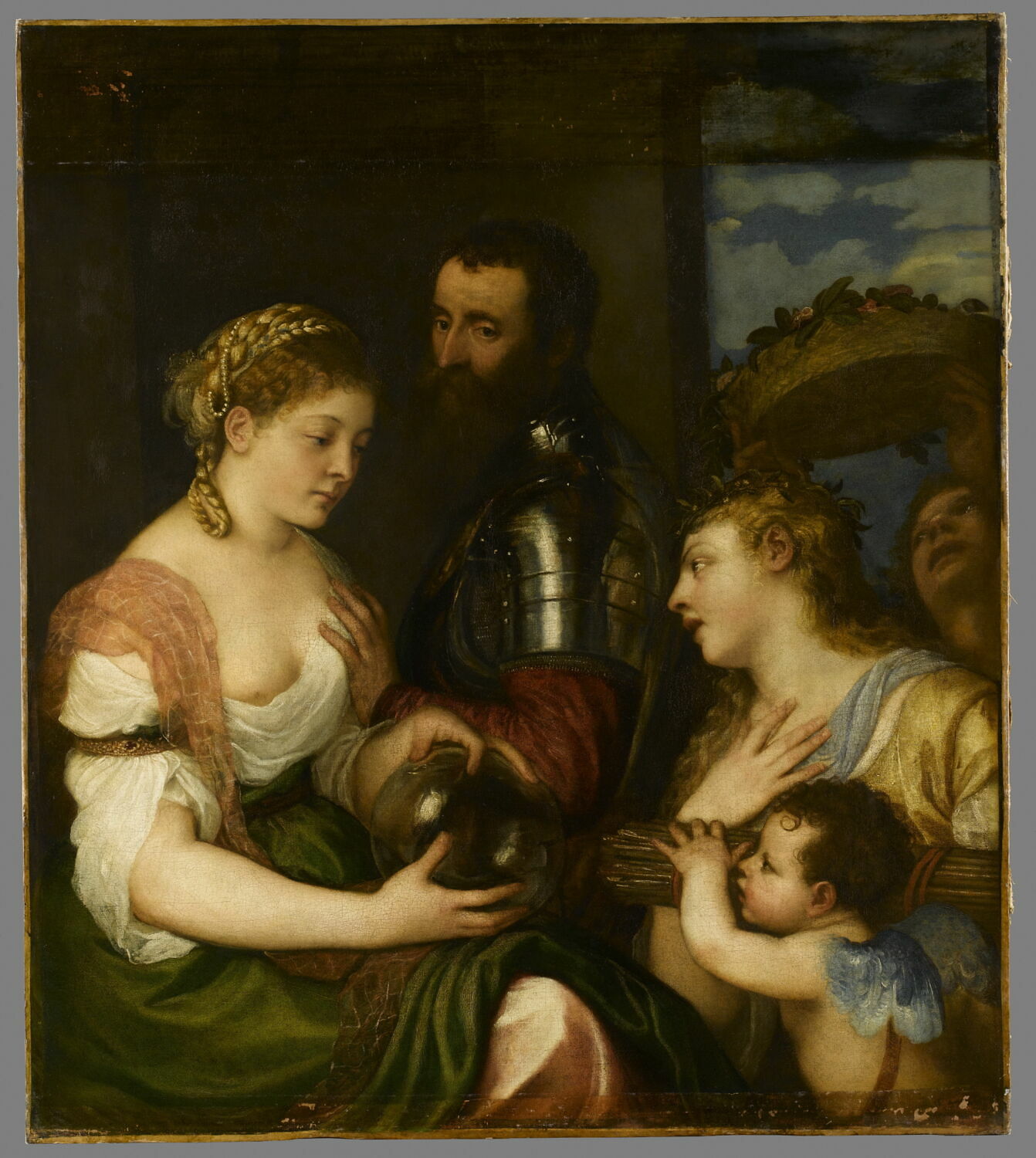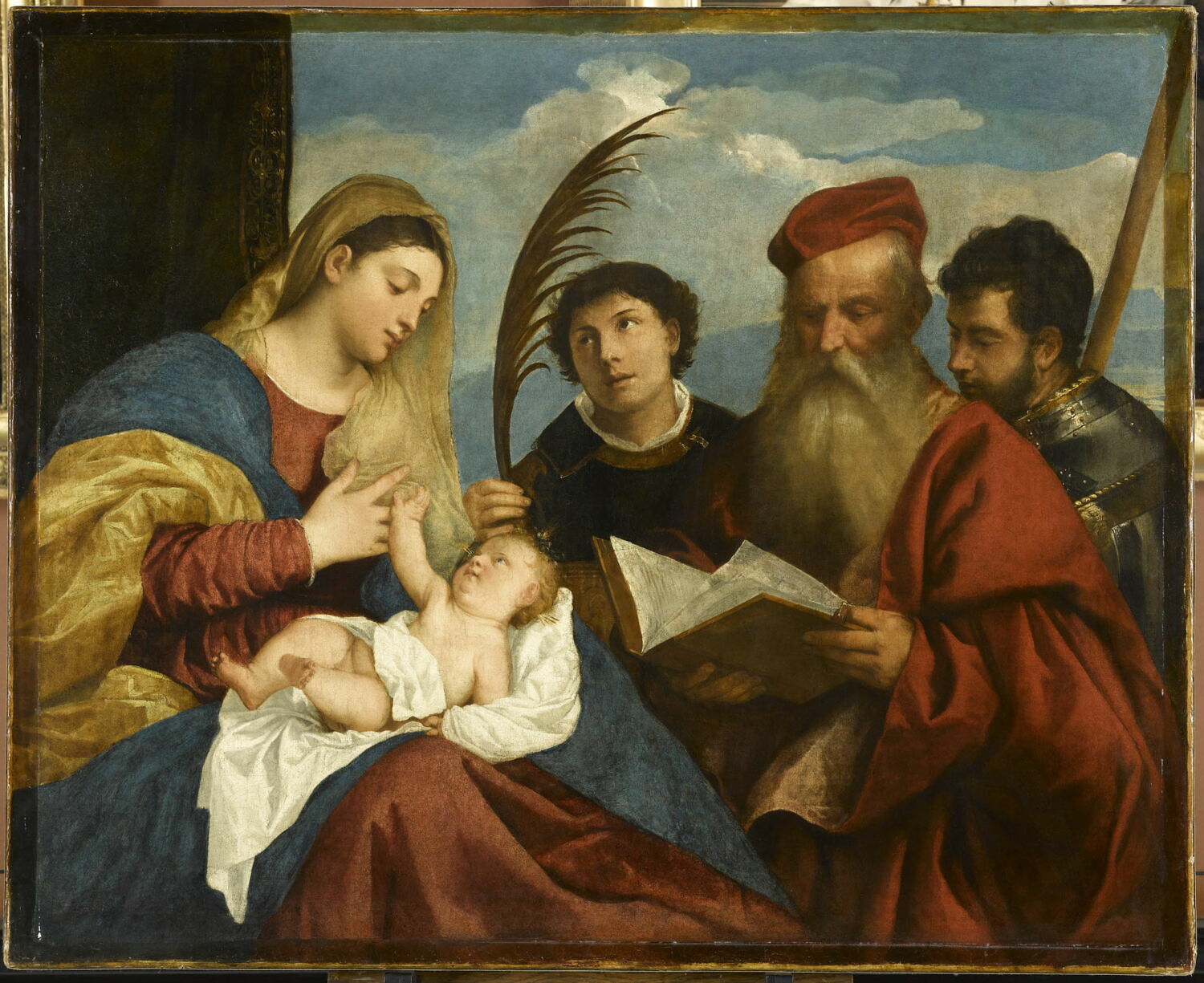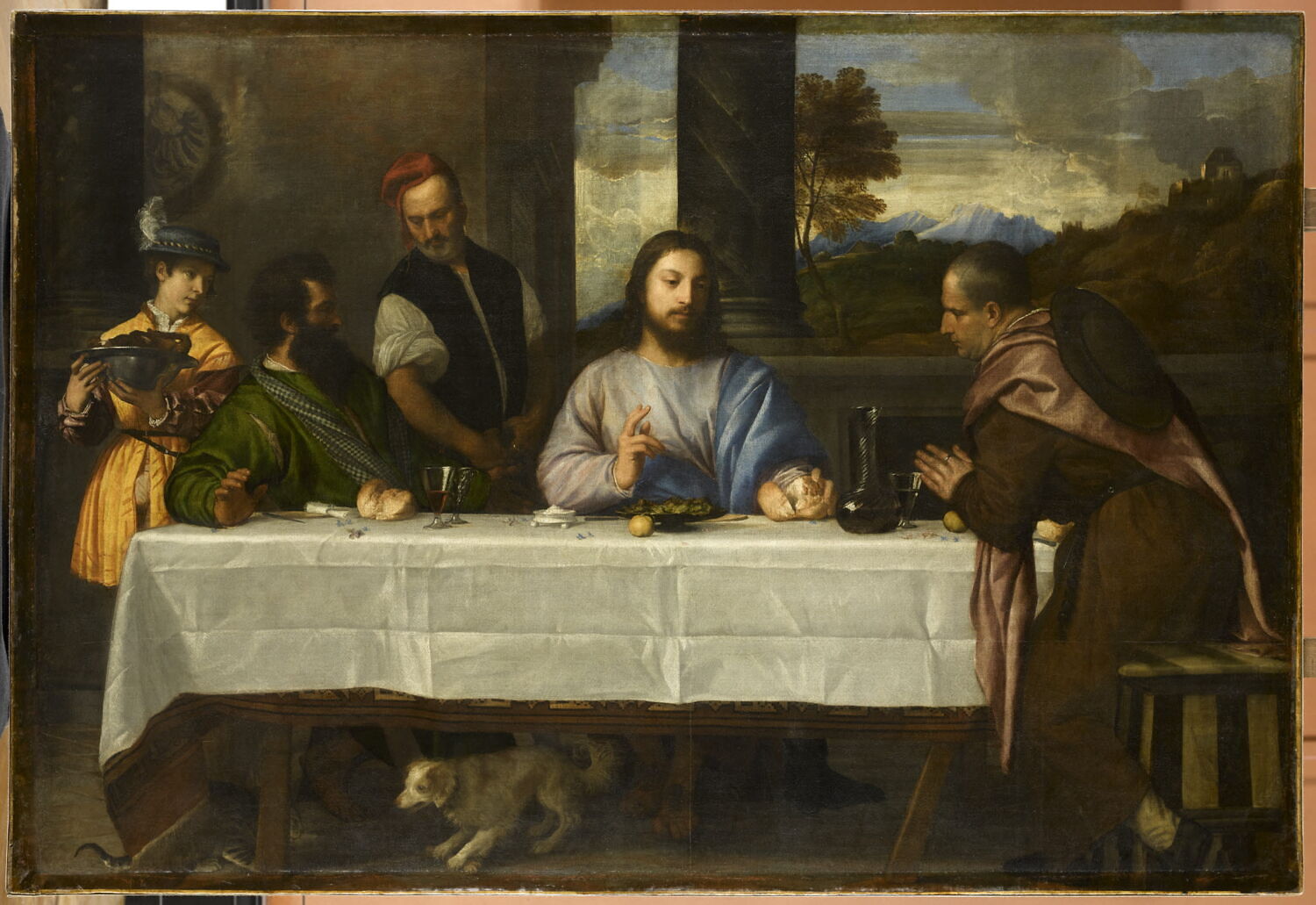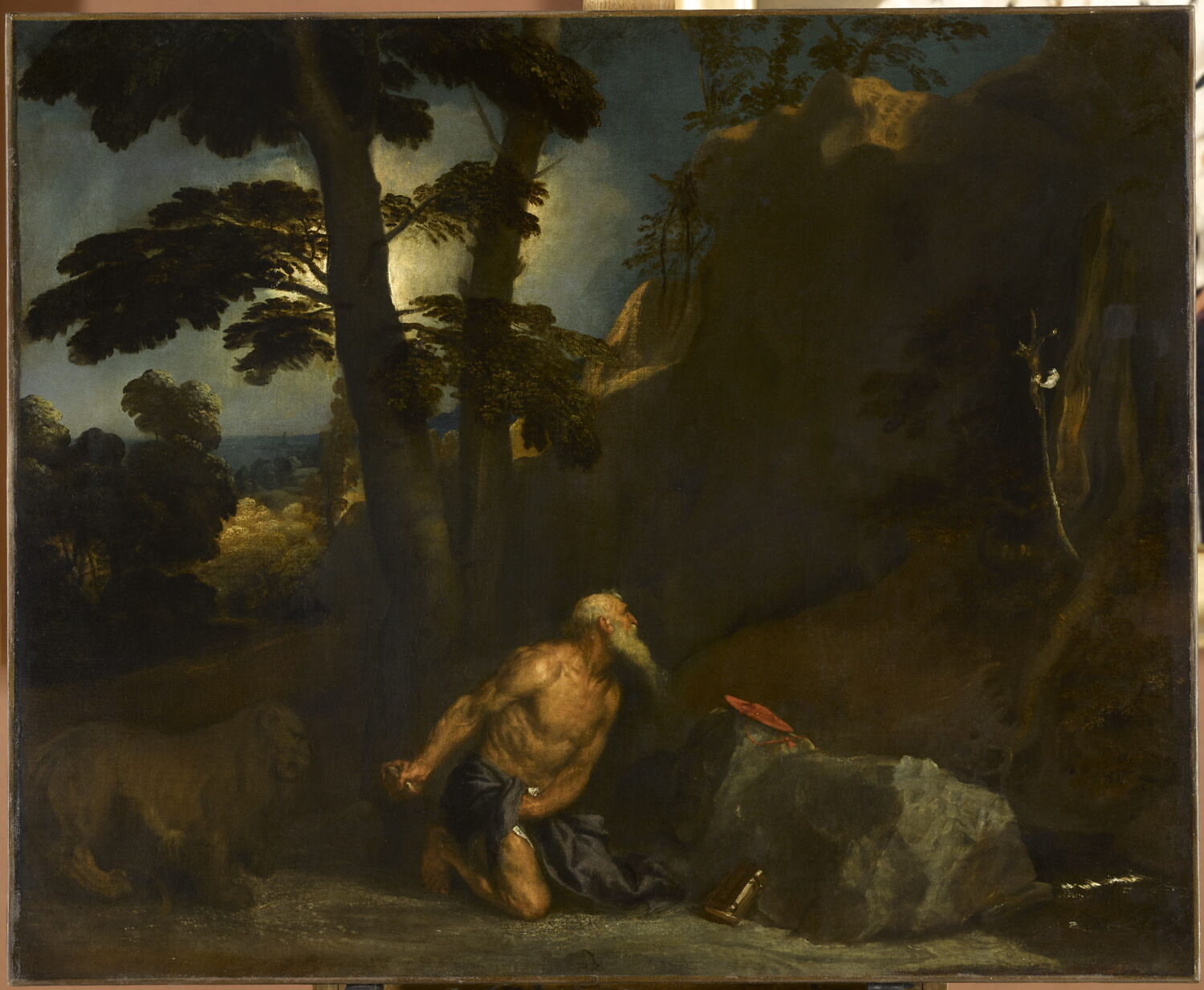
 TitianItália, 1490–1576
Coroação de Cristo com espinhos
Le Couronnement d'épines
Será possível contemplá-la?
Sim, recebe visitas

Exposta ao público. Quem o garante vem indicado abaixo.
- Verificado
- Neste estado desde
- Fonte
- O museu
Sobre a pintura
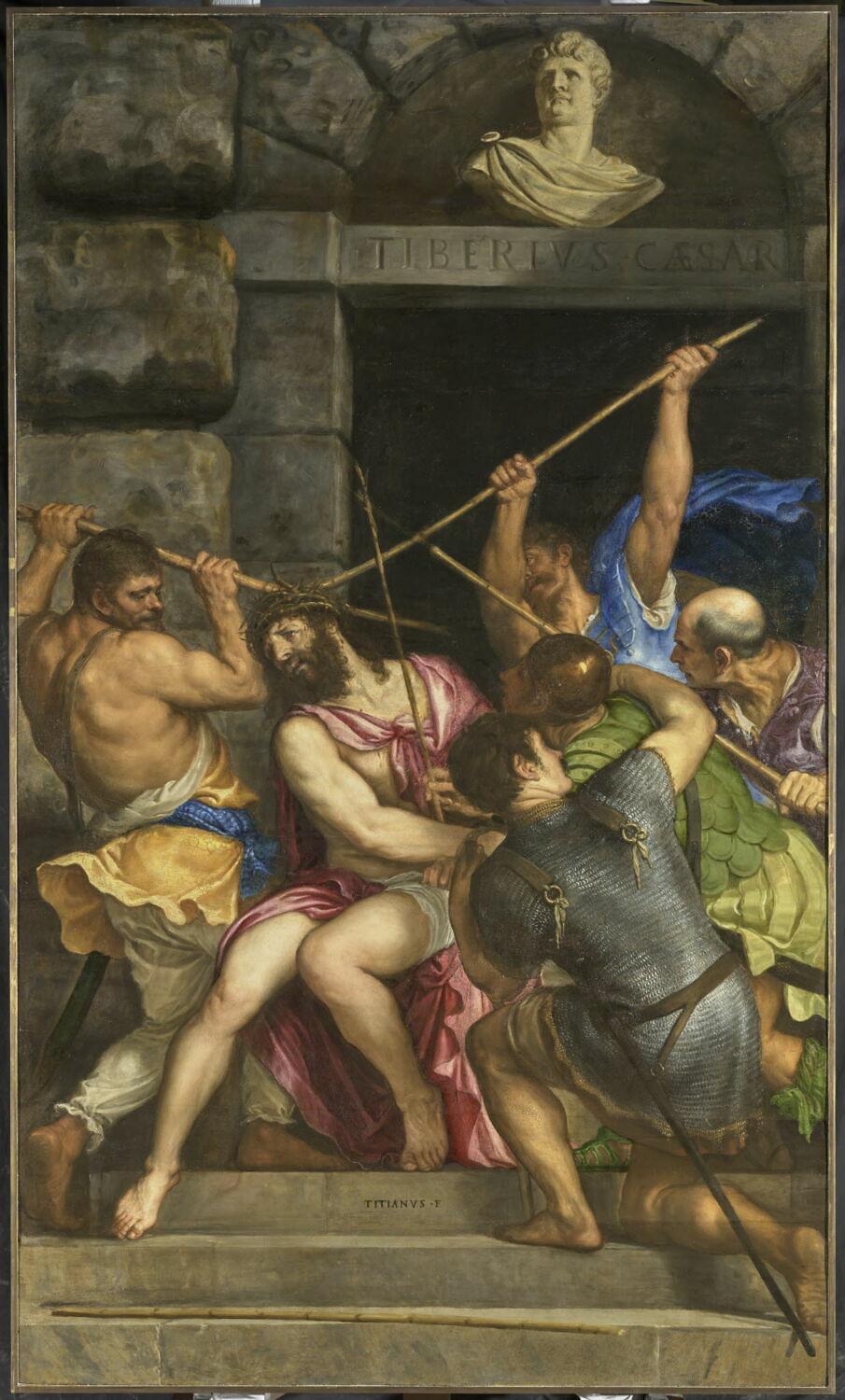
The Crowning with Thorns is a painting by the Italian Renaissance master Titian (Tiziano Vecellio) done during 1542 and 1543. It is housed in the Musée du Louvre, in Paris.
The painting was commissioned by the confraternity of Santa Maria delle Grazie in Milan. It was brought to France after the Napoleonic conquest of the city in 1797.
Continuar a ler
The space of the painting is compressed by the arrangement the figures on a shallow plane, delimited by the wall of a building. There are explicit references to antiquity: the figure of Christ derives from the celebrated Laocoön, an antique statue discovered in Rome in 1506, an archetypal exemplum doloris ("example of pain"). Another famous antique sculptural fragment, the Belvedere Torso, provides the model for the upper body of the torturer on the left. With the inclusion of the bust of Emperor Tiberius, a direct reference to the Roman authorities who condemned Christ, Titian also pays homage to the classical past.
This is a brutal scene, in which Christ's tormentors twist the crown onto his head with their canes, but the violence is relieved and Christ's suffering exalted by the beauty of the colours, which especially in the blue and green to the right are colder than usual in deference to Titian's Roman sources. In Christ's foot extended on the steps, however, Titian pulls out all the Venetian stops and one can sense the blood flowing through the veins under the flesh. The pattern of the canes slices through the massed figures like the strokes of a knife, forming a Trinitarian triangle to the right of Christ's head. An inimitable Titian touch is the cane lying unused on the foremost step, still, shadowless and deadly, like a snake.
According to Robert Haven Schauffler, the German painter Fritz von Uhde once considered it to be "the greatest picture ever painted."
Pormenores
- Número de inventário
- INV 748
No catálogo
Fontes
- Museu do Louvre
- Imagem: Museu do Louvre — © 2019 GrandPalaisRmn (musée du Louvre) / Adrien Didierjean
Entretanto, na vida de Titian
A vida inteira1525
Marries Cecilia, the mother of his sons
Cecilia, a barber's daughter from Pieve di Cadore, had been Titian's housekeeper and for some five years his mistress, and had already borne him two sons, Pomponio and Orazio. In 1525, when she fell seriously ill, Titian married her to legitimise the children; Cecilia recovered, and the marriage was a happy one.
1527
Aretino, Sansovino and the “triumvirate”
In March 1527 the satirist Pietro Aretino arrived in Venice: he became friends with Titian and with Jacopo Sansovino, and the three were popularly known as “the triumvirate”, becoming the centre of the city's artistic establishment. Aretino enlisted both in pursuing the patronage of Federico II Gonzaga, and by the autumn of 1527 the Marquis of Mantua had received from Titian a portrait of Aretino (lost); important commissions and an introduction to Emperor Charles V followed.
1529
First meeting with Emperor Charles V in Parma
Thanks to the patronage of Federico Gonzaga, Duke of Mantua, in 1529 at Parma Titian obtained an audience with Emperor Charles V, who promised him his patronage.
1533
Bologna: Count Palatine and Knight of the Golden Spur
In 1533, after painting a portrait of Emperor Charles V in Bologna, Titian was made a Count Palatine and Knight of the Golden Spur; his children were reportedly also made nobles of the Empire. He was court painter to Charles V from 1533 and received from him a heavy gold chain.
1545–1546
A triumphant trip to Rome
In 1545–1546 Titian made a triumphant trip to Rome, painting portraits of Pope Paul III and meeting Michelangelo. Returning to Venice, he found that the most lucrative commissions were going to other, younger artists.
1547–1548
Augsburg: the “Equestrian Portrait of Charles V”
In 1547 Titian was summoned from Venice to Augsburg to paint portraits of Charles V and other dignitaries; at the Diet in early 1548 he completed six paintings, among them the “Equestrian Portrait of Charles V”. He also made the emperor aware that he had not received a single payment of his stipend, and on 10 July 1548 Charles V granted him a second annual pension of 100 scudi.