 Camille CorotFrança, 1796–1875
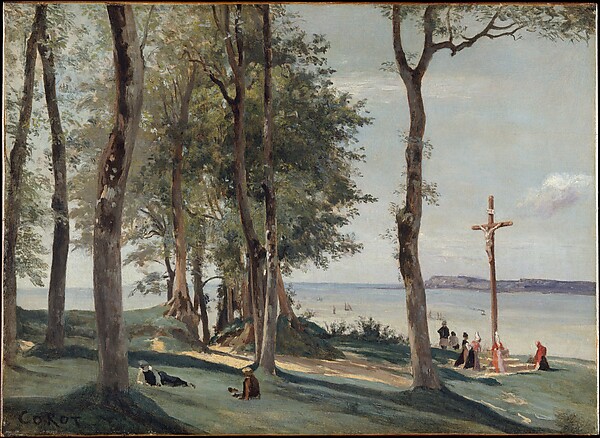
Honfleur: Calvary
Posso vê-la?
Sim, exposta agora
Onde está «Honfleur: Calvary» hoje? Museu Metropolitano de Arte, Sala 802, Nova Iorque. Sim, exposta agora. Verificado 29 de setembro de 2026.

Nova Iorque, Estados Unidos
Aberto agora· até às 21:00
Exposta ao público.
- Verificado
- Neste estado desde
- Fonte
- O museu
Pormenores
- Número de inventário
- 1974.3
O que mostra
No catálogo
Fontes
- Museu Metropolitano de Arte
- Imagem: Museu Metropolitano de Arte — Open Access (CC0)
Na vida de Camille Corot
A vida inteira1825–1828
First trip to Italy
With his parents' support Corot went to Italy to study the Renaissance masters and draw the crumbling monuments of antiquity; his parents' condition was that he paint a self-portrait for them, his first. In three years he completed over 200 drawings and 150 paintings, worked and travelled with several young French painters, and spent most of his time around Rome and in the Italian countryside.
1825–1828
A vow to landscape: no marriage for the sake of painting
Although strongly attracted to Italian women, Corot wrote that he had only one goal in life, to make landscapes, and that this firm resolution kept him from a serious attachment, that is, from marriage. He did in fact forsake any long-term relationships with women and remained very close to his parents even in his fifties.
1828–1834
Chasing the Salon: Normandy, portraits and first commissions
Between his first and second Italian trips Corot concentrated on preparing large landscapes for the Salon, often adapting his Italian oil sketches, reworked in the studio, according to Neoclassical principles. Away from the studio he travelled throughout France, returned to the Normandy coast and to Rouen, painted portraits of friends and relatives and received his first commissions; one of the most successful, a portrait of his niece Laure Sennegon in powder blue, was later donated to the Louvre.
spring 1829
Spring in Barbizon: the Forest of Fontainebleau
In the spring of 1829 Corot came to Barbizon to paint in the Forest of Fontainebleau, where he had first painted at Chailly in 1822; he returned in the autumn of 1830 and the summer of 1831, making drawings and oil studies. There he met the members of the Barbizon school: Théodore Rousseau, Paul Huet, Constant Troyon, Jean-François Millet and the young Charles-François Daubigny.
1831–1833
A cool reception at the Salon and a decision to return to Italy
Corot exhibited one portrait and several landscapes at the Salon in 1831 and 1833. The critics received them coolly, and having failed to satisfy them with his Neoclassical themes, he decided to return to Italy.