Chuck CloseEstados Unidos, 1940–2021
Frank
Dá para ver?
Não está exposta no momento
Onde está “Frank” hoje? Coleção: Instituto de Artes de Minneapolis, Minneapolis. Não está exposta no momento. Verificado 16 de novembro de 2026.

Minneapolis, Estados Unidos
Pertence à coleção, mas no momento não está exposta.
- Verificado
- Com este status desde
- Fonte
- O museu
Sobre a pintura
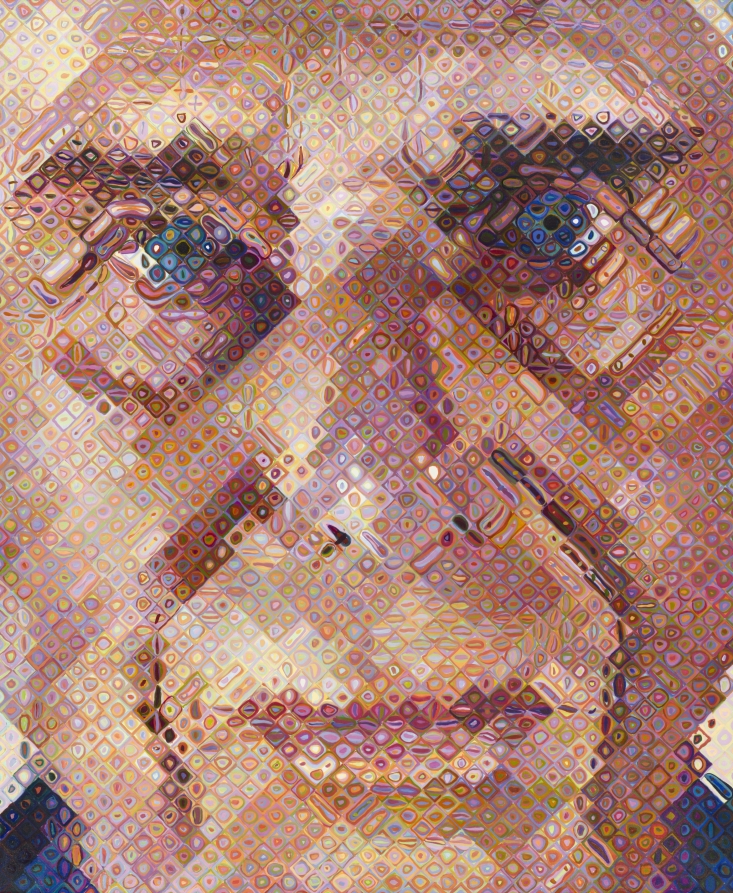
Chuck Close pintou Frank a partir de uma fotografia em 1969. O retrato ampliado está no Minneapolis Institute of Art, em Minneapolis. Sua fonte foi uma cópia fotográfica de oito por dez polegadas, não uma sessão ao vivo. Close ampliou a imagem, sobrepôs uma grade e transferiu cada seção para a tela, finalizando com cuidado uma área após a outra. O método preserva o detalhe impessoal da fotografia, mas produz uma enorme cabeça humana. Sua escala convida o espectador a ler partes separadas: poros e pelos podem se tornar um arranjo abstrato de branco, cinza e preto.
Nas palavras do museu
The model for this painting was not Frank himself but rather an 8-by-10-inch photograph of him. Since the late 1960s, Chuck Close’s method has been to start with a photographic print that he enlarges and overlays with a grid. He then systematically transposes each gridded block directly onto the canvas or paper, meticulously refining and finishing the image. The result is a technically masterful and ironically monumental portrait. By his painstaking technique, he preserves the objectivity of photography. A work of such grand scope—typical of American painting after 1950—is unsettling, particularly when it features a colossal human head. “The large scale, ” Close said, “forces the viewer to read the surface of the painting differently . . . [to] look at it piece by piece.” The details, then, can be perceived either as facial pores and hairs or as an abstract pattern of black, gray, and white.
Instituto de Artes de Minneapolis
Detalhes
- Número de inventário
- 69.137
No catálogo
Fontes
- Instituto de Artes de Minneapolis
- Imagem: Instituto de Artes de Minneapolis — © Chuck Close, courtesy PaceWildenstein, New York
Na vida de Chuck Close
A vida inteira1967
Gives up the brush to force a breakthrough
In 1967 he chooses to make art hard for himself and force a personal artistic breakthrough by abandoning the paintbrush; as he later explains, he chose to do things he had no facility with, because a limit imposed on what you have done before pushes you somewhere you have never gone.
1967
His first solo show is closed by the university over nudity
Close’s first solo exhibition, at the University of Massachusetts Art Gallery in Amherst, with paintings, painted reliefs and drawings based on photographs of record covers and magazine illustrations, is promptly closed by the university administration, which cites the male nudity as obscene. The ACLU and the AAUP come to his defence and a landmark court case ensues; a Massachusetts Supreme Court justice decides in the artist’s favour, but when the university appeals Close chooses not to return to Boston, and an appeals court ultimately overturns the decision (the university will award him an honorary doctorate of the arts in 1995).
1967
Moves to New York and settles in SoHo
In 1967 Close moves to New York City and establishes himself in SoHo.
1969
The Walker Art Center buys “Big Self-Portrait”
The Walker Art Center, then directed by Martin Friedman, buys Big Self-Portrait, the first painting Close ever sells; he credits the purchase with launching his career.
1970
His first solo show in New York
Close’s first one-man show in New York City is held at the Bykert Gallery.