 Nicolas PoussinFrança, 1594–1665
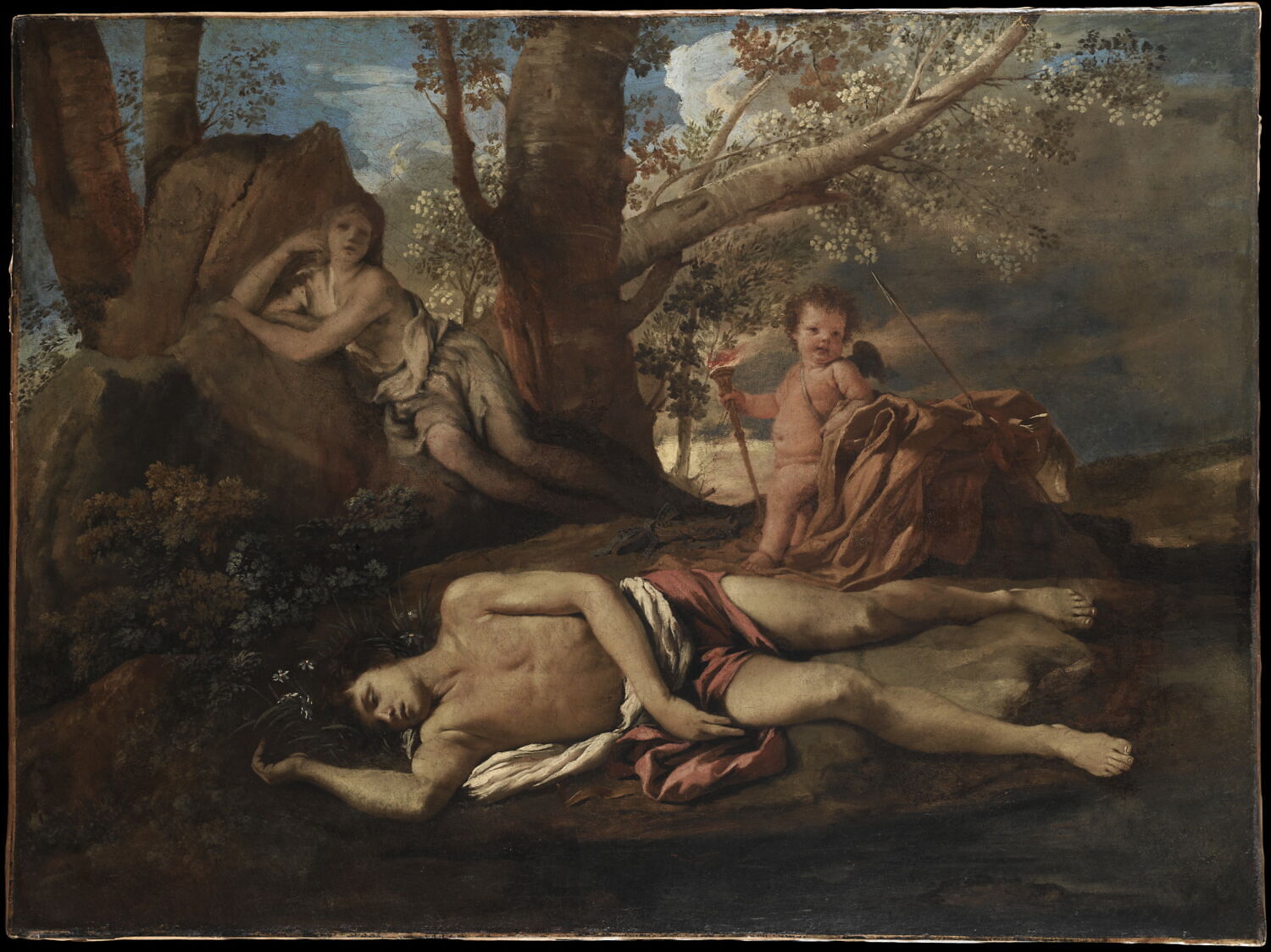
Echo et Narcisse
Será possível contemplá-la?
Desconhecido: o museu guarda silêncio

Museu do Louvre
Paris, França
O dono é conhecido. Se hoje está exposta, o museu não o diz, e adivinhar não é da nossa competência.
- Neste estado desde
- Fonte
- Os dados da própria coleção do museu
About the painting
Eco e Narciso é uma pintura do pintor francês Nicolas Poussin. Este óleo sobre tela mede 74 × 100 cm. Foi pintado entre 1627 e 1628 e está guardado no Museu do Louvre, em Paris.
Pormenores
- Número de inventário
- INV 7297
No catálogo
Fontes
- Museu do Louvre: the museum's own open data · obtido há 6 dias
- Imagem: Museu do Louvre — © 2012 GrandPalaisRmn (musée du Louvre) / Tony Querrec
Entretanto, na vida de Nicolas Poussin
A vida inteira1620s
The Cavaliere Marino takes the painter under his wing
Poussin’s work caught the attention of the Italian poet Cavaliere Marino, then living in France; his patronage let the thirty-year-old painter work in peace. According to Bellori the poet took him into his house and helped him with the invention of subjects and the rendering of emotion, and in Marino’s house Poussin gained access to a library with treatises by Alberti and Dürer and manuscripts and drawings by Leonardo.
c. 1629
A grave illness: the Dughet family nurses Poussin
Around 1629 Poussin fell gravely ill and was nursed by the family of the French pastry-cook Dughet; on recovering he became engaged to the eldest daughter, Anne-Marie. The wedding in the church of San Lorenzo in Lucina took place on 1 September 1630.
1630
Gives up monumental commissions
In 1630 the commission headed by Domenichino and d’Arpino gave the decoration of the Chapel of the Immaculate Conception in San Luigi dei Francesi to the Lorrainer Charles Mellin, not to Poussin. After that he firmly renounced the monumental genre and turned to “cabinet painting” for private patrons.
1630
Patron: Cardinal Camillo Massimo
Thanks to his earlier patrons, Cassiano dal Pozzo and Giulio Rospigliosi, in 1630 Poussin gained a powerful patron in Cardinal Camillo Massimo: the cardinal visited him in his studio after a serious illness, and the painter gave him a self-portrait drawing with a dedication. They worked together until Poussin left for Paris in 1640.
9 de agosto de 1630
Married: Anne-Marie Dughet
1630s
Cassiano dal Pozzo — his chief patron
Poussin’s flowering coincided with his complete abandonment of church commissions: he gathered a circle of patrons around him but strove for independence, accepting commissions from connoisseurs without binding himself to any of them permanently. The most important was Cassiano dal Pozzo; in the surviving correspondence the relationship comes close to servitude, although the painter did not live in his house.