
 William HogarthInglaterra, 1697–1764
A Rake’s Progress: The Gaming House
Posso vê-la?
Desconhecido
Onde está «A Rake’s Progress: The Gaming House» hoje? Coleção: Museu Estatal de Amesterdão, Amesterdão. Desconhecido.

Amesterdão, Países Baixos
O proprietário é conhecido; não se sabe se hoje está exposta.
- Fonte
- O museu
Sobre a obra
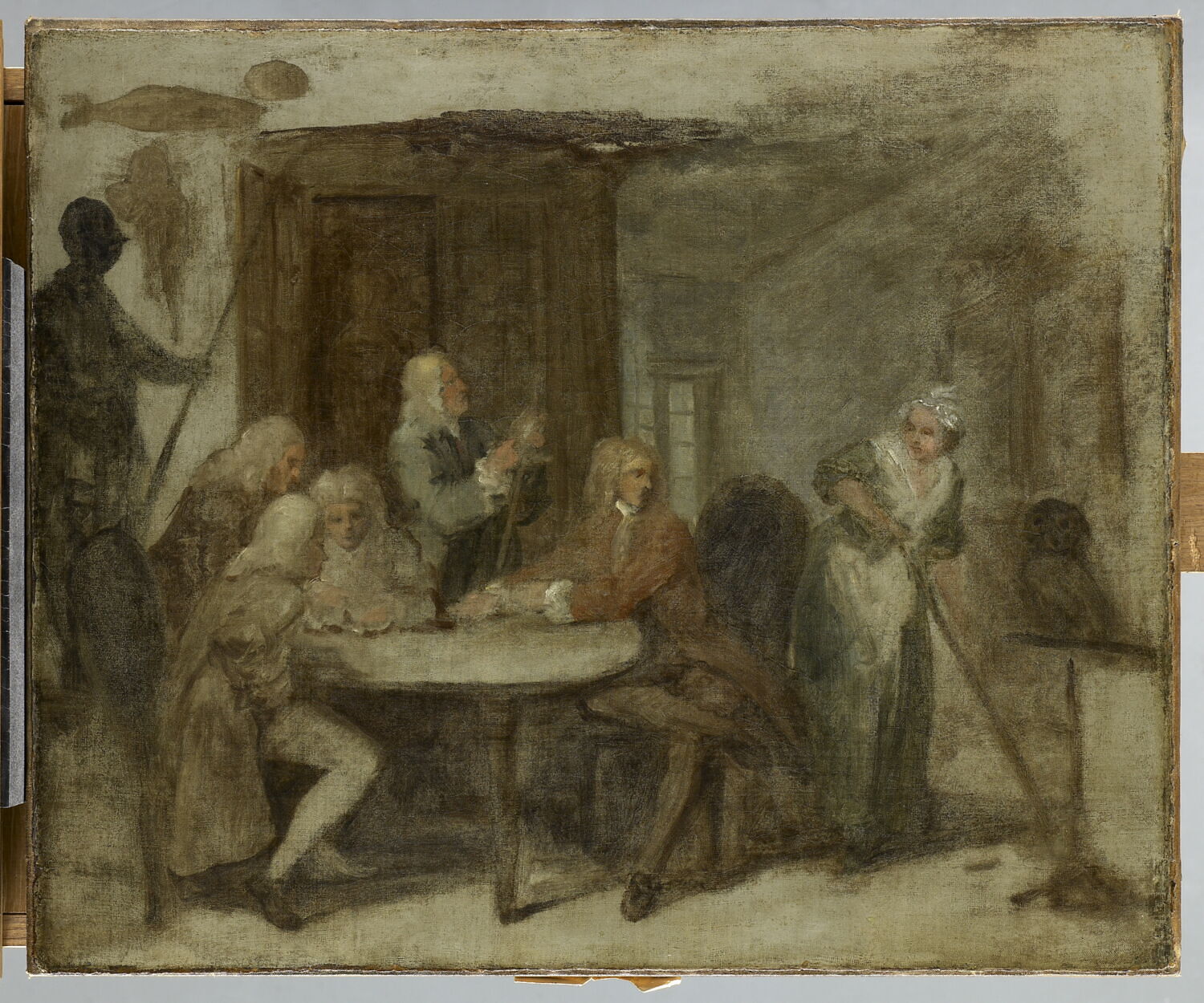
A rich man’s son, Tom Rakewell, has just gambled away a fortune in White’s Club in London. Kneeling, he prays for God’s help. Fire breaks out behind him, but men gamble away, unaware of impending danger. Hogarth devoted a series of eight paintings to Tom’s wasteful lifestyle, which he later issued in print. Incidentally, it ended badly for Tom: he was thrown into debtors’ prison and ultimately landed in a mental institution.
Museu Estatal de Amesterdão
Pormenores
- Número de inventário
- RP-P-OB-19.239
O que mostra
No catálogo
Fontes
- Museu Estatal de Amesterdão
- Imagem: Museu Estatal de Amesterdão — public domain
Na vida de William Hogarth
A vida inteira1712–1764 · Local de trabalho
London
1735
Founds the St Martin’s Lane Academy
In 1735 Hogarth founded the St Martin’s Lane Academy in London — in essence a drawing studio that grew out of a circle of painters, draughtsmen and engravers who met at Slaughter’s coffee house on St Martin’s Lane. It became a forerunner of the Royal Academy of Arts and spread new artistic ideas in England.
25 June 1735
“Hogarth’s Act”: copyright for engravings
When the success of the two series produced numerous pirated copies, Hogarth lobbied Parliament for a law protecting engravers: the Engravers’ Copyright Act, known as “Hogarth’s Act”, became law on 25 June 1735 — the first copyright law to cover visual works and to recognise the authorial rights of an individual artist.




![[Louis XIV.; Ludwig XIV., König von Frankreich], Charles Le Brun, 1656–1700](https://diglib.hab.de/varia/haum/masson-a-v3-3594/max/000001.jpg)


