 ParmigianinoItália, 1503–1540
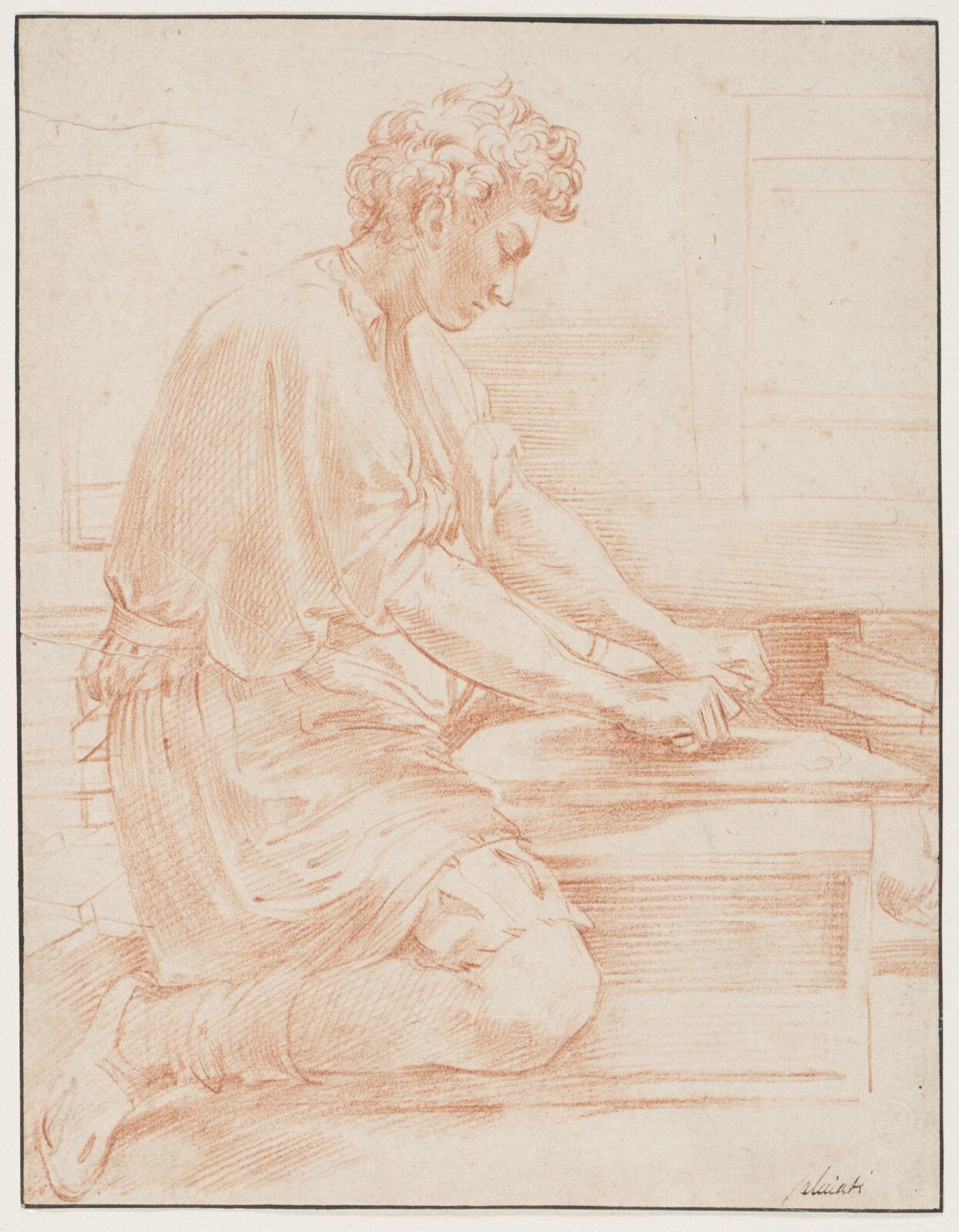
A garzone grinding pigments
Posso vê-la?
Não exposta de momento
Onde está «A garzone grinding pigments» hoje? Coleção: Museu Vitória e Alberto, Londres. Não exposta de momento. Verificado 25 de setembro de 2026.

Londres, Reino Unido
Pertence à coleção, mas de momento não está exposta.
- Verificado
- Neste estado desde
- Fonte
- O museu
Sobre a obra
This drawing shows an everyday scene that the artist would have seen in his own workshop. Like most successful artists at this time he employed a number of assistants to help with the preparatory work involved in producing a painting. In this instance the assistant is grinding mineral pigments which will be mixed with oil to make paint.
Museu Vitória e Alberto
Pormenores
- Número de inventário
- D.989-1900
O que mostra
No catálogo
Fontes
- Museu Vitória e Alberto
- Imagem: Museu Vitória e Alberto — © Victoria and Albert Museum, London
Na vida de Parmigianino
A vida inteiraby 1530
Returns to his native Parma
By 1530 Parmigianino had come back from Bologna to Parma. Here, among other works, he painted “The Madonna with the Long Neck” and took on the decoration of the church of Santa Maria della Steccata.
1531
Commissioned to decorate Santa Maria della Steccata
In May 1531 Parmigianino was commissioned to fresco the church of Santa Maria della Steccata in praise of the Virgin, with the Coronation as the main scene, and undertook to finish within eighteen months; the work stalled again and again over irregular supplies and the church administration's dislike of his unusual design. Other accounts say the commission was for two altarpieces, of Saint Joseph and Saint John the Baptist. The confraternity advanced him a salary.
1534
“The Madonna with the Long Neck” destined for the Baiardi chapel
In 1534 it was decided that “The Madonna with the Long Neck” would hang in the chapel of Elena Baiardi's family. The painting, on which he worked until 1540 (around 1535, by other accounts), remained unfinished, according to Vasari because it never fully satisfied him.
1539
Jailed for breach of contract
Absorbed in alchemy (Vasari says the elegant, handsome man turned into a bearded, unkempt, almost savage recluse), the artist did little work in the church, and the Steccata confraternity, which had paid him in advance, had him imprisoned for two months. Released on his promise to finish the work, he again failed to keep it and fled Parma for the small town of Casalmaggiore.
5 August 1540
Illness and will at Casalmaggiore
Falling ill, possibly with malaria, the artist made his will: he named as heirs three underage servants, perhaps also his studio assistants, left 100 scudi to his sister Ginevra, and asked to be buried in the Servite church of La Fontana near Casalmaggiore, naked with a cross on his chest. Vasari gives the cause of death now as a severe fever, now as poisoning by the mercury he used in his alchemical experiments.
24 de agosto de 1540
Died