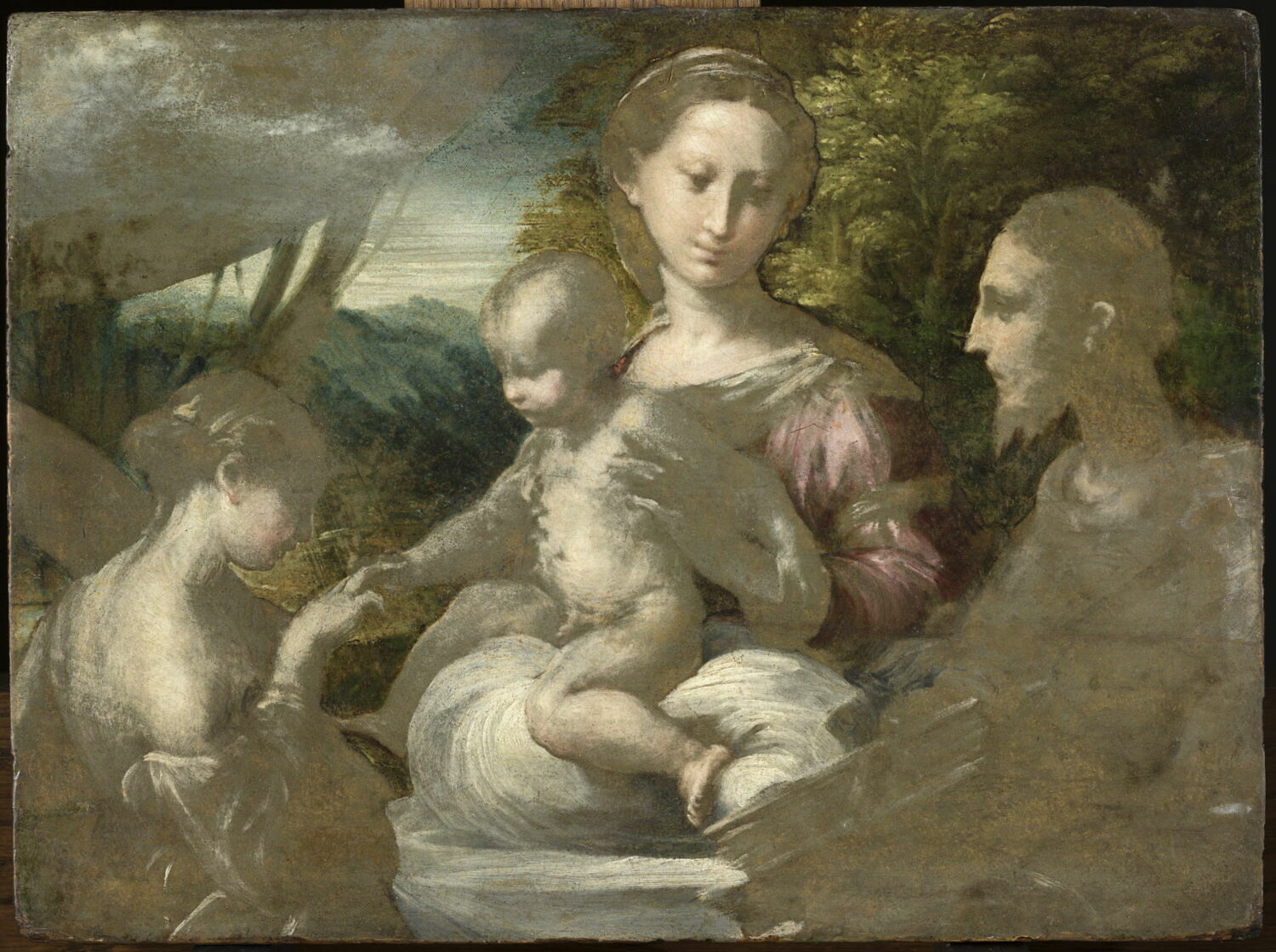
 ParmigianinoItália, 1503–1540
Le Mariage mystique de sainte Catherine
Posso vê-la?
Sim, exposta agora
Onde está «Le Mariage mystique de sainte Catherine» hoje? Museu do Louvre, Salle 712, Aile Denon, Niveau 1, Paris. Sim, exposta agora. Verificado 26 de setembro de 2026.

Aberto agora· até às 18:00
Exposta ao público.
- Verificado
- Neste estado desde
- Fonte
- O museu
Sobre a pintura
Mystic Marriage of Saint Catherine is an unfinished c.1529 oil on panel painting of the mystical marriage of Saint Catherine by Parmigianino.
It dates to the painter's time in Bologna or a few years earlier during his stay in Rome. From 1638 to 1687 it was owned by don Gaspar Mendez de Haroy Guzman, the Spanish ambassador to Rome, before passing to Giovanni Battista Sommariva. It was acquired in 1823 by Frédéric Reiset and then in 1992 by its current owner the Louvre, as a gift from the Société des amis du Louvre.
Three copies of it are known in the Pushkin Museum in Moscow, in the Campori collection in Modena and one in a private collection sold at Phillips in London on 19 April 1994.
Pormenores
- Número de inventário
- RF 1992 411
No catálogo
Fontes
- Museu do Louvre
- Imagem: Museu do Louvre — © 2015 GrandPalaisRmn (musée du Louvre) / Michel Urtado
Na vida de Parmigianino
A vida inteira11 de janeiro de 1503
Born
summer 1524
Travels to Rome with his uncles
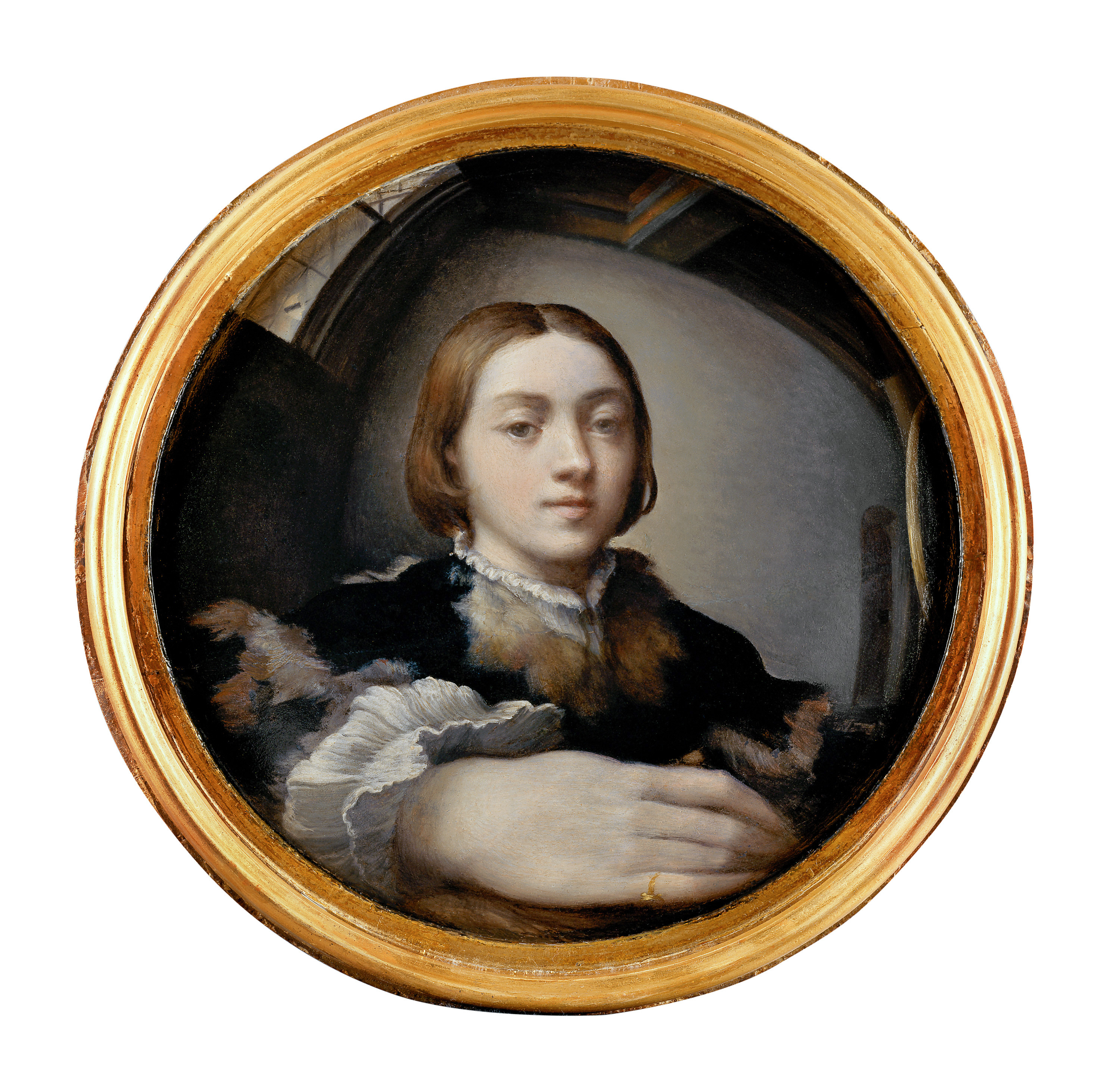
According to Vasari, on hearing Raphael and Michelangelo praised, Francesco longed to see Rome; his uncles approved and advised him to take some of his works to open doors to the lords and artists there. They arrived in Rome in the summer of 1524, and Parmigianino presented several paintings to Pope Clement VII, among them the “Self-Portrait in a Convex Mirror” painted on a wooden hemisphere.
1527
The Sack of Rome finds him at work
During the Sack of Rome by the landsknechts of Emperor Charles V, soldiers burst into the studio where Parmigianino was painting “The Vision of Saint Jerome” but harmed neither the pictures nor the artist. Soon, however, he had to abandon his lodgings and Rome, and he left the altarpiece with the church of Santa Maria della Pace.
1531
Commissioned to decorate Santa Maria della Steccata
In May 1531 Parmigianino was commissioned to fresco the church of Santa Maria della Steccata in praise of the Virgin, with the Coronation as the main scene, and undertook to finish within eighteen months; the work stalled again and again over irregular supplies and the church administration's dislike of his unusual design. Other accounts say the commission was for two altarpieces, of Saint Joseph and Saint John the Baptist. The confraternity advanced him a salary.
1539
Jailed for breach of contract
Absorbed in alchemy (Vasari says the elegant, handsome man turned into a bearded, unkempt, almost savage recluse), the artist did little work in the church, and the Steccata confraternity, which had paid him in advance, had him imprisoned for two months. Released on his promise to finish the work, he again failed to keep it and fled Parma for the small town of Casalmaggiore.
24 de agosto de 1540
Died