City guide
Art in Rouen: Monet’s Cathedral, Caravaggio and a Walk to the Seine
Monet rented rooms to watch a wall change colour. Pissarro looked out of hotel windows at a working port; Rouen lets you follow their choices from the paintings into the streets.
2 november 2026 · 7 min lezen · Redactie ART WIKI
Monet’s cathedral began to invade his sleep. While struggling with the Rouen series, he dreamed that the building was falling on him in changing colours. It is a useful story to remember in front of the real façade, where visitors now have the luxury of making a quick photograph and walking away. He kept returning to a subject that would not stay still. The stone was dependable; the light refused to cooperate.
Start outside Notre-Dame, continue to the Musée des Beaux-Arts, and finish by the Seine. Allow a day for this route, with the Musée Le Secq des Tournelles as an extra stop beside the picture gallery. The paintings discussed here belong to the Rouen collection in our records, which leave their current display unresolved. Confirm a particular picture with the museum before making it the sole reason for the journey.
The cathedral: return to the same patch of stone
In 1892 and 1893, Monet rented working spaces opposite the cathedral. He then reworked his canvases in the studio, and in 1895 exhibited twenty in Paris. This sequence complicates the idea of an impression as something dashed off outdoors. Hours before the façade were followed by further decisions away from it. You do not need to reproduce his viewpoint precisely to understand the problem. Choose one recess in the stone and watch what happens to it when a cloud passes.
The museum’s Rouen Cathedral: The Portal and the Tour d’Albane, Grey Weather rewards that exercise. Close up, dense paint can seem to obscure the architecture it is supposed to describe. Step back and the separate marks begin to supply depth. The difference between these two viewing distances matters more than spotting every piece of carving. Try the movement twice, resisting the temptation to settle at the distance that makes the picture easiest to recognise.
Outside, the façade records centuries of construction, from the twelfth century into the sixteenth. Above it rises a cast-iron spire added in the nineteenth century. Monet’s cropped view is therefore a choice within a building that offers far more than one painter could include. Walk into the cathedral as well as around its exterior. Let the change of scale interrupt the comparison with the canvas; a working church has uses that a painted façade cannot contain.

A coal merchant buys the changing light
François Depeaux saw Monet’s cathedral project take shape and became the first buyer of a painting from the series. He made his money in coal. Over his collecting life he owned close to 600 paintings and drawings, including as many as fifty-five Sisleys. Those numbers describe a repeated commitment, not a single lucky purchase. In 1909 he gave paintings to Rouen, helping establish its public Impressionist collection.
Depeaux also backed painters working in Normandy, bringing their pictures into public collections early in the twentieth century. It is worth keeping his occupation in mind when you turn from Monet to the industrial river. Coal could pay for the painted effects of modern life; smoke could become part of the subject. The relationship is more interesting than a story in which a provincial city simply waits for Paris to tell it what to admire.
Caravaggio arrives under somebody else’s name
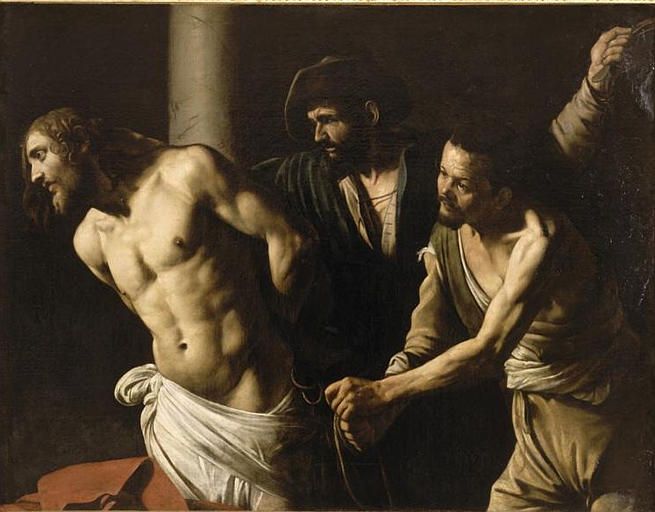
A purchase in 1955 changed the museum’s older collection. Christ at the Column came from the Paris art market attributed to Mattia Preti. Its recognition as a Caravaggio involved comparison with other versions and arguments about originals and copies. The name on the label was the result of that work. Rouen did not inherit an uninterrupted tradition of certainty; it acquired a painting whose identity had to be recovered.
Caravaggio brings the violence close. A few bodies fill the space, with light falling from above onto the men’s movements and Christ’s bare torso. Look at how little room is left for you to stand outside the event in imagination. There is no distant crowd through which the eye can wander. The handling of a shoulder or hair becomes enough to explain the imbalance of force. An executioner’s task occupies the foreground.
The painting is generally associated with the period around Caravaggio’s flight from Rome to Naples, after he killed Ranuccio Tomassoni in 1606. That biography is relevant, but it cannot tell us what every shadow means. Stay with the painted evidence. The column’s veining resembles wounds, while Christ’s muscular body appears intact. The museum’s reading draws attention to this displacement: damage can be suggested in the stone beside a body rather than painted directly on the flesh.
Pissarro turns his back on the medieval city
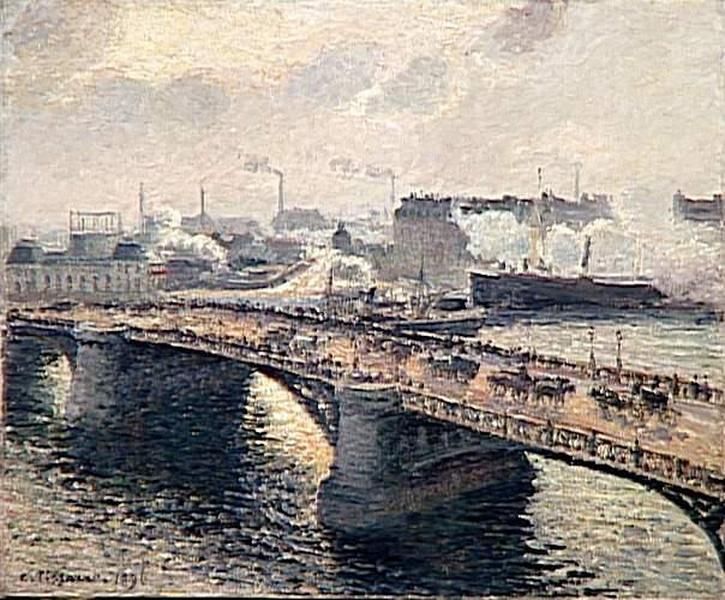
An eye condition helped determine Pissarro’s Rouen views. Unable to work outside, he painted from hotel rooms overlooking the Seine. He had seen Monet’s cathedral series in Paris and admired its unity; returning to Rouen, he pursued a sustained group of urban views himself. The city supplied an alternative to the cathedral. Its bridges moved people and goods, and its port kept producing subjects that would not wait for the painter.
In Pont Boieldieu, Rouen, Sunset, Misty Weather, small touches crowd together to make the bridge traffic, river and distant haze. Pissarro had experimented with pointillism, but here the marks do not obey a uniform grid of dots. The cloud mass and moving strokes keep another rhythm. Look first for the line that carries people across the water, then let your attention disperse into the smoke.
There is a practical consequence to his elevated viewpoint. A hotel window lets the eye combine activities that would be harder to see together from the pavement. Remember that when you reach the river after the museum. You will not recover the painting simply by finding the name of the bridge. Instead, compare the information available from ground level with the connected view Pissarro could construct above it. His enforced retreat indoors widened the visible city.
An old church makes room for iron
The former church of Saint-Laurent almost had a very different ending. In 1891 its owner wanted to demolish it for housing. The city eventually bought and repaired the building; it later became the Le Secq des Tournelles museum. The ironwork collection had been started by Henri Le Secq and continued by his son. Locks and shop signs acquired the space and attention once reserved for religious ceremony.
This is a useful pause after painted names and disputed attributions. A lock asks how it works; a sign asks how it could be understood from a street. Give those questions some time before heading down towards the Seine. If the day is short, keep the cathedral and the Beaux-Arts, then take the river walk instead of squeezing in another museum. Return to the cathedral on your way back only if you are curious about what the light has done since morning.
Op de omslag: La Cathédrale de Rouen.le portail et la tour d'Albane. temps gris — Claude Monet. © musées de la ville de Rouen; Ministère de la Culture (France), base Joconde
Verder lezen
Art city by city →City guide
Art in Edinburgh: Vermeer, the Skating Minister and Niagara at the National Gallery
Edinburgh’s art includes a minister balancing on one blade and an American waterfall brought home by a Scottish emigrant. Begin on the Mound, where private purchases became a national collection.
City guide
Art in Munich: Memling, Rubens and Guardi at the Alte Pinakothek
A pilgrimage unfolds across one panel, a painter’s wife becomes a model of motherhood, and Venice catches fire. Give Munich’s old masters a morning, including time to look at the building that survived around them.
City guide
Art in Colmar: The Isenheim Altarpiece, Cranach and Monet at Unterlinden
Begin with a pointing finger and a wounded body. Colmar’s art leads from a monastery hospital to a room full of unease, then out into Monet’s evening light.