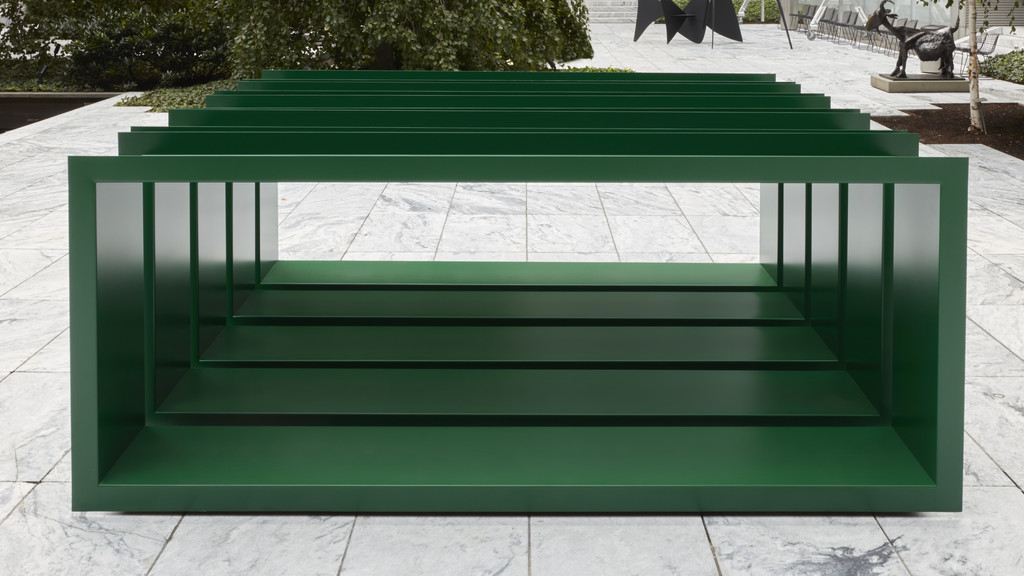
An influential practitioner of what would come to be called—much to his chagrin— Minimalism, Donald Judd preferred to describe his often sleek, industrially fabricated works as “specific objects,” neither painting nor sculpture as understood traditionally. His primary form became the box—solid or hollow, enclosed or open—often in exacting, serial arrays. Untitled comprises Judd’s seventh “stack,” a compositional mode that became the signature manifestation of his ideas. Every stack is installed like a spine or column, not only cantilevered out from the wall but also connecting floor to ceiling. Judd sought to banish symbolism from abstraction, intending his work to be experienced physically. This “stack” casts a lush orange glow against the wall around it; as a result, negative space is as much a part of the work as the boxes themselves.
Judd shows two pieces at the seminal exhibition “Primary Structures” at the Jewish Museum in New York. In the panel discussion he challenges Mark di Suvero’s claim that real artists make their own art: the method should not matter as long as the result is art.
1968
Retrospective at the Whitney Museum
In 1968 the Whitney Museum of American Art stages a retrospective of Judd’s work that includes none of his early paintings.
1968
Buys 101 Spring Street
Judd buys a five-story cast-iron building at 101 Spring Street (designed by Nicholas Whyte, built in 1870) for under $70,000, and it becomes his New York residence and studio: over the next 25 years he renovates it floor by floor, occasionally installing works he bought or commissioned from other artists. The building lets him place his work permanently — the start of his insistent push for permanent installations, since temporary exhibitions, he believed, push the art itself into the background.
1968 · Onderscheiding
Guggenheim Fellowship
27 juni 1968 – 6 oktober 1968
Exhibition: 4. documenta
early 1970s
Annual trips to Baja California
In the early 1970s Judd begins to make annual trips to Baja California with his family. The clean, empty desert affects him deeply, and his strong attachment to the land stays with him for the rest of his life.