 Antonio CanovaItalië, 1757–1822
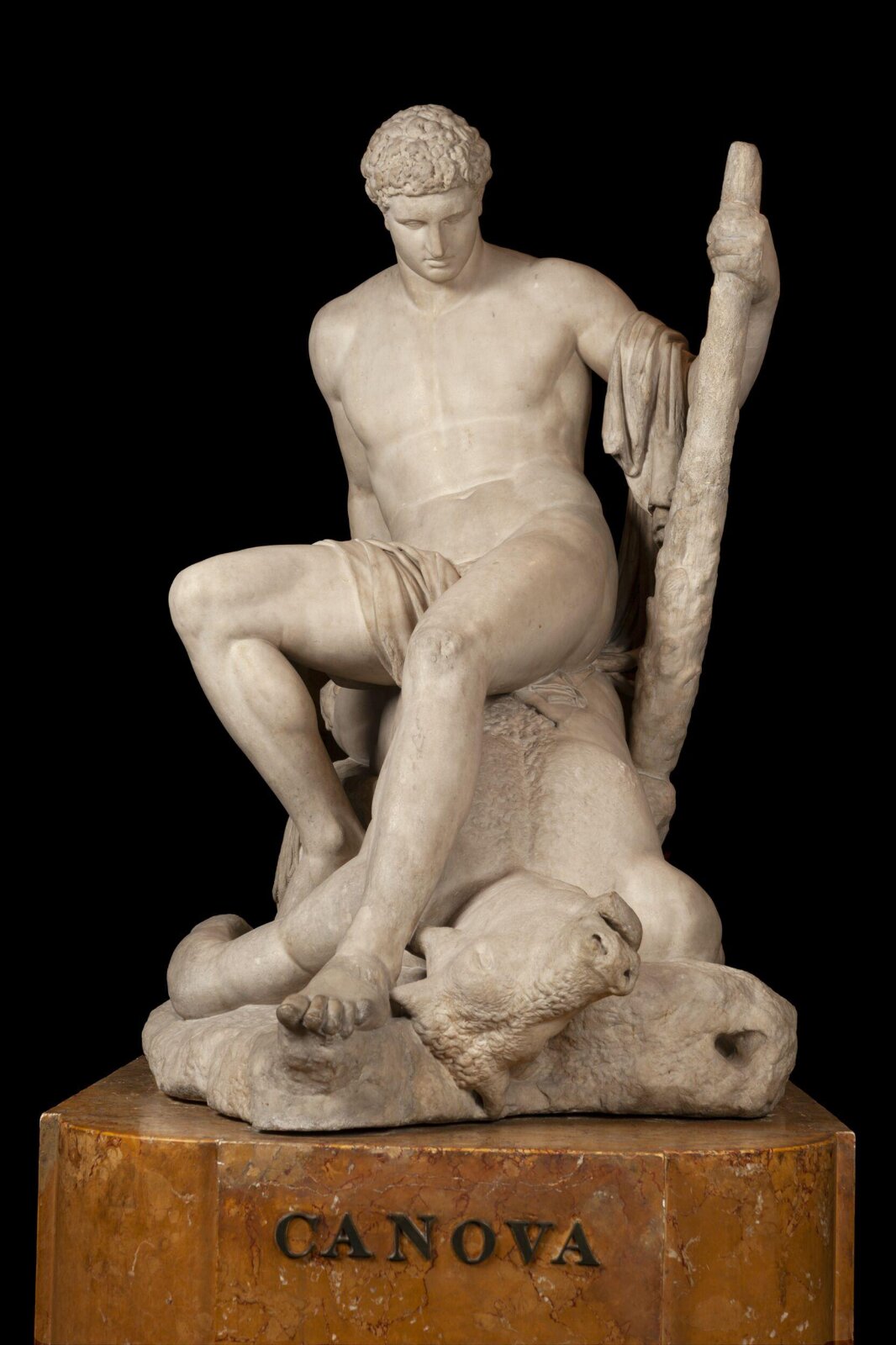
Theseus and the Minotaur
Kan ik het zien?
Ja, nu te zien
Waar is „Theseus and the Minotaur” nu? Victoria and Albert Museum, Sculpture, Room 22, The Dorothy and Michael Hintze Galleries, Londen. Ja, nu te zien. Gecontroleerd 25 september 2026.

Londen, Verenigd Koninkrijk
ZaalSculpture, Room 22, The Dorothy and Michael Hintze Galleries
Gesloten· gaat morgen om 10:00 open
Publiek tentoongesteld.
- Gecontroleerd
- Ongewijzigd sinds
- Bron
- Het museum
Over de sculptuur
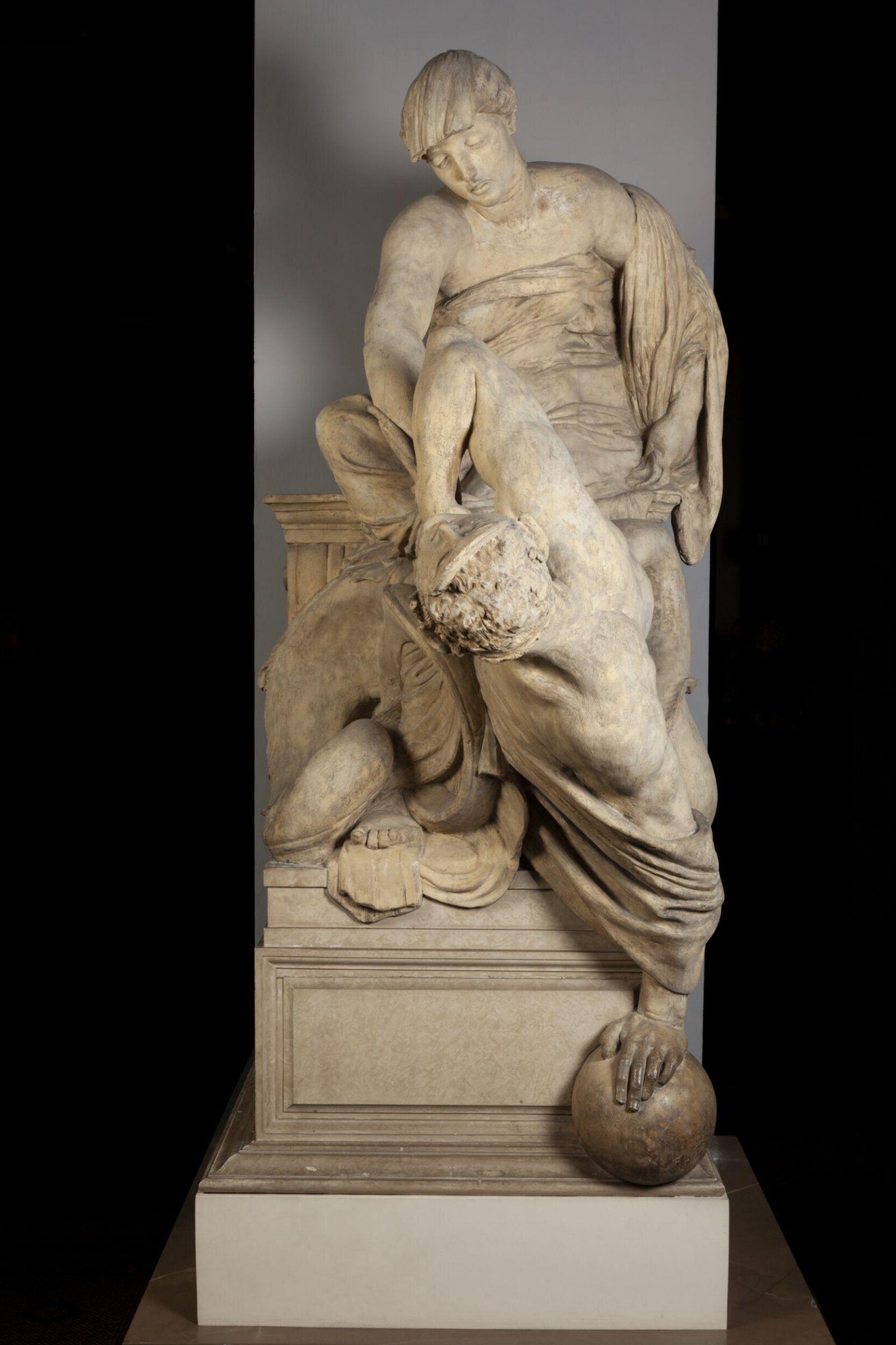
The legendary Greek hero Theseus sits astride the minotaur whom he has just killed. Coils of thread used by Theseus to retrace his steps from the minotaur's lair can be seen by the minotaur's left leg. This was one of Canova's earliest completed works after he left Venice to settle in Rome in 1780. The massive block of marble from which this group was carved was given to Canova by his patron Girolamo Zulian, who was Venetian ambassador in Rome in 1781. Zulian gave Canova the choice of subject for the work, and he decided on one of the stories from Ovid's Metamorphoses.
Lees meer
The Scottish painter, archaeologist and dealer, Gavin Hamilton (1723-1798), who was a friend of Canova, advised that he should portray Theseus and the Minotaur after their struggle. He considered that Canova would gain more favour and critical acclaim if he were to create a static group rather than a violent one. The sculpture did indeed receive widespread acclaim, and helped establish Canova's reputation as the leading European sculptor of his day. By the time Canova finished the work in 1782, his patron Zulian had moved to Constantinople, and he therefore allowed Canova to keep it. Canova sold it to an Austrian nobleman and collector, Count Johann Josef Graf von Fries (1765-1788), and it was transported to Vienna. Later it was acquired by the 3rd Marquis of Londonderry and was installed in Londonderry House, probably during the 1820s. The contents of the house were sold in the 1960s prior to its demolition, when the Museum acquired the sculpture.
Victoria and Albert Museum
Gegevens
- Inventarisnummer
- A.5&A-1962
Wat het toont
In de catalogus
Bronnen
- Victoria and Albert Museum
- Afbeelding: Victoria and Albert Museum — © Victoria and Albert Museum, London
In het leven van Antonio Canova
Het hele leven1775–1800
Shows his statues by candlelight
In the last quarter of the eighteenth century it became fashionable to view galleries at night by torchlight, and Canova seized on the fad: he displayed his works in his studio by candlelight and finished the statues by candlelight with special tools, softening the transitions between the parts of the nude. He then rubbed the marble with pumice, sometimes for weeks or months, and if need be with tripoli and lead.
1779–1780
Leaves Venice for Rome
Dreaming of living and working in Rome, “the capital of art”, Canova left Venice in October 1779 and, accompanied by the architect Giannantonio Selva and stopping in Bologna and Florence, reached Rome — on 4 November 1779 or, by other accounts, on 28 December 1780. He studied the antiquities and sketched the works of Michelangelo, but his first Roman works were received coolly.
22 January – 28 February 1780
Naples: Sanmartino’s “Veiled Christ”
From 22 January to 28 February 1780 he stayed in Naples as a guest of Contarina Barbarigo; he saw the Farnese collection and the Sansevero Chapel, where he so admired Giuseppe Sanmartino’s “Veiled Christ” that he tried to buy it, as well as the veiled figures by his fellow Venetian Antonio Corradini.



![Blue Club [working proof 8], Richard Diebenkorn, 1981](https://api.nga.gov/iiif/ca004a41-d32e-4561-9425-2045d02033f4/full/!2400,2400/0/default.jpg)
![Blue Club [working proof 7], Richard Diebenkorn, 1981](https://api.nga.gov/iiif/f21849ef-d631-4ceb-b579-d8c665572d01/full/!2400,2400/0/default.jpg)