 Antonio CanovaItalië, 1757–1822
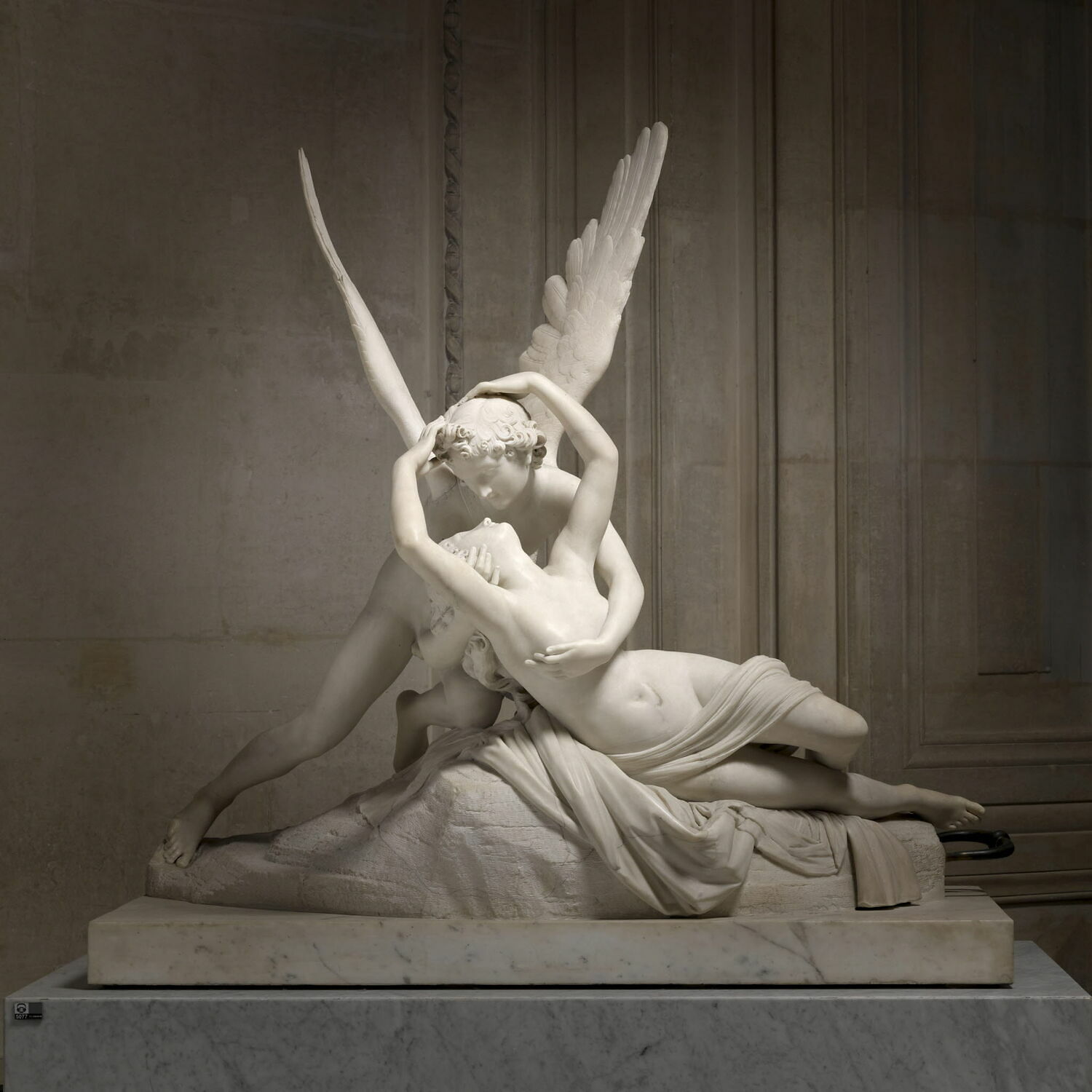
Amor en Psyche
L'Amour et Psyché à demi couchée
Kan ik het zien?
Ja, nu te zien
Waar is „Amor en Psyche” nu? Louvre, Salle 403, Aile Denon, Niveau 0, Parijs. Ja, nu te zien. Gecontroleerd 26 september 2026.

Nu open· tot 18:00
Publiek tentoongesteld.
- Gecontroleerd
- Ongewijzigd sinds
- Bron
- Het museum
Over de sculptuur
Amor en Psyche is een marmeren neoclassicistisch beeld van de Italiaanse beeldhouwer Antonio Canova. Hij begon aan het beeld in 1787 maar maakte het pas af in 1793.
Het beeld toont Cupido (Amor) net nadat hij Psyche wakker gekust heeft. Dit is een scène uit De Gouden Ezel (Metamorphosen) van de Latijnse schrijver Lucius Apuleius Madaurensis.
Het is een van de zes beelden die Canova maakte over de legende van Amor en Psyche. Het beeld staat tegenwoordig in het Louvre in Parijs. Canova maakte in 1796 een tweede versie en deze staat in de Hermitage in Sint-Petersburg.
Gegevens
- Inventarisnummer
- MR 1777
In de catalogus
Bronnen
- Louvre
- Afbeelding: Louvre — © 2011 GrandPalaisRmn (musée du Louvre) / René-Gabriel Ojéda
In het leven van Antonio Canova
Het hele leven1775–1800
Shows his statues by candlelight
In the last quarter of the eighteenth century it became fashionable to view galleries at night by torchlight, and Canova seized on the fad: he displayed his works in his studio by candlelight and finished the statues by candlelight with special tools, softening the transitions between the parts of the nude. He then rubbed the marble with pumice, sometimes for weeks or months, and if need be with tripoli and lead.
1790–1795
The monument to Titian is never built
In 1790 he began work on a pyramid-shaped tomb for Titian in the church of the Frari, but by 1795 the project was abandoned for lack of funds. Canova reused the idea for the tomb of Archduchess Maria Christina in the Augustinian church in Vienna.
1790s
Declines Catherine the Great’s invitation
News of Canova’s work reached Russia, and Empress Catherine II tried to summon the sculptor to her court; he politely declined the honourable invitation and, in thanks, made a second version of “Cupid and Psyche”, now in the Hermitage in St Petersburg.
1791–1818
Honorary member of many academies in Europe and America
Canova was elected an honorary member of many academies: Florence (1791), Stockholm (1796), Verona (1803), Venice (1804), Siena (1805), Lucca (1806), St Petersburg (1804), Geneva (1804), Denmark (1805), Graz (1812), Marseille (1813), Monaco (1814), New York (1817), Antwerp and Vilnius (1818), and also Philadelphia.
1792
Returns to Possagno to recover his health
Strenuous work had weakened his health, and in May 1792 Canova decided to visit his family in Possagno; on his way back to Rome he stopped in Padua, Vicenza, Verona, Mantua, Parma, Modena and Bologna, winning general acclaim in every one of them.
1794
Makes an exception: restores sculptures for Zulian
Canova disliked restoring ancient statues, but in 1794 he made an exception for his friend and early patron Zulian, restoring several sculptures that Zulian had moved from Rome to Venice.