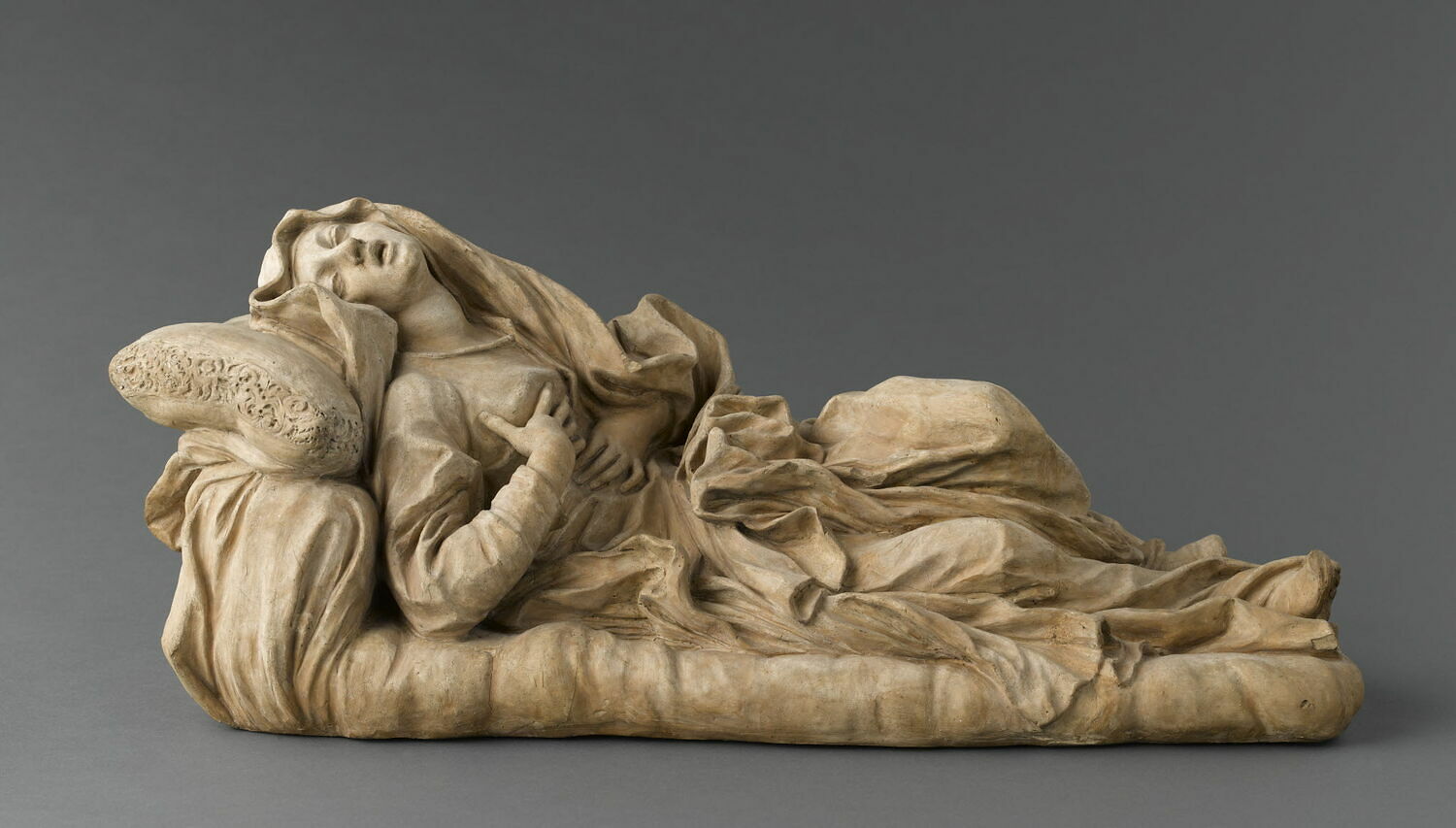
Gian Lorenzo BerniniItalië, 1598–1680
Neptune with Dolphin
Mag men het zien?
Ontvangt momenteel niet
Los Angeles, Verenigde Staten
Het hoort bij de collectie, maar is momenteel niet tentoongesteld.
- Gecontroleerd
- Ongewijzigd sinds
- Bron
- Het museum
Over de sculptuur
Neptune, Roman god of the sea, stands astride a dolphin on a bed of waves, lunging forward with his trident into the viewer's space. His unruly hair and beard and the billowing drapery that winds around his muscled figure evoke the sense of a whipping wind over the ocean. The flattened planes with which the sculptor modeled the muscles on the chest, arms, and legs heighten the feel of strength in the figure's movements. His intense focus on an unseen object before him adds a menacing tone. This drama of physicality and motion is characteristic of the Baroque style. The tabletop bronze is a reduced variant of a marble fountain sculpture made by Gian Lorenzo Bernini around 1620 for the garden of the great collector and patron, Cardinal Montalto, in Rome.
Lees meer
All of the four known versions in bronze include a long-bodied dolphin between Neptune's legs, replacing the figure of a triton who served as a supportive strut on the marble statue. Reductions in bronze are unusual in Roman sculpture of the time; the multiple reproductions of Neptune are probably due to the celebrity of its maker, who dominated Roman sculptural production in the seventeenth century.
J. Paul Getty Museum
Gegevens
- Inventarisnummer
- 94.SB.45
In de catalogus
Bronnen
- J. Paul Getty Museum
- Afbeelding: J. Paul Getty Museum — Open Content
Intussen, in het leven van Gian Lorenzo Bernini
Het hele leven1606–1642 · Woonplaats
House of Pietro and Gianlorenzo Bernini (Rome)
1620s
Serious work as a painter
Encouraged by Urban VIII, who wanted him to paint the Loggia of the Blessings in St Peter's, Bernini began to develop his skill as a painter in earnest; according to early biographers he finished at least 150 canvases, mostly in 1620–1630, but only some 35–40 surviving paintings can be confidently attributed to him.
1621
Gregory XV makes him a knight
Paul V's successor Gregory XV (Alessandro Ludovisi), who reigned only briefly, commissioned portraits of himself from Bernini in marble and bronze and conferred on him the honorary rank of Cavaliere, by which he was habitually called for the rest of his life.
1623
Urban VIII becomes pope: the Barberini years
Bernini's old friend and former tutor Cardinal Maffeo Barberini became Pope Urban VIII and, until his death in 1644, gave the artist near-monopolistic patronage; Bernini was made curator of the papal art collection, director of the papal foundry at Castel Sant'Angelo and commissioner of the fountains of Piazza Navona.