John Singleton CopleyVerenigde Staten, 1738–1815
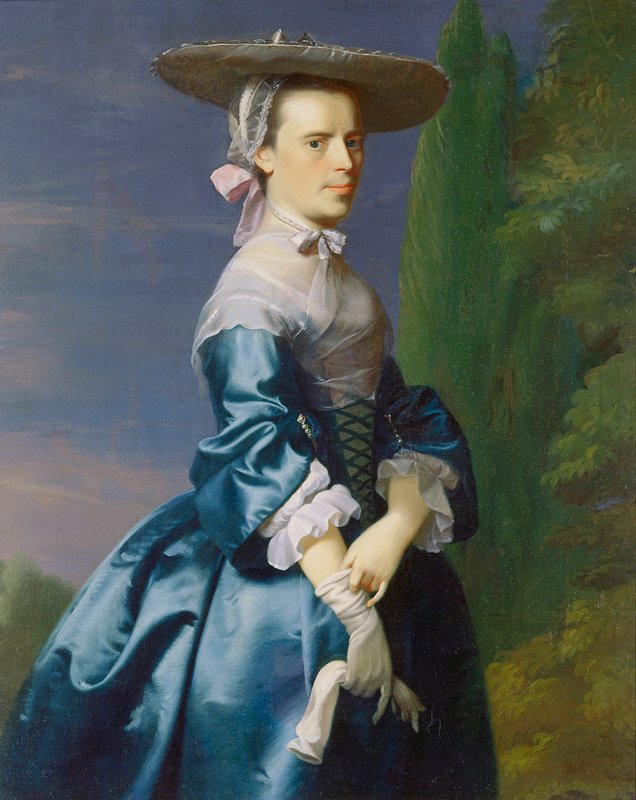
Mrs. Daniel Hubbard (Mary Greene)
Mag men het zien?
Ontvangt momenteel niet

Chicago, Verenigde Staten
Het hoort bij de collectie, maar is momenteel niet tentoongesteld.
- Gecontroleerd
- Ongewijzigd sinds
- Bron
- Het museum
Over het schilderij
John Singleton Copley was largely self-taught, his only formal training from his stepfather Peter Pelham, an English artist who specialized in mezzotint engraving. He nonetheless garnered considerable success as a portrait painter before the Revolutionary War. The sitter here, Mary Greene Hubbard, was a member of Boston’s merchant class (Copley’s portrait of her husband, Daniel Hubbard [1947.27], is also in the Art Institute collection). Her pose, gown, and background were precisely copied from a British engraving of a noblewoman, yet Copley distinguished the work as his own by capturing the figure’s individual features as well as the surfaces and colors of the luxurious fabrics. A decade later, he left colonial Massachusetts for England to further his career and simultaneously escape the strong political divides among family, friends, and patrons amid the impending Revolution.
Art Institute of ChicagoCC BY 4.0
Gegevens
- Inventarisnummer
- 1947.28
Wat het toont
In de catalogus
Bronnen
- Art Institute of Chicago
- Afbeelding: Art Institute of Chicago — CC0
Intussen, in het leven van John Singleton Copley
Het hele leven1753–1774 · Werkzaam in
Boston
1760s
A needy tobacconist’s son among Boston’s elite
The income Copley earned by painting in the 1760s was extraordinary for his town and time and raised the son of a needy tobacconist into the local aristocracy. The foremost personages of New England came to his painting-room as sitters.
30 September 1762
Asks Liotard for Swiss pastel crayons
Copley writes to the Swiss painter Jean-Étienne Liotard asking for a set of the best Swiss crayons for drawing portraits, in the hope that America will one day become a school of the fine arts. The pastels arrive and are put to use; Copley was a pioneer American pastellist.
1766
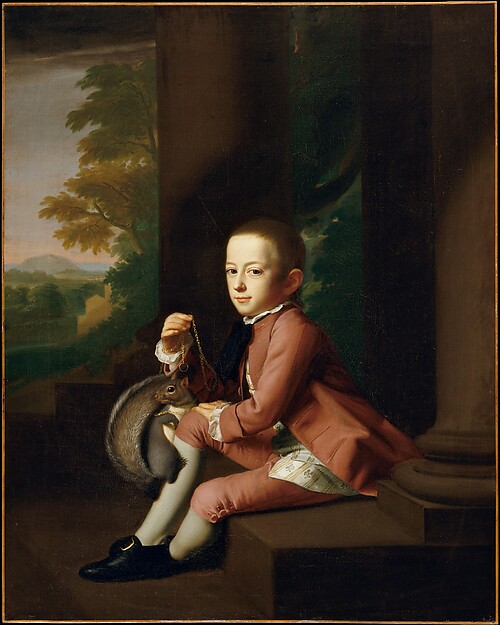
“A Boy with a Flying Squirrel” at the London exhibition
The exhibition of 1766 establishes Copley’s fame in England. Joshua Reynolds speaks warmly of the picture, saying that with a proper artistic education Copley could become a master of world stature.
4 August 1766
West urges Copley to study in Europe
By one account, on receiving the picture without the painter’s name West exclaimed that its colouring was worthy of Titian, and he got it into the exhibition; on 4 August he writes to Copley of Reynolds’s interest and advises a visit to Europe of three or four years. In October and November Copley gladly agrees to send more pictures but laments that no portrait worthy of the name of a picture has been brought to Boston within his memory.
3 September 1766
Elected to the Society of Artists of Great Britain
By vote of 3 September 1766, “A Boy with a Flying Squirrel” makes the young Boston painter a Fellow of the Society of Artists of Great Britain.