ART WIKI32.963 te zien
KaartCollectieKunstenaarsMuseaTentoonstellingenJournal
Inloggen

ART WIKI

Waar het meesterwerk hangt en wanneer men u toelaat.

Collecties: Art Institute of Chicago, Cleveland Museum of Art, Getty Villa, Harvard Art Museums, Hermitage, Hirshhorn Museum and Sculpture Garden, J. Paul Getty Museum, Louvre, Metropolitan Museum of Art, Minneapolis Institute of Art, Museum of Modern Art, National Gallery of Art, National Museum of Asian Art, National Portrait Gallery, Poesjkinmuseum, Rijksmuseum Amsterdam, Russisch Museum, Smithsonian American Art Museum, Statens Museum for Kunst, Tretjakovgalerij, Victoria and Albert Museum, Whitney Museum of American Art, Staatscatalogus van het Russische museumfonds (274 musea), Europeana (19 musea), Wikidata (6 musea), Paris Musées (12 musea) en Joconde, de museumdatabank van het Franse ministerie van Cultuur (495 musea). De afbeeldingen behoren toe aan hun rechthebbenden.

Rubrieken

  • Kaart
  • Zoeken
  • Collectie
  • Meesterwerken
  • Nu te zien
  • Kunstenaars

Meer

  • Musea & galerieën
  • Tentoonstellingen
  • Journal
  • Waar de gegevens vandaan komen
  • Privacy & cookies
StartpaginaKaartCatalogus
  1. Collectie/
  2. Art Institute of Chicago/
  3. Jacques and Berthe Lipchitz
Jacques and Berthe Lipchitz, Amedeo Modigliani, 1916

Jacques and Berthe Lipchitz

1916 · Painting

Over het schilderij

Jacques and Berthe Lipchitz is a 1916 oil on canvas painting by Amedeo Modigliani. It depicts Modigliani's friend, the sculptor Jacques Lipchitz, standing alongside his seated wife Berthe.

Modigliani and Lipchitz had each moved to France at a young age, were both from Jewish backgrounds, and became close friends who frequented the same artistic circles in Paris. Despite their commonalities, there were marked differences: Lipchitz exemplified artistic industriousness while Modigliani was given to bohemian dissolution.

Before painting Jacques and Berthe Lipchitz Modigliani made a series of preparatory drawings, of which five survive: two of Lipchitz, two of Berthe, and one of them together in the resolved composition. Lipchitz described the painting's development years later:

Verder lezen

In 1916, having just signed a contract with Leonce Rosenberg, the dealer, I had a little money. I was also newly married, and my wife and I decided to ask Modigliani to make our portrait. "My price is ten francs a sitting and a little alcohol, you know," he replied when I asked him to do it. He came the next day and made a lot of preliminary drawings, one right after the other, with tremendous speed and precision.... Finally a pose was decided upon— a pose inspired by our wedding photograph.

The following day at one o'clock, Modigliani came with an old canvas and his box of painting materials, and we began to pose. I see him so clearly even now— sitting in front of his canvas which he had put on a chair, working quietly, interrupting only now and then to take a gulp of alcohol from the bottle standing nearby.... By the end of the day he said "Well, I guess it's finished."

Lipchitz was uncomfortable accepting the painting for merely ten francs, and made excuses in order for Modigliani to continue working on the portrait. "You know", I said, "we sculptors like more substance." "Well," he answered, "if you want me to spoil it, I can continue." The portrait occupied Modigliani for nearly two weeks, "probably the longest time he ever worked on one painting."

Intussen, in het leven van Amedeo Modigliani

Het hele leven
  1. by 1914

    Gives up sculpture for painting

    By 1914 Modigliani abandons sculpting and focuses solely on painting, a move precipitated by the difficulty of acquiring sculptural materials once the war breaks out, and by his physical debilitation.

  2. June 1914

    Beatrice Hastings

    Modigliani meets the talented and eccentric Englishwoman Beatrice Hastings, a poet and columnist for The New Age, who becomes his companion, muse and favourite model: he devotes 14 portraits to her. The relationship lasts about two years.

  3. 1916

    Léopold Zborowski, friend and dealer

    Modigliani befriends the Polish poet and art dealer Léopold Zborowski and his wife Anna; in the artist’s final years Zborowski is his primary dealer and friend. He lends Modigliani his apartment, supplies models and painting materials, and pays him between fifteen and twenty francs a day.

  4. spring 1917

    Meets Jeanne Hébuterne

    In the spring of 1917 the Ukrainian sculptor Chana Orloff introduces Modigliani to a 19-year-old art student, Jeanne Hébuterne, who has posed for Foujita. Her conservative, devoutly Catholic family renounces her for her liaison with a Jew, but she soon lives with Modigliani anyway and becomes a principal subject of his art.

  5. 3 December 1917

    His first solo exhibition — and the police

    An exhibition of Modigliani’s nudes opens at Berthe Weill’s gallery in Paris, his first solo show in the city. The gallery stands opposite a police station, and the officers, outraged by the nudes, force the show to close on its opening day.

Meer van Amedeo Modigliani

Alle werken

In dezelfde zaal · Gallery 391, Art Institute of Chicago

Museumpagina

Over hetzelfde thema · Century of Progress

Alle werken over dit thema

One of only two double portraits painted by Modigliani, Jacques and Berthe Lipchitz has been noted for its complex and enigmatic study of contrasting personalities. Lipchitz is shown with his wife Berthe Kitrosser, a Russian poet, in their Paris apartment that had previously been the home of the sculptor Constantin Brâncuși. Posed in front of an abstracted architectural interior, Lipchitz is handsomely dressed, and stands casually with one hand on Berthe's shoulder. Their mask-like faces have encouraged varied readings; Berthe's gentle sensuality, her large eyes and lips and graceful neck, have been seen to offer a striking contrast to Lipchitz's self-pride, his small eyes and mouth and "wickedly twisted nose" combining to satirical effect. For art historian and curator Mason Klein, Berthe's face is bland and bourgeois, her frilly collar and pert nose suggesting haughtiness, while Lipchitz stands above her, domineering and protective.

Modigliani biographer Werner Schmalenbach compared Jacques and Berthe Lipchitz to the artist's Bride and Groom of 1915, and noted the development away from a purely formal depiction of 'types' to a greater interest in the characterization of individuals. This difference in the two works is consistent with an evolution in Modigliani's drawing and painting toward increased refinement.

After Modigliani died in 1920 Lipchitz crafted his death mask, making twelve plaster molds for Modigliani's friends and family. Soon thereafter Lipchitz traded the painting to his dealer in exchange for the return of sculptures "which I no longer felt were representative." The painting was purchased in 1922, and entered the Art Institute of Chicago in 1926 as part of the Helen Birch Bartlett Memorial Collection.

Wikipedia · CC BY-SA

In de woorden van het museum

After receiving his artistic training in Italy, the sculptor and painter Amedeo Modigliani moved to Paris in 1906. Three years later, he helped pioneer a general migration of artists to the neighborhood of Montparnasse, which remained the center of avant-gard activity in the city until World War II. Scores of artists lived there, and many of them shared a Jewish heritage—including Modigliani and his friend the Lithuanian-born sculptor Jacques Lipchitz.

Verder lezen

Lipchitz commissioned Modigliani to paint this portrait on the occasion of his marriage to the Russian poet Berthe Kitrosser, as a way of helping his troubled friend financially. The double portrait is one of only three in the artist’s oeuvre and, according to Lipchitz, took two days to paint. Modigliani made about twenty drawings on the first day; the next day, he declared the picture finished. At the modest price of what Lipchitz remembered as “ten francs per sitting and a little alcohol,” however, he persuaded Modigliani to work on the portrait for another two weeks in an effort to provide more financial assistance to his friend. Despite Modigliani’s exceptional talent, his work found a market only after his death in 1920, which was hastened by tuberculosis and his legendary bohemian lifestyle.

Art Institute of Chicago · CC BY 4.0

Gegevens

1916 · op 32-jarige leeftijd
18841920
Inventarisnummer
1926.221

Bronnen

  • Art Institute of Chicago
  • Afbeelding: Art Institute of Chicago — CC0
  • 1918

    Flight to the south: Cagnes-sur-Mer and Nice

    Fearing a German invasion, Modigliani leaves Paris with Jeanne Hébuterne, the Zborowskis and Chaïm Soutine for the south of France, first to Cagnes-sur-Mer and then to Nice. He returns to portraiture and sends the finished canvases to Paris for sale.

  • Amedeo Modigliani, portretAmedeo ModiglianiItalië, 1884–1920

    Mag men het zien?

    Ja, het ontvangt bezoek

    Art Institute of Chicago

    Chicago, Verenigde Staten

    Zaal391

    Publiek tentoongesteld. Wie daarvoor instaat, staat hieronder.

    Gecontroleerd
    3 dagen geleden
    Ongewijzigd sinds
    19 aug 2026
    Bron
    Het museum
    Op de kaartMuseumpagina
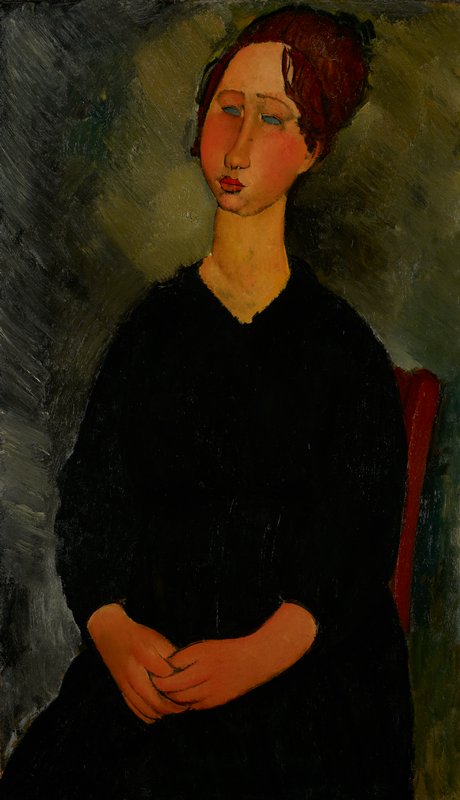
    Little Servant Girl, Amedeo Modigliani, c. 1916

    Little Servant Girl

    c. 1916 · Minneapolis Institute of Art

    Head of a Woman, Amedeo Modigliani, c.1911-1912

    Head of a Woman

    c.1911-1912 · National Gallery of Art

    Monsieur Deleu, Amedeo Modigliani, 1916

    Monsieur Deleu

    1916 · National Gallery of Art

    Léon Bakst, Amedeo Modigliani, 1917

    Léon Bakst

    1917 · National Gallery of Art

    Café Singer, Amedeo Modigliani, 1917

    Café Singer

    1917 · National Gallery of Art

    Nude on a Blue Cushion, Amedeo Modigliani, 1917

    Nude on a Blue Cushion

    1917 · National Gallery of Art

    Adrienne (Woman with Bangs), Amedeo Modigliani, 1917

    Adrienne (Woman with Bangs)

    1917 · National Gallery of Art

    Madame Kisling, Amedeo Modigliani, c. 1917

    Madame Kisling

    c. 1917 · National Gallery of Art

    Portrait of Pablo Picasso, Juan Gris, January–February 1912

    Juan Gris

    Portrait of Pablo Picasso, January–February 1912

    Daniel-Henry Kahnweiler, Pablo Picasso, autumn 1910

    Pablo Picasso

    Daniel-Henry Kahnweiler, autumn 1910

    Bathers by a River, Henri Matisse, 1909–10, 1913, and 1916–1917

    Henri Matisse

    Bathers by a River, 1909–10, 1913, and 1916–1917

    Little Harbor in Normandy, Georges Braque, spring 1909

    Georges Braque

    Little Harbor in Normandy, spring 1909

    The Leap of the Rabbit, Amadeo de Souza Cardoso, 1911

    Amadeo de Souza Cardoso

    The Leap of the Rabbit, 1911

    Madam Pompadour, Amedeo Modigliani, 1915

    Amedeo Modigliani

    Madam Pompadour, 1915

    Apples, Henri Matisse, 1916

    Henri Matisse

    Apples, 1916

    Farm near Duivendrecht, Piet Mondrian, c. 1916

    Piet Mondrian

    Farm near Duivendrecht, c. 1916

    American Gothic, Grant Wood, 1930

    Grant Wood

    American Gothic, 1930

    Art Institute of Chicago

    A Sunday on La Grande Jatte — 1884, Georges Seurat, 1884–86, border added 1888–89

    Georges Seurat

    Dimanche d'été à la Grande Jatte, 1884–86, border added 1888–89

    Art Institute of Chicago

    The Old Guitarist, Pablo Picasso, late 1903–early 1904

    Pablo Picasso

    De oude gitarist, late 1903–early 1904

    Niet te zien · Art Institute of Chicago

    At the Moulin Rouge, Henri de Toulouse-Lautrec, 1892/95

    Henri de Toulouse-Lautrec

    At the Moulin Rouge, 1892/95

    Art Institute of Chicago

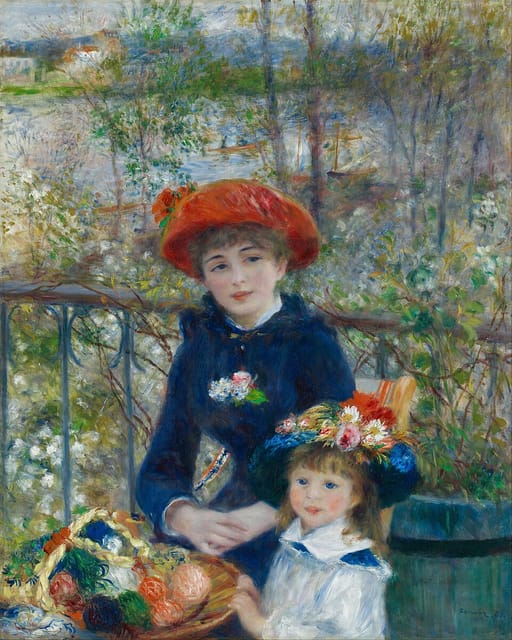
    Two Sisters (On the Terrace), Pierre-Auguste Renoir, 1881

    Pierre-Auguste Renoir

    Twee zusjes, 1881

    Art Institute of Chicago

    The Basket of Apples, Paul Cézanne, c. 1893

    Paul Cézanne

    Mand met appelen, c. 1893

    Art Institute of Chicago

    The Assumption of the Virgin, Domenico Theotokópoulos, called El Greco, 1577–79

    Domenico Theotokópoulos, called El Greco

    The Assumption of the Virgin, 1577–79

    Art Institute of Chicago

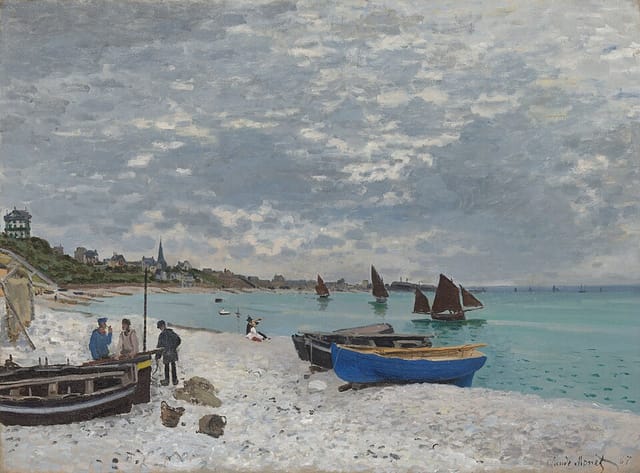
    The Beach at Sainte-Adresse, Claude Monet, 1867

    Claude Monet

    The Beach at Sainte-Adresse, 1867

    Art Institute of Chicago

    Wat het toont

    Century of ProgressWorld's fairsChicago World's FairsSuitsInteriorCouplesPortret

    In de catalogus

    SchilderijenOlieverfItaliaanse schilderkunstModernisme
    20e eeuw
    Italië