Paul KleeDuitsland, 1879–1940
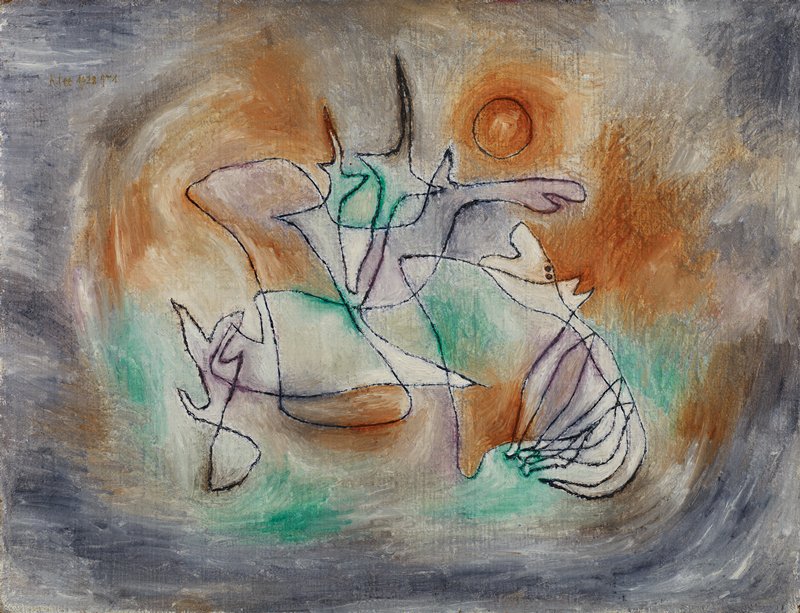
Hoffmanneske Szene
Mag men het zien?
Onbekend

Amsterdam, Nederland
De eigenaar is bekend; of het werk nu te zien is, is onbekend.
- Bron
- Het museum
Gegevens
- Inventarisnummer
- BI-2018-1-6
In de catalogus
Bronnen
- Rijksmuseum Amsterdam
- Afbeelding: Rijksmuseum Amsterdam — public domain
Intussen, in het leven van Paul Klee
Het hele leven1918–1919
After the revolution: demobilisation and an artists’ committee
After the November Revolution Klee petitioned the new authorities to release him from service and was demobilised. In spring 1919 he was invited onto the Executive Committee of Revolutionary Artists, but the republic fell before he could begin.
1919
A rejected candidacy for the Stuttgart Academy
Oskar Schlemmer and Willi Baumeister put Klee forward, unsuccessfully, for a teaching post at the Stuttgart Academy of Fine Arts. Some of those who opposed the appointment hinted at the artist’s Jewish origin.
1919
Goltz and Kahnweiler: a first financial footing
After the failure in Stuttgart Klee secured a three-year contract with the dealer Hans Goltz, guaranteeing a minimum annual income; Goltz’s gallery brought him wide exposure and commercial success. His works were also bought by the Paris dealer Kahnweiler, under whose arrangement Klee received financial support.
1920
Retrospective at Goltz’s: over 300 works
In 1920 Hans Goltz showed Klee’s works at his Munich gallery — a retrospective of more than 300 works.
1920
Gropius invites Klee to teach at the Bauhaus
In October 1920, on behalf of the Bauhaus staff, its director Walter Gropius invited Klee to teach; from January 1921 to April 1931 he was a “form master” — first in the bookbinding workshop, then, together with Kandinsky, in the stained-glass and mural-painting workshops, and later he ran a painting class.
1921–1931
The preliminary course on the “theory of form”
Klee developed a preliminary course in the “theory of form” that began with the “point as the beginning of all beginnings”, moving through space, and the “cosmic egg” from which line, spiral, square, circle and cube are born. Students listened to lectures illustrated with Klee’s own abstract watercolours and then painted their own, trying to express movement, balance, flight and tension.