Helen FrankenthalerVerenigde Staten, 1928–2011
10/29/52
Mag men het zien?
Ja, het ontvangt bezoek

Art Institute of Chicago
Zaal291Chicago, Verenigde Staten
Publiek tentoongesteld. Wie daarvoor instaat, staat hieronder.
- Gecontroleerd
- Ongewijzigd sinds
- Bron
- De eigen collectiegegevens van het museum
Over het schilderij
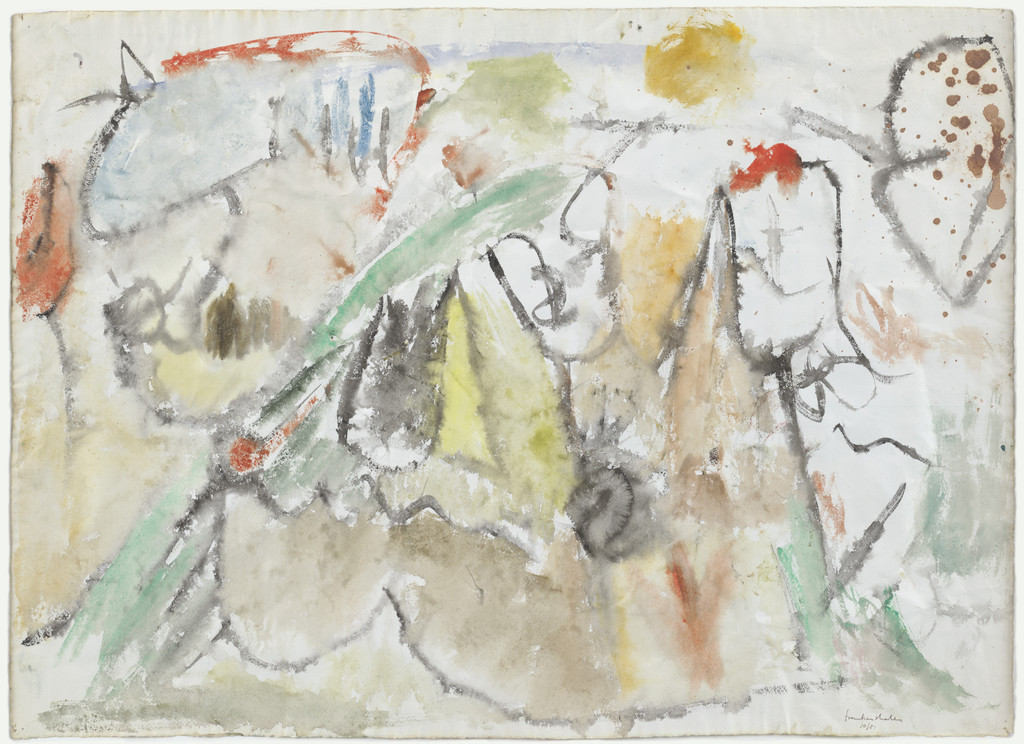
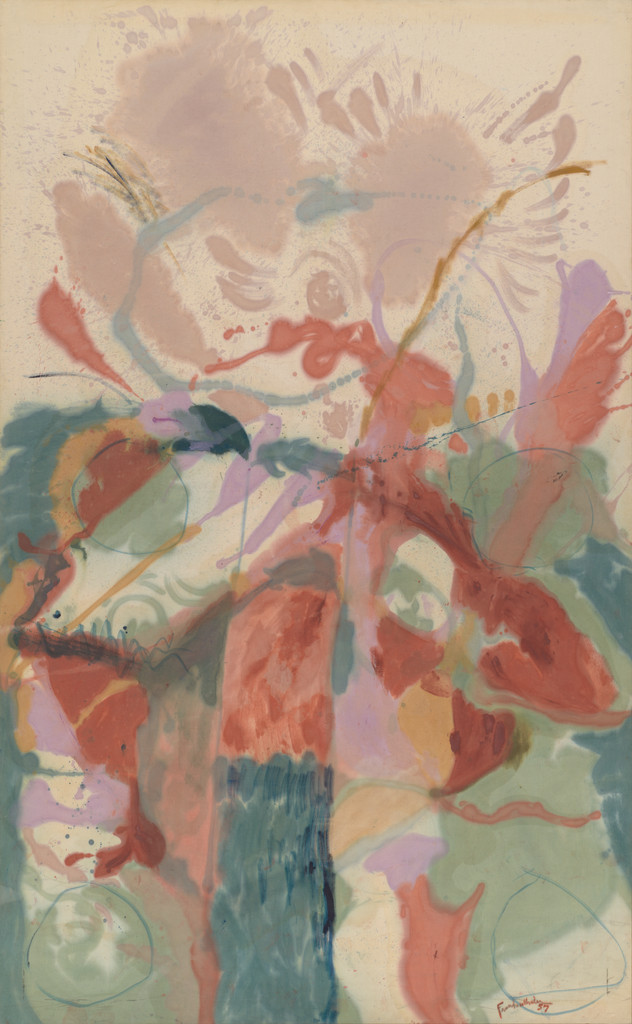
10/29/52 illuminates Helen Frankenthaler's abstract approach to landscape. Created at a turning point in her career, this painting demonstrates the "soak stain technique" that she pioneered following a summer spent painting landscapes in Nova Scotia, Canada. Using paint thinner to liquify her oil paint until it was the consistency of watercolor, Frankenthaler introduced a new way of engaging with canvas, which she placed on the floor as opposed to on an easel.
Here, the swirling, undulating forms suggest her affinity for the improvisational compositions of Wassily Kandinsky (on view in Gallery 392) and Arshile Gorky (Gallery 398), and the looping shapes allude to the signature aesthetic of her contemporary Jackson Pollock, whose work is on view nearby.
Art Institute of ChicagoCC BY 4.0
Gegevens
- Inventarisnummer
- 2023.1317
In de catalogus
Bronnen
- Art Institute of Chicago: de open data van het museum · opgehaald 8 dagen geleden
- Afbeelding: Art Institute of Chicago — © the artist or rights holder
Intussen, in het leven van Helen Frankenthaler
Het hele leven1950
Meets Clement Greenberg
She meets the critic Clement Greenberg; they have a five-year relationship, and through him she is introduced to the New York art scene — in 1964 he will include her in the exhibition “Post-Painterly Abstraction”.
1950
Pollock’s show at the Betty Parsons Gallery
She sees a Jackson Pollock show for the first time, at the Betty Parsons Gallery: “Autumn Rhythm”, “Number 30, 1950” and “Lavender Mist” impress her so much that she recalls wanting to live in that world and master its language. Other accounts date the show to 1951; after it she adopts Pollock’s method of laying the canvas out on the studio floor.
summer 1950
A summer with Hans Hofmann
Under Clement Greenberg’s guidance she spends the summer of 1950 studying with Hans Hofmann, the catalyst of the Abstract Expressionist movement.
autumn 1951
First solo exhibition at Tibor de Nagy
Frankenthaler’s first solo exhibition takes place in the fall of 1951 at the Tibor de Nagy Gallery in New York.
1952
The “Mountains and Sea” exhibition launches her career
The exhibition of “Mountains and Sea” launches her official career as a painter; throughout the 1950s her compositions tend to be centred.
1953
Louis and Noland see “Mountains and Sea”
Kenneth Noland and Morris Louis see “Mountains and Sea”, which Louis later calls a bridge between Pollock and what was possible.