Max Ernstフランス, 1891–1976
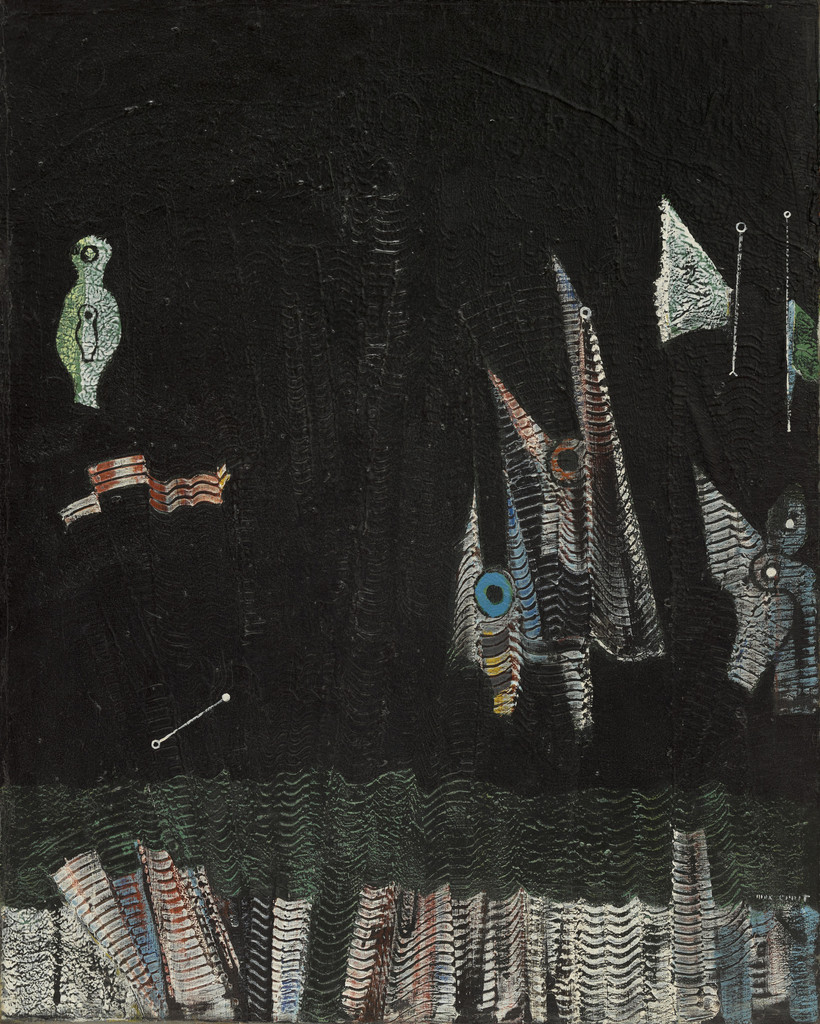
Untitled (Birds)
お目にかかれますか?
はい、お客様をお迎えしています

シカゴ美術館
展示室展示室 397シカゴ, アメリカ合衆国
一般公開されています。裏付けとなる出典は下に記しています。
- 確認
- 一昨日
- この状態になった日
- 2026年8月19日
- 出典
- 美術館自身の所蔵データ
About the painting
This work belongs to a group of paintings of birds, most of which were made between 1924 and 1920, according to Spies (Ernst Katalog/, vol. 2, 1975 pp. 381-91, nos. 728-50, ills.; vol. 3, 1976, p. 131, nos. 1044-45. ills.). Dated by Spies to 1924 (ibid., vol. 2, 1975. p. 381, no. 730, ill.), this work is especially close to Ernst's Birds, also of 1924, and Two Birds of around 1925 (ibid., vol. 2, 1975, pp. 385-86 nos. 738, 740, ills.), all three of which were given very similar cork frames by the artist. Although these works are generally thought to be executed on sandpaper, in this case at least, as Cynthia Kuniej Berry has observed, "close examination of the unframed painting reveals otherwise" (see Cynthia Kuniej Berry, Examination Report, August 27, 1993, in curatorial files).
Read on
In her report, the painting is described as "executed on a fine lightweight, plain weave linen," on which the paint was "generously applied with active brushwork in textured, opaque masses with thick impasto," while 'the remainder of the surface is covered with a thin, even layer of sand" (ibid.). Ernst indeed applied paint thickly to create the forms of the birds and then scraped through to reveal colored layers below, employing what he called his grattage technique. The ribbed flecks of brown and black paint skillfully connote feathers. The circular heads of the birds appear in many of Ernst's works from the period, such as 100,000 Doves (1926, Paris, private collection; Ernst Katalog, vol. 3, 1976, p. 121, no. 1025, ill.), in which the circular form also is transformed into an eye or a breast.
The undulation of the picture's surface seems intrinsic to the work and gives the effect of a relief, although it may have also resulted from environmental changes (see Kuniej Berry 1993 above). Ernst used similar carved cork frame, often with varying designs, in other works of the same subject (Ernst Katalog, vol. 2, 1975, pp. 385-91 nos. 738-40, 744-46, 749, 751, ills.; vol. 3, 1976, pp. 131, 136, nos. 1045, 1055, ills.).
— Entry, Dawn Ades, Surrealist Art: The Lindy and Edwin Bergman Collection at the Art Institute of Chicago, 1997, p. 126.
シカゴ美術館CC BY 4.0
作品データ
- 収蔵番号
- 2018.289
カタログ収録
出典
- シカゴ美術館: the museum's own open data · 5 日前に取得
- 画像: シカゴ美術館 — © the artist or rights holder
その頃、Max Ernstの人生では
生涯をすべて見るlate summer 1922
To Paris illegally on Éluard’s passport
At the end of summer 1922 Ernst saw his wife and son off to Cologne and left for Paris; lacking a French visa, he used Paul Éluard’s passport. For a year and a half he lived with the Éluards at Saint-Brice and then at Eaubonne, an illegal immigrant making ends meet with odd jobs.
summer 1922
A love triangle with the Éluards
Ernst spent the summer of 1922 at Tarrenz, mostly at the Éluards’ villa; Gala became his lover and a ménage à trois began.
1922
“Les malheurs des immortels” with Éluard
Éluard’s Répétitions appeared in March 1922, and the poet handed Ernst his copy in person at Düsseldorf. Together they wrote the little book Les malheurs des immortels, prose poems based on Ernst’s collages, published in a small edition at Tarrenz, where both spent the summer with their wives.
1924
To Saigon after the Éluards
In March 1924 Paul Éluard abruptly left for Monaco and then for Vietnam. To raise the fare Ernst sold paintings to the gallery owner Johanna Ey; he met Éluard and Gala in Singapore and Saigon, but Gala stayed with Paul. Ernst went on exploring South-East Asia for several more months.
1926
“Histoire naturelle”: a portfolio of frottages
At Jeanne Bucher’s press Ernst published Histoire naturelle, a portfolio of drawings in the frottage technique, with an introduction by Hans Arp.
1926
The first large show at Galerie van Leer
In 1926 the Paris gallery van Leer held Ernst’s first large exhibition; in place of a preface the catalogue printed poems by Paul Éluard, Benjamin Péret and Robert Desnos.