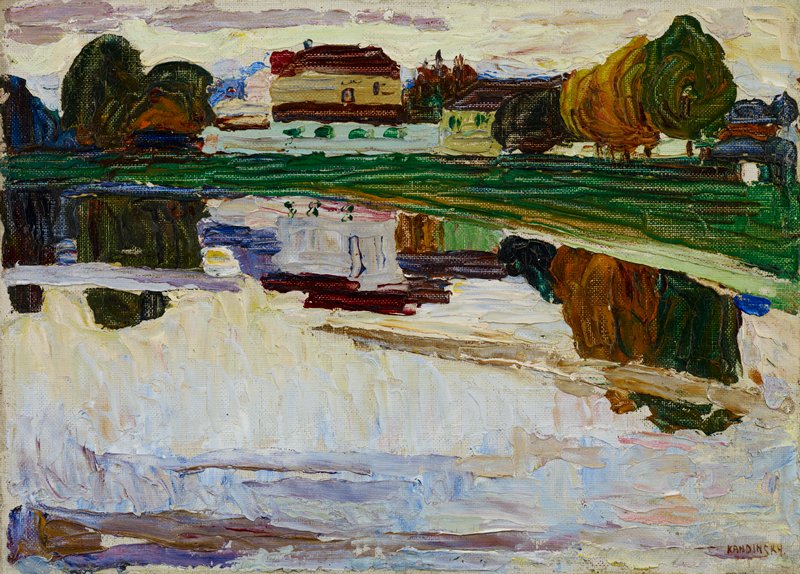
Vasily Kandinskyフランス, 1866–1944
Delicate Tension
見られますか?
不明
『Delicate Tension』は今どこに? 所蔵: ティッセン=ボルネミッサ美術館, Madrid. 不明.
Madrid, スペイン王国
所蔵者は判明していますが、現在展示中かどうかは不明です。
- この状態になった日
- 出典
- 美術館
作品データ
- 収蔵番号
- 610 (1977.77)
カタログ収録
出典
- ウィキデータ
- 画像: ティッセン=ボルネミッサ美術館 — Wassily Kandinsky · Public domain · Wikimedia Commons
その頃、Vasily Kandinskyの人生では
生涯をすべて見る1917–1921
Cultural politics in revolutionary Moscow
After the revolution Kandinsky worked actively in public life: he helped protect monuments, founded the Museum of Painterly Culture and the Russian Academy of Artistic Sciences, taught at the Vkhutemas, sat on the fine arts collegium of the People's Commissariat for Education and chaired the All-Russian purchasing commission. He also became vice-president of the RAKhN.
1918–1921
The Institute of Artistic Culture: rejected by the radicals
Kandinsky became the first director of the Institute of Artistic Culture in Moscow, but the institute's radical members judged his spiritual, expressionist view of art too individualistic and bourgeois. He painted little in these years but taught a great deal, using a programme of form and colour analysis.
1921
Leaves for Berlin
In December 1921 Kandinsky left for Berlin to set up a branch of the RAKhN there. He took part in the First Russian Art Exhibition in Germany and began teaching painting.
summer 1922
Teacher at the Bauhaus
From the summer of 1922 Kandinsky worked at the Bauhaus and became a leading theorist of the school. In the interwar years he gained worldwide recognition as one of the leaders of abstract art.
1922–1933
Employed by: Bauhaus
1923
The Blue Four
At the instigation of Galka Scheyer, Kandinsky, Paul Klee, Lyonel Feininger and Alexej von Jawlensky formed the group the Blue Four; from 1924 Scheyer promoted their work in the United States.

_MET_DP236124.jpg?width=1280)