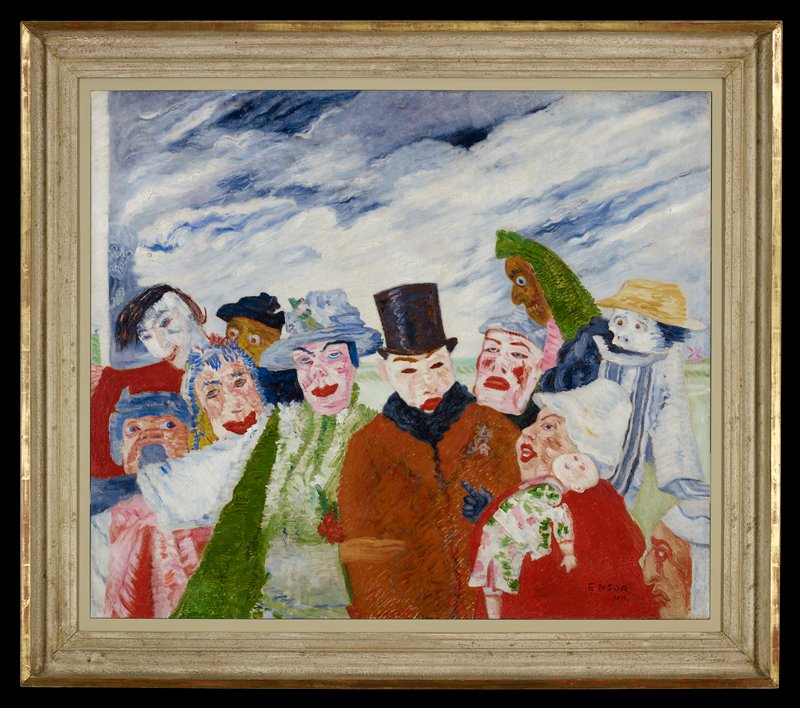
キリストのブリュッセル入城
Christ's Entry into Brussels in 1889
About the painting
James Ensor took on religion, politics, and art in this scene of Christ entering contemporary Brussels in a Mardi Gras parade. In response to the French pointillist style, Ensor used palette knives, spatulas, and both ends of his brush to put down patches of colors with expressive freedom. He made several preparatory drawings for the painting, including one in the J. Paul Getty Museum's collection. Ensor's society is a mob, threatening to trample the viewer--a crude, ugly, chaotic, dehumanized sea of masks, frauds, clowns, and caricatures. Public, historical, and allegorical figures, along with the artist's family and friends, make up the crowd. The haloed Christ at the center of the turbulence is in part a self-portrait: mostly ignored, a precarious, isolated visionary amidst the herdlike masses of modern society.
Read on
Ensor's Christ functions as a political spokesman for the poor and oppressed--a humble leader of the true religion, in opposition to the atheist social reformer Emile Littré, shown in bishop's garb holding a drum major's baton and leading on the eager, mindless crowd. After rejection by *Les XX,* the artists' association that Ensor had helped to found, the painting was not exhibited publicly until 1929. Ensor displayed *Christ's Entry* prominently in his home and studio throughout his life. With its aggressive, painterly style and merging of the public with the deeply personal, *Christ's Entry* was a forerunner of twentieth-century Expressionism.
その頃、Ensor, Jamesの人生では
生涯をすべて見る1860–1949 · 活動地
Ostend
1880s
Brief trips to France and the Netherlands
Ensor travelled very little: in the 1880s, just three brief trips to France and two to the Netherlands.
1883–1893 · 所属
Les XX
1887
Death of his father
His father, James Frederic Ensor, died — a scion of a wealthy English family who never found his footing in Belgium, mocked by small-town Ostend as a drunkard and failure, yet always supportive of his son's passion for art. Left the only man in the family, James felt a special responsibility for his younger sister Mariette (Mitche).
1888–1892
Turning-point years: the Passion of Christ
Ensor turned to religious themes, most often the torments of Christ, expressing through them his disgust at the inhumanity of the world; an atheist, he identified with Christ as a victim of mockery. At the height of his creative powers, between 1886 and 1891, he made 86 of his 133 etchings.