 Leonardo da VinciItalia, 1452–1519
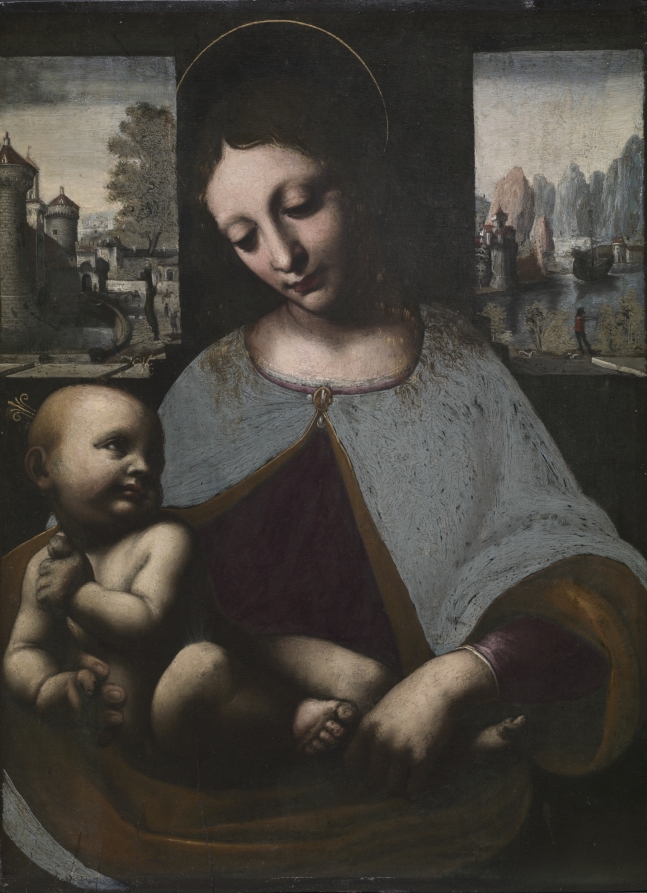
Virgin and Child
Si può ammirare?
Al momento non riceve

Cleveland Museum of Art
Cleveland, Stati Uniti
Appartiene alla collezione, ma al momento non è esposta.
- Verificato
- Ultimo cambio di stato
- Fonte
- Il museo
Sul dipinto
Madonna and Child appear in half-length, seated against a dark wall. The Child's body is covered in shadow as he looks over his shoulder at his mother. This painting was bought by James Jackson Jarves as a Leonardo. The landscape and features of the figures are similar to Leonardo's Madonna of the Rocks, and in typical Leonardesque fashion, the figures' heads incline slightly to the left. However, Virgin and Child was later attributed to a member of Leonardo's circle named Francesco Napolitano (active 1500) because of its resemblance to his Madonna and Child with St. Sebastian and St. John the Baptist in Zurich, Switzerland. Virgin and Child has not been widely accepted as a work of Napolitano; however, he was certainly a member of Leonardo's circle. The Sforzesco Castle, the seat of Milan's ruling Sforza family, appears in the background. The castle's original Torre del Filarete, visible in this painting, was destroyed by lightning in 1521 and later rebuilt by Francesco II Sforza. The destruction of the tower establishes a date of about 1500 for this painting.
Cleveland Museum of Art
Scheda
- Numero di inventario
- 1916.779
In catalogo
Fonti
- Cleveland Museum of Art
- Immagine: Cleveland Museum of Art — Museum open access
Nel frattempo, nella vita di Leonardo da Vinci
Tutta la vita1482–1500 · Luogo di lavoro
Milan
1499
The French take Milan
Milan was captured by the troops of King Louis XII of France. Leonardo left the city, and the model of the Francesco Sforza monument was badly damaged.
1500 · Residenza
Florence
1500
Back in Florence: a workshop with the Servites
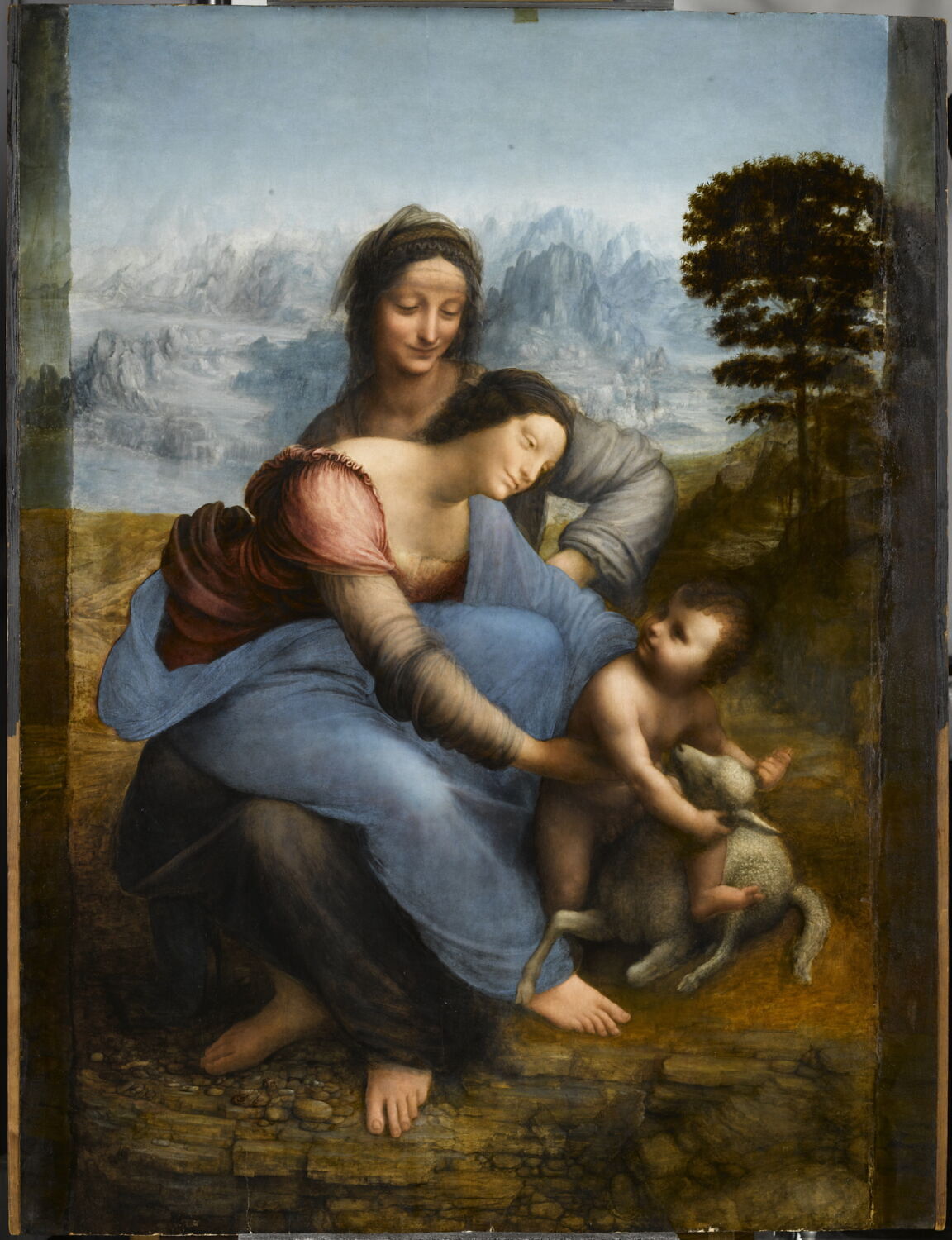
In Florence Leonardo and his household were guests of the Servite monks at Santissima Annunziata, who gave him a workshop. According to Vasari, the cartoon of the Virgin and Child with Saint Anne and Saint John the Baptist he made there won such admiration that people flocked to see it “as if they were going to a solemn festival”.
1500
Flight to Venice with Salaì and Pacioli
When Ludovico Sforza was overthrown by France, Leonardo fled Milan for Venice with his assistant Salaì and his friend the mathematician Luca Pacioli. There he worked as a military architect and engineer, devising ways to defend the city from naval attack.
1502
In the service of Cesare Borgia
In Cesena Leonardo entered the service of Cesare Borgia, son of Pope Alexander VI, travelling throughout Italy with him. To win his patronage he drew a town plan of Imola, after which Borgia made him his chief military engineer and architect.

![Wreath of Laurel, Palm, and Juniper with a Scroll inscribed Virtutem Forma Decorat [reverse], Leonardo da Vinci, c. 1474/1478](https://api.nga.gov/iiif/ff62e8d0-45c4-498f-ad36-6358de827e04/full/!2400,2400/0/default.jpg)
![Ginevra de' Benci [obverse], Leonardo da Vinci, c. 1474/1478](https://api.nga.gov/iiif/8f29e3c9-a289-4d53-abf0-31a66e9e98fa/full/!2400,2400/0/default.jpg)