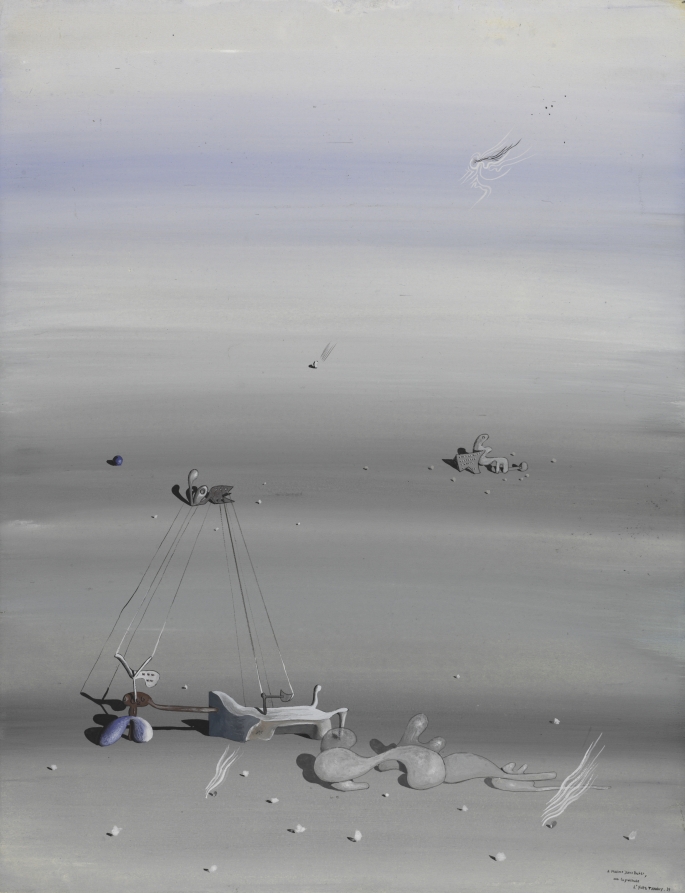
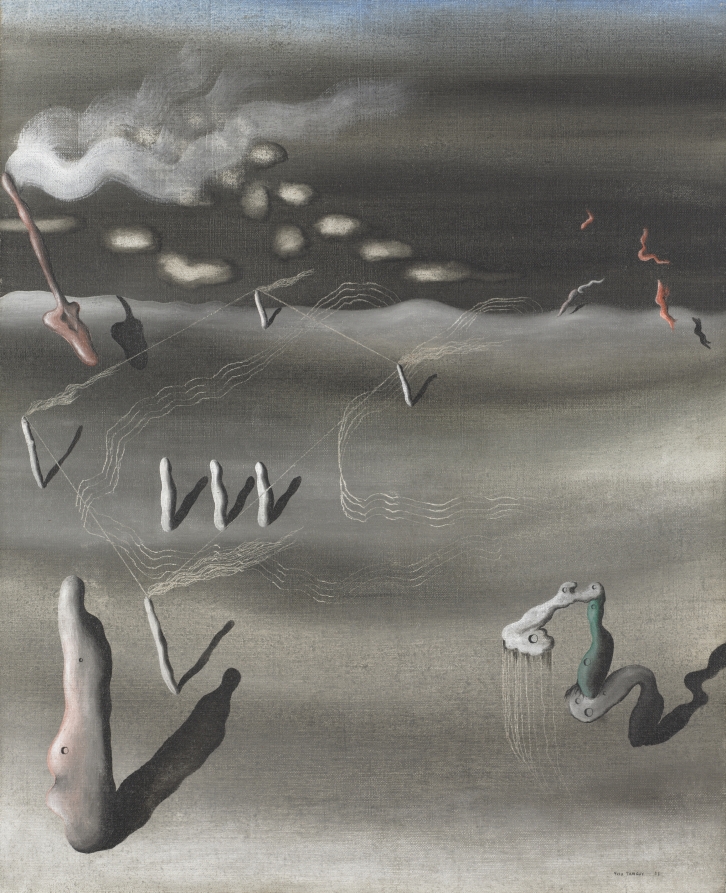
Yves Tanguy developed an interest in the surrealist movement during the early decades of the 20th century, creating vague but evocative and meticulously rendered images that suggested dreams and the subconscious. Using smoothly applied color, Tanguy painted enigmatic biomorphic forms that often suggest human or animal figures and cast dramatic shadows throughout the composition. These shapes are found in the present drawing, within a sparse setting. The gray background tones suggest underwater depths, and could relate to the artist's experience in the Merchant Navy during World War I.
He travels to London with his wife, Jeannette Ducrocq, to hang his first British retrospective at Peggy Guggenheim’s gallery, Guggenheim Jeune. The show is a great success: by Guggenheim’s own account, Tanguy found himself rich for the first time in his life, and she buys his “Toilette de l’Air” and “The Sun in Its Jewel Case” (Le Soleil dans son écrin) for her collection.
1938
Begins a relationship with Kay Sage
After seeing the work of the fellow Surrealist artist Kay Sage, he begins a relationship with her that will lead to his second marriage.
1938
An affair with Peggy Guggenheim
During the London trip with his wife, Tanguy begins an intense affair with Peggy Guggenheim, for whom he paints two earrings. The affair continues in London and Paris and ends only when he meets the woman who will become his second wife.
1939
Follows Kay Sage to New York
With the outbreak of the Second World War Sage returns to her native New York, and Tanguy, judged unfit for military service, follows her; he will spend the rest of his life in the United States. Other accounts place the move in 1940.