Vasily KandinskyFrancia, 1866–1944
Untitled
Si può ammirare?
Al momento non riceve

Art Institute of Chicago
Chicago, Stati Uniti
Appartiene alla collezione, ma al momento non è esposta.
- Verificato
- 5 ore fa
- Ultimo cambio di stato
- 19 ago 2026
- Fonte
- I dati di collezione del museo stesso
Sull’opera
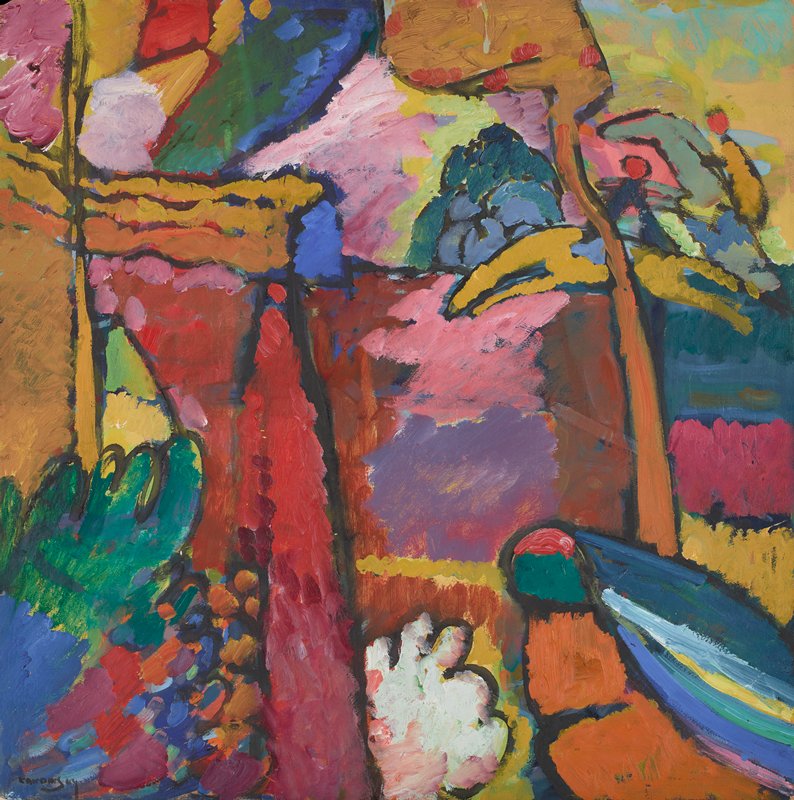
Filled with shifting forms and colors that push forward and recede, this watercolor appears completely abstract at first glance. But deeper examination reveals references to landscape, including a hilltop town illuminated by a deep red sun at upper left.
Forced by World War I to leave Germany, where he had lived since 1898, Vasily Kandinsky returned to Moscow in 1914. Restricted by limited space and financial resources, he concentrated on small-scale works primarily in watercolor, of which Untitled is a particularly fine example. It epitomizes the artist’s balance between representation and non-representation in this period.
Art Institute of ChicagoCC BY 4.0
Scheda
- Numero di inventario
- 2018.753
In catalogo
Fonti
- Art Institute of Chicago: the museum's own open data · acquisita 6 giorni fa
- Immagine: Art Institute of Chicago — © the artist or rights holder
Nel frattempo, nella vita di Vasily Kandinsky
Tutta la vita1914
The war: back to Russia via Switzerland and Sweden
The outbreak of World War I ended the Blue Rider's plans for further almanacs and exhibitions and sent Kandinsky back to Russia via Switzerland and Sweden; he returned to Moscow in 1914.
1916
The break with Münter in Stockholm
The relationship between Kandinsky and Münter worsened through mutual tension and disappointment over his reluctance to marry, and formally ended in Stockholm in 1916.
29 January 1917
Marries Nina Andreevskaya
Kandinsky, already fifty, married Nina Nikolaevna Andreevskaya, the daughter of a captain and a student of the Moscow Higher Courses for Women.
febbraio 1917
Married: Nina Nikolajewna Andreevskaja
19 November 1917
Birth of his son Vsevolod
A son, Vsevolod, was born to Kandinsky and Nina; the boy was baptized in the Neopalimovskaya church near Devichye Pole in Moscow on 7 January 1918.
1917–1921
Cultural politics in revolutionary Moscow
After the revolution Kandinsky worked actively in public life: he helped protect monuments, founded the Museum of Painterly Culture and the Russian Academy of Artistic Sciences, taught at the Vkhutemas, sat on the fine arts collegium of the People's Commissariat for Education and chaired the All-Russian purchasing commission. He also became vice-president of the RAKhN.
_MET_DP236124.jpg?width=1280)