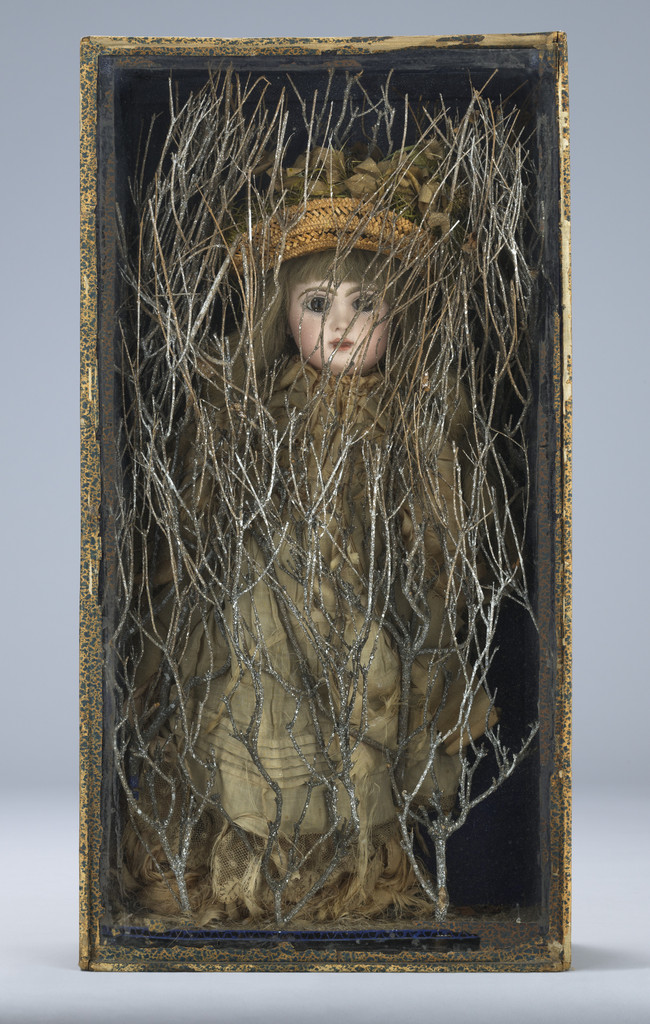
Untitled (Game)
Si può vedere?
Sì, esposta ora
Dove si trova «Untitled (Game)» oggi? Art Institute of Chicago, Sala 397, Chicago. Sì, esposta ora. Verificato 23 novembre 2026.

Chicago, Stati Uniti
Chiuso· apre alle 11:00
Esposta al pubblico.
- Verificato
- Ultimo cambio di stato
- Fonte
- Il museo
Sull’opera
In a diary entry for March 1960, Cornell pointed to the centrality of the idea of a game or toy for his boxes:
"Perhaps a definition of the box could be as a kind of 'forgotten game,' a philosophical toy of the Victorian era, with poetic or magical 'moving parts,' … that golden age of the toy alone should justify the 'box’s' existence" (Cornell Papers, AAA, reel 1060, Mar. 1960).
Leggi
Although Cornell here related the idea of the toy to the Victorian era, it was not incompatible with the notion of Surrealist object that had been an important source for him. The second time Cornell‘s works were shown by Julien Levy, in a joint exhibition with etchings by Pablo Picasso (Nov.–Dec. 1932), they were presented under a variety of headings in the exhibition announcement: “Minutiae, Glass Bells, Shadow Boxes [cutout figures and montages], Coups d’oeil, and Jouets surrealistes [Surrealist toys].” Levy thus recognized, in the very multiplicity of these categories, that Cornell’s constructions were not easily classified under conventional labels, and acknowledged the toy as an important reference.
The notion of the “Surrealist toy” may be understood as one of Cornell‘s responses to the complex and elastic idea of the Surrealist object. A toy or game normally involves movement in the object and the active participation of the player (s). In addition to the early puzzle boxes and the optical and kinetic games with which Cornell tinkered, there are two Surrealist sources for the game boxes. One is the Surrealist object as conceived by Salvador Dalí in 1931 (see Salvador Dalí, “Objects surrealistes,”Le Surrealisme au service de La revolution 3 [Dec. 1931]); the other is found in Marcel Duchamp’s work.
The immediate inspiration for Dali’s type of object was Alberto Giacometti’s Suspended Ball (1930–31; Yves Bonnefoy, Alberto Giacomelli: A Biography of His Work, Paris, 1991, pl. 176), the difference between this and the Surrealist object with symbolic function being that the latter was to be constructed of ready-made, found materials, rather than traditional sculptural ones. Cornell was certainly aware of Giacometti’s Suspended Ball by the time he made his construction Ball and Book in 1934 (Art of this Century, New York 1942, exh. cat., p. 149; and New York, 1980–82, no. 63, ill.), but unlike Giacometti he significantly refrained in his construction from any erotic over tones. He seems to have felt more kinship with the readymades and “readymades aides” (assisted readymades) of Duchamp.
Duchamp was the first person literally to introduce movement into his work in his Bicycle Wheel of 1913 (original lost; Pontus Hulten, ed., Marcel Duchamp: Work and Life, Cambridge, Mass., 1993, p. 30, ill.), but more relevant to Cornell’s work are Duchamp’s With Hidden Noise (1916)—the first object to incorporate noise as an element—and Why Not Sneeze Rrose Selavy (1921, both in the Philadelphia Museum of Art; Hulten 1993, pp. 63, 79, ills.). The secretive character of the former would certainly have appealed to him. Duchamp’s With Hidden Noise, enigmatic as it is, looks however like a machine part forgotten on a factory floor, its invisible, rattling innards the result of a random oversight; Cornell’s game boxes resemble in stead toys long relegated to the attic, the noise generated by rolling ball rattling counter clearly part of their original function as games, whose rules or objectives have long since been forgotten.
Although this particular game box invites handling, its orientation is uncertain. It was reproduced horizontally in the catalogue for The Museum of Modern Art’s Cornell retrospective (New York 1980–82, no. 185, ill.), but it is currently installed at the Art Institute in a vertical position. Positioned vertically, it resembles certain Sand-Fountain Boxes.
— Entry, Dawn Ades, Surrealist Art: The Lindy and Edwin Bergman Collection at the Art Institute of Chicago, 1997, p. 43-44.
Art Institute of ChicagoCC BY 4.0
Scheda
- Numero di inventario
- 1982.1842
In catalogo
Fonti
- Art Institute of Chicago
- Immagine: Art Institute of Chicago — © the artist or rights holder