
 Théodore GéricaultFrancia, 1791–1824
The White Horse Tavern
Si può vedere?
Sì, esposta ora
Dove si trova «The White Horse Tavern» oggi? Harvard Art Museums, Gallery 2200, floor 2, European and American Art, 17th–19th century, Cambridge. Sì, esposta ora. Verificato 29 settembre 2026.

Cambridge, Stati Uniti
Sala2200, floor 2, European and American Art, 17th–19th century
Esposta al pubblico.
- Verificato
- Ultimo cambio di stato
- Fonte
- Il museo
Sul dipinto
Discouraged by what he believed to be the conservative tastes of the French art establishment, Géricault traveled to England and exhibited his work in London in 1820–21. Received with critical acclaim, he engaged with the local manner, which included an embrace of naturalistic compositions and a more muted palette. Here he depicts a weary uniformed postman receiving a drink from a waiter outside a roadside inn. He focuses attention on the horses, contrasting their detailed muscular frames with the summarily rendered figures and landscape. The inn’s sign, which translates as “White Horse” even though a black one is illustrated, locates the scene in France, possibly outside Paris, explicitly alluding to Géricault’s mingling of British painting conventions and a French context.
Harvard Art Museums
Scheda
- Numero di inventario
- 1943.244
In catalogo
Fonti
- Harvard Art Museums
- Immagine: Harvard Art Museums — © President and Fellows of Harvard College
Nella vita di Théodore Géricault
Tutta la vitac. 1818 – 1819
Delacroix poses for a dying figure
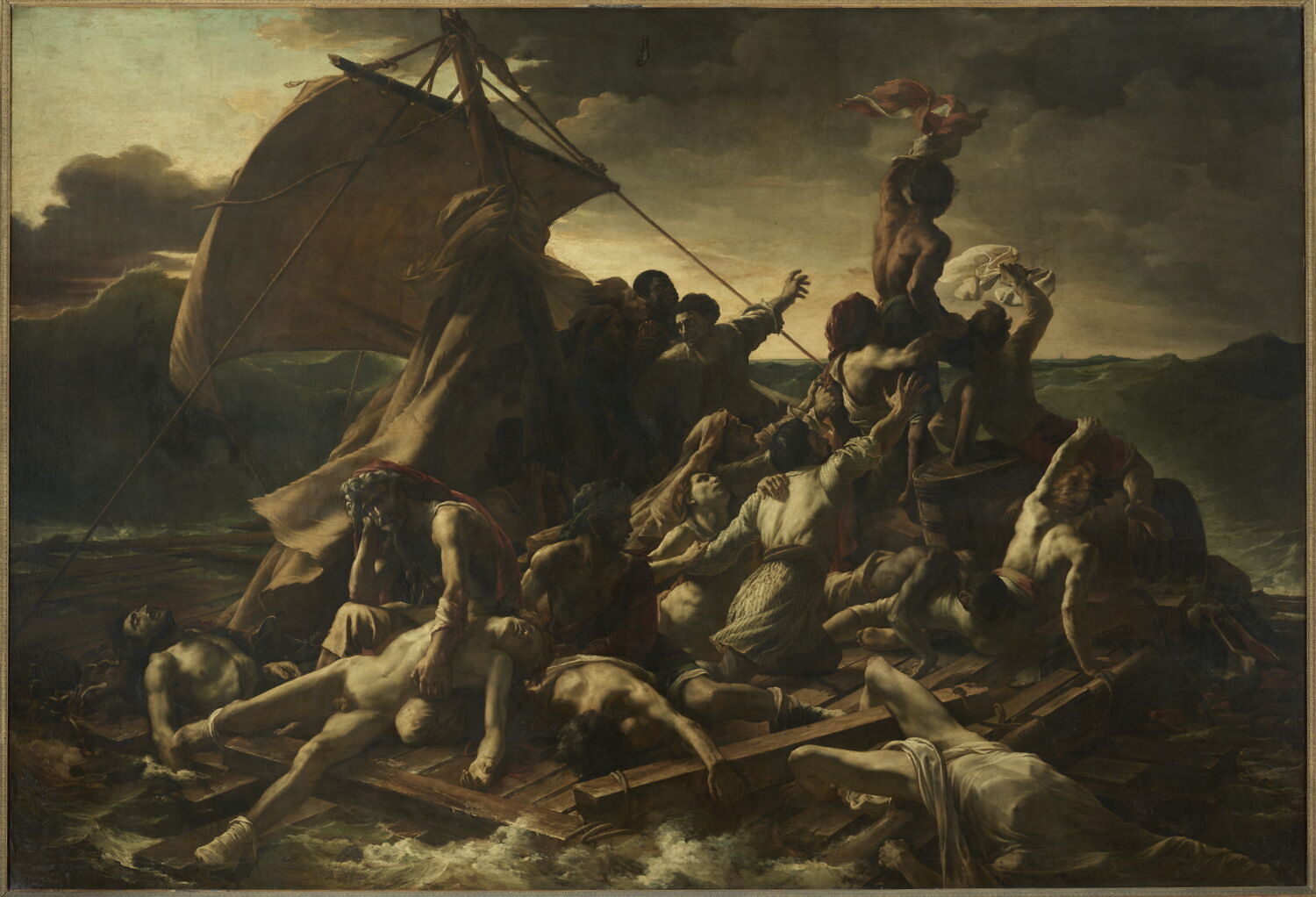
The painter Eugène Delacroix posed for one of the dying figures in “The Raft of the Medusa”.
1819
“The Raft of the Medusa” sparks a political controversy at the Salon
When first exhibited at the Paris Salon of 1819, “The Raft of the Medusa” ignited political controversy: it indicted a corrupt establishment, in which the captain had left the crew and passengers to die, but also dramatized the eternal struggle of man against nature.
12 June – 30 December 1820
London: 50,000 visitors and 20,000 francs
The entrepreneur Bullock exhibited “The Raft of the Medusa” in London from 12 June to 30 December 1820; about 50,000 people saw it, critics called it a masterpiece, and its author was compared to Michelangelo and Caravaggio. Géricault was entitled to a third of the ticket receipts and received 20,000 francs.
1821–1824
Illness and falls from horses after his return from England
After returning to Paris from England Géricault was often ill, and his condition was made worse by several falls during horseback rides.
1824
Tuberculosis and a long period of suffering before his death
Weakened by riding accidents and a chronic tubercular infection, Géricault died in Paris in 1824 after a long period of suffering.
26 gennaio 1824
Died




![[Tah-Col-o-Quoit (Rising Cloud)], Asakiwaki/Sauk Warrior; representative of the Sauk and Fox coalition, Henry Inman, c. 1832-1834](https://nrs.harvard.edu/urn-3:HUAM:787793/full/!2400,2400/0/default.jpg)
