 Antonio CanovaItalia, 1757–1822
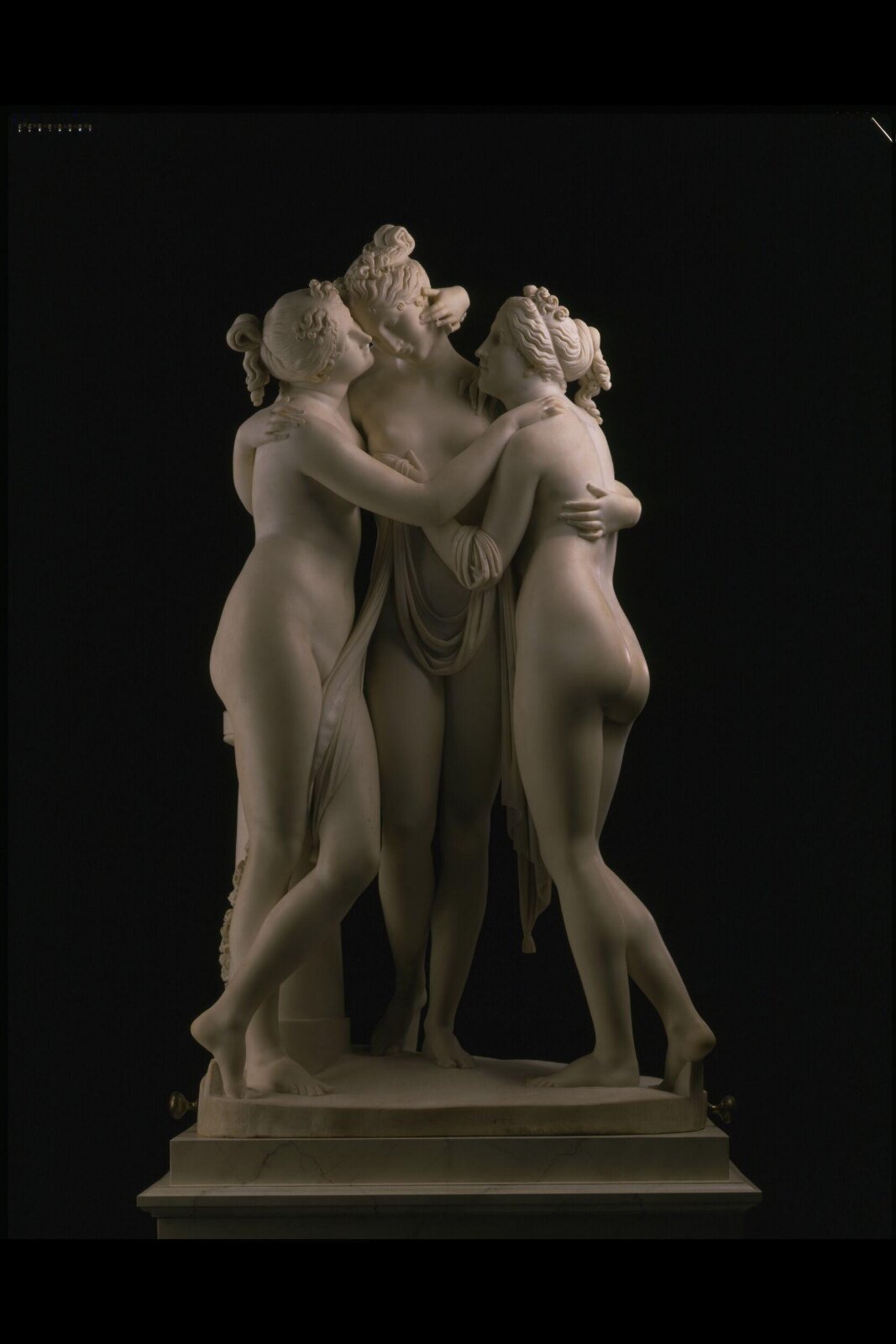
The Three Graces
Si può ammirare?
Non si sa: il museo mantiene il riserbo

Victoria and Albert Museum
Londra, Regno Unito
Il proprietario è noto. Se oggi sia esposta, il museo non lo dice, e a indovinare non ci hanno insegnato.
- Ultimo cambio di stato
- 25 set 2026
- Fonte
- I dati di collezione del museo stesso
About the sculpture
Object Type
Read on
This marble figure group was made for the Sculpture Gallery at Woburn Abbey, Bedfordshire, and was originally housed in a specially designed Temple of the Graces. It was commissioned from Antonio Canova (1757-1822) by John Russell, 6th Duke of Bedford, who visited the sculptor in his studio in Rome in 1814, and was captivated by the group of the Three Graces which Canova had carved for the Empress Josephine, the estranged wife of Napoleon Bonaparte. She had died in May of that year, and the Duke offered to buy the group from Canova, but Josephine's son claimed it, and that version is now in the Hermitage, St Petersburg. The Duke commissioned a second version from Canova; this was begun in 1814, finished in 1817, and installed at Woburn in 1819. It cost 6,000 zechinni, equivalent to £3000. Canova came over to England to supervise the installation. In the Temple it was displayed on a pedestal adapted from an earlier marble plinth, with a rotating top.
Subject Depicted
The Three Graces, celebrated in classical literature and art, were the daughters of Jupiter (or Zeus in Greek mythology), and companions to the Muses. Thalia (youth and beauty) is accompanied by Euphrosyne (mirth), and Aglaia (elegance). Canova had first depicted the Graces in a painting of 1799, and other drawings and a relief of the subject are also known to have been executed by him at around the same time. In 1810 he modelled a terracotta sketch (Musée de Lyon, France), and in 1812 the Empress Josephine ordered a full-size marble.
Materials & Making
Canova's marble group is based ultimately on his earlier drawings of the subject, and a closely comparable terracotta sketch model (see above). The immediate model for the marble used in the studio was the full-size plaster group, which still exists in the Canova Museum at Possagno, Italy. This has points on it which were used to transfer the composition from the plaster to the marble.
Canova was responsible for the original design of the group, but his assistants would roughly block out the marble. The sculptor himself completed the final carving, and ensured the surface of the stone was finished in such a way as to suggest the soft flesh of the figures and the harmonious relationships between the three heads, for example. The slightly earlier version, now in St Petersburg and similarly supervised by the sculptor though differing in some details, exhibits a high quality of carving. Copies were made in marble during the 19th century after the sculptor's death; these however do not exhibit the same sensitive handling of the marble.
Victoria and Albert Museum
Scheda
- Numero di inventario
- A.4-1994
What it shows
In catalogo
Fonti
- Victoria and Albert Museum: the museum's own open data · acquisita 5 giorni fa
- Immagine: Victoria and Albert Museum — © Victoria and Albert Museum, London
Nel frattempo, nella vita di Antonio Canova
Tutta la vita1791–1818
Honorary member of many academies in Europe and America
Canova was elected an honorary member of many academies: Florence (1791), Stockholm (1796), Verona (1803), Venice (1804), Siena (1805), Lucca (1806), St Petersburg (1804), Geneva (1804), Denmark (1805), Graz (1812), Marseille (1813), Monaco (1814), New York (1817), Antwerp and Vilnius (1818), and also Philadelphia.
1815
Mission to Paris: bringing back the looted masterpieces
In 1815 Pope Pius VII named Canova his Minister Plenipotentiary and tasked him with recovering works of art that Napoleon had taken to Paris. At the Louvre he met resistance from its director Vivant Denon and, because of the works’ size or unclear whereabouts, was forced to leave major pieces behind, among them Veronese’s “The Wedding at Cana”.
1815
London: Haydon and the Elgin Marbles
In 1815 Canova visited London and met Benjamin Haydon; it was on Canova’s advice that the British Museum acquired the Elgin Marbles, with plaster copies sent to Florence at his request.
1816
Marquis of Ischia and the “Golden Book”
Returning to Rome in 1816 with some of the art Napoleon had taken, Canova was rewarded by the Pope with the title of Marquis of Ischia, inscription in the “Golden Book of Roman Nobles” (the Pope entered his name with his own hands) and an annual pension of 3,000 crowns.
1816
First president of the Pontifical Roman Archaeological Academy
In 1816 Canova was appointed the first president of the newly founded Pontifical Roman Archaeological Academy.
11 July 1819
Lays the foundation stone of his own temple in Possagno
After his 1814 proposal for a statue of Religion in St Peter’s was rejected, Canova resolved to build his own temple: he designed and financed the building himself and partly built it, combining the Parthenon and the Pantheon. On 11 July 1819 he laid the foundation stone, dressed in a red papal uniform and wearing all his medals, and afterwards visited Possagno every autumn to direct the workmen.