Frederic RemingtonStati Uniti, 1861–1909
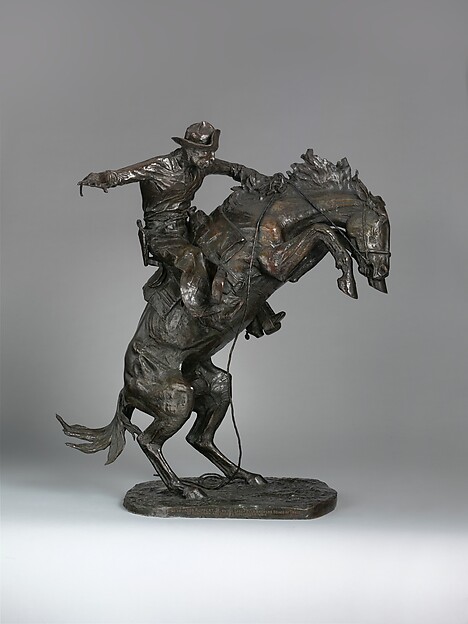
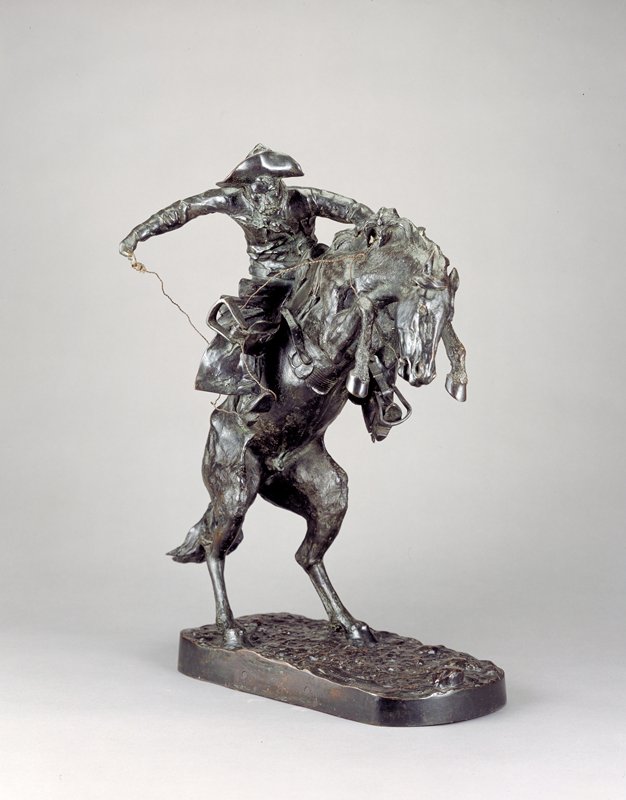
The Broncho Buster (cast #86)
Si può vedere?
Non si sa
Dove si trova «The Broncho Buster (cast #86)» oggi? Collezione: Smithsonian American Art Museum, Washington. Non si sa.

Washington, Stati Uniti
Il proprietario è noto; non si sa se oggi sia esposta.
- Ultimo cambio di stato
- Fonte
- Il museo
Sulla scultura
A version of this sculpture has appeared in the White House Oval Office throughout numerous presidential terms.
Smithsonian American Art Museum
Scheda
- Numero di inventario
- 2005.23.2
Che cosa raffigura
In catalogo
Fonti
- Smithsonian American Art Museum
- Immagine: Smithsonian American Art Museum — CC0
Nella vita di Frederic Remington
Tutta la vitaSeptember 1893
“The Evolution of the Cowpuncher” with Owen Wister
In September 1893 Harper’s Monthly publishes “The Evolution of the Cowpuncher”, Remington’s collaboration with Owen Wister — the first statement of the mythical cowboy in American literature, which spawned the whole genre of Western fiction, films and theatre that followed. Remington supplied the concept, the factual content and the illustrations; Wister supplied the stories, sometimes altering Remington’s ideas.
1897
To Cuba as a correspondent for Hearst's paper
His association with Roosevelt, then New York City Police Commissioner, pays off: the artist is hired as a war correspondent and illustrator for William Randolph Hearst's New York Journal and sent to Cuba with the celebrity journalist Richard Harding Davis. Cuba's apparent peacefulness leaves them nothing to report; in a famous but probably apocryphal exchange of telegrams, Remington says there will be no war and he wishes to return, and Hearst replies that the artist should furnish the pictures and he will furnish the war. Remington returns to New Rochelle while Davis remains.
1898
At war in Cuba: a heroic image shattered
As the Spanish–American War takes shape, he returns to Cuba to see military action for the first time and goes through the most wrenching, disillusioning experience of his life. Witnessing the assault on San Juan Hill by American forces, including those led by Roosevelt, he sees his heroic conception of war shattered by the actual horror of jungle fighting and the deprivations of camp. His reports and illustrations on his return focus not on heroic generals but on the troops.
1900
Harper's drops him; he writes a novel
As an economy move, Harper's drops Remington as its star artist. To compensate for the lost work he writes and illustrates a full-length novel, The Way of an Indian, intended for serialization by a Hearst publication; his protagonist, a Cheyenne named Fire Eater, is a prototype Native American as viewed by Remington and many of his time.
after 1902
Decides to give up writing and illustration
After “John Ermine” Remington decides he will soon quit writing and illustrating — he has drawn over 2,700 illustrations — to focus on sculpture and painting.
26 dicembre 1909
Died