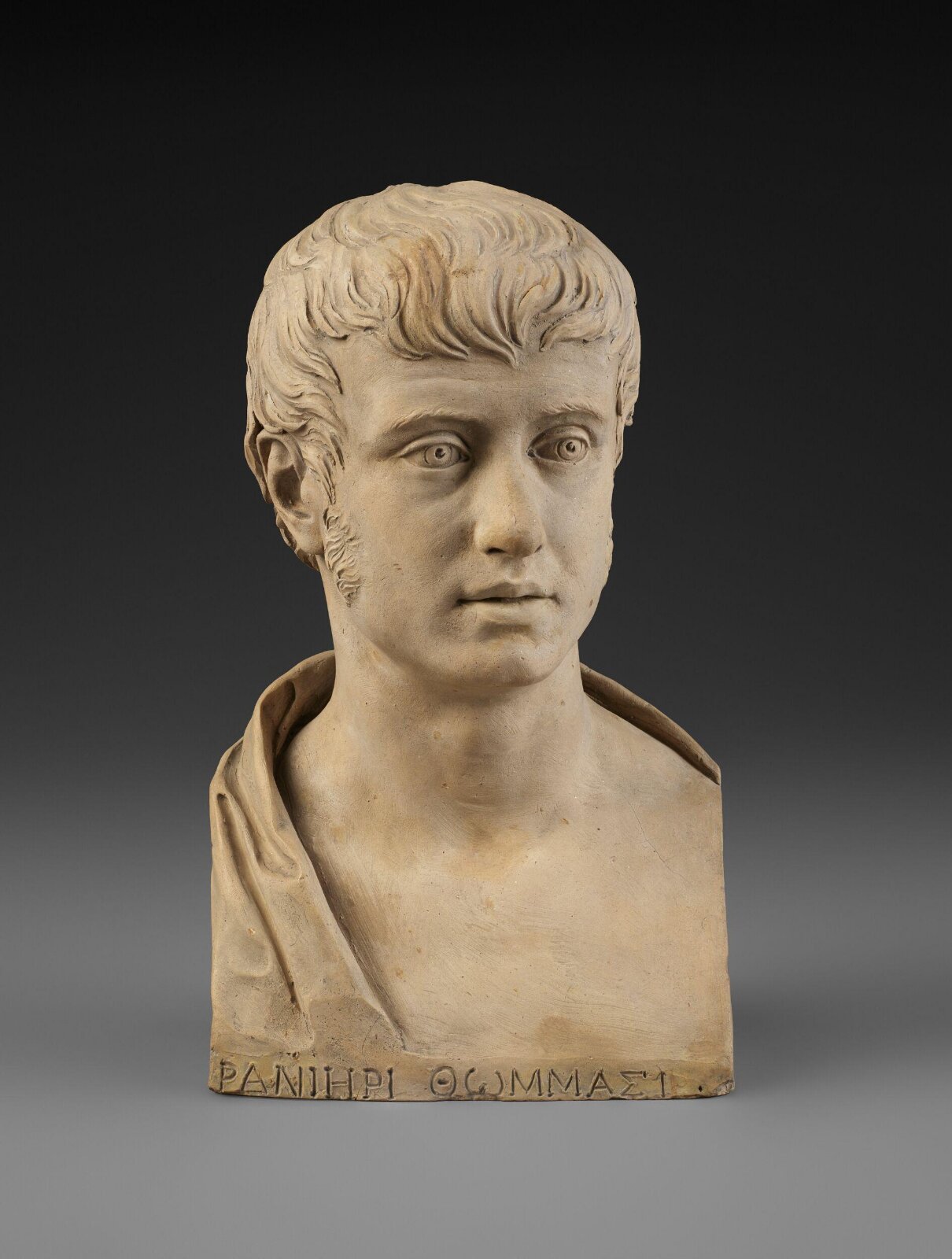
Ranieri Tommasi
Si può vedere?
Sì, esposta ora
Dove si trova «Ranieri Tommasi» oggi? Victoria and Albert Museum, Sculpture, Room 111, The Gilbert Bayes Gallery, Londra. Sì, esposta ora. Verificato 25 settembre 2026.

Chiuso· apre alle 10:00
Esposta al pubblico.
- Verificato
- Ultimo cambio di stato
- Fonte
- Il museo
Sulla scultura
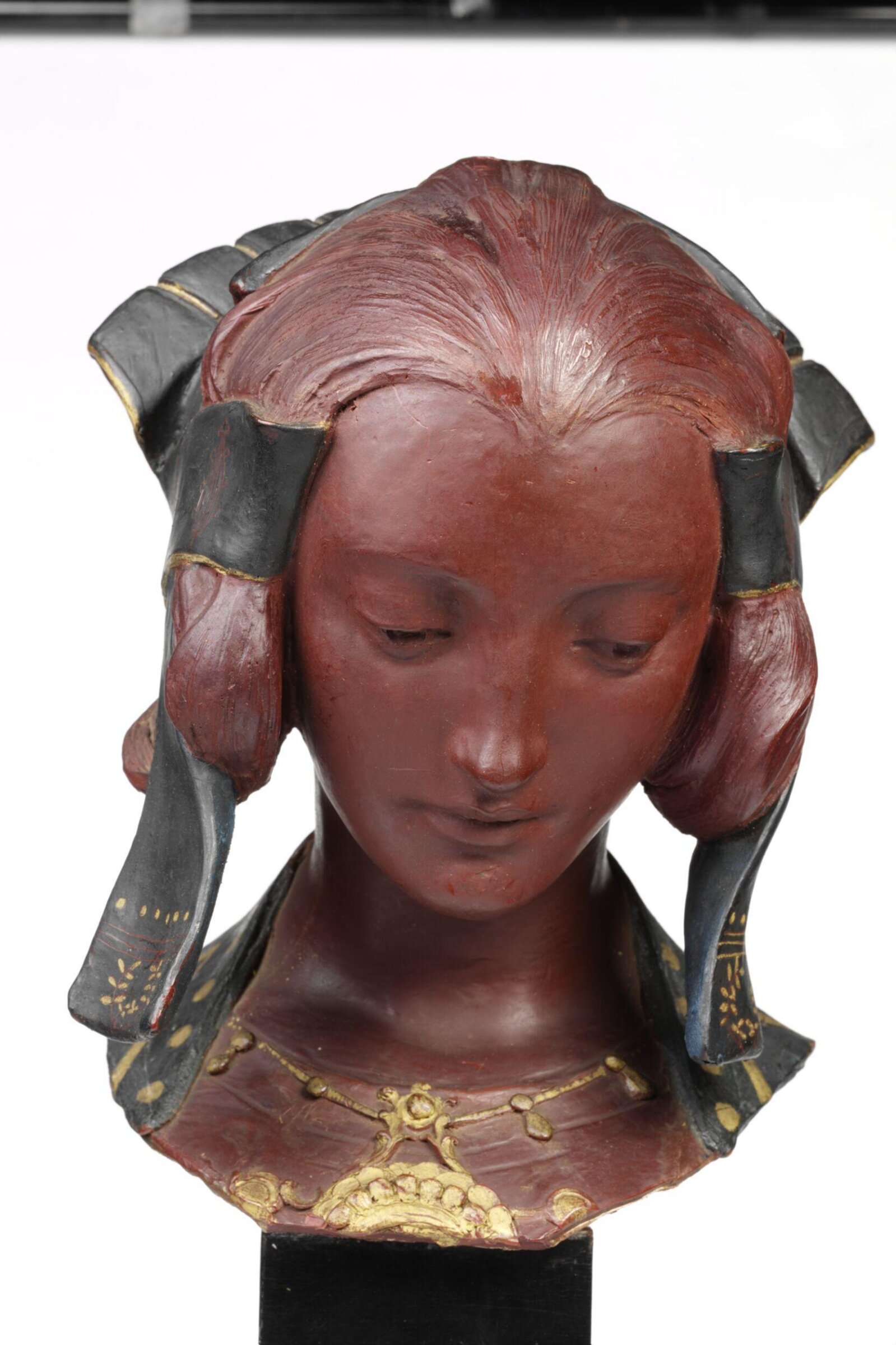
This fine terracotta bust, about half life-size (h. 27 cm.) portrays Ranieri Tommasi, a member of an aristocratic family of Cortona in Central Italy. The sitter is shown looking forward, with an alert facial expression, clean-shaven, slightly curly hair and side-burns, with the suggestion of a toga around his shoulders. The bust is truncated as a herm, which is inscribed in Greek lettering on the front with the sitter’s name. On the right side is the artist’s signature and date: ‘M. VAN-LINT/ F.A. 1801’. The naturalism of the sculpture is balanced by its classical restraint and overall form. The working of the surface of the terracotta is evident, for instance in the rendering of the incised pupils of the eyes, and the suggestion of lines on the forehead. The Adam’s apple on the throat is visible, and the hair is naturalistically modelled, while at the same time the bare chest and hint of drapery recall antique forms. Similarly, the use of ancient Greek for the inscription of the name reminds us of the sitter’s classical inclinations.
Leggi
Tommasi evidently formed part of an enlightened group of individuals in Cortona. An earlier member of his family of the same name belonged to the Accademia Etrusca, a learned society, established there in 1727. Michele Enrico van Lint (b. Rome 1767- d. after 1814) came from a dynasty of artists originally heralding from Antwerp; his father was a silversmith; Michele himself was born in Rome, where he lived until 1792. Thereafter he was based in Tuscany, active in both Cortona and Pisa. The style of this piece is a confluence of the eighteenth-century tradition of terracotta sculpture in Flanders, while the neo-classical handling of the material seen in the work of the French artist Joseph Chinard, or van Lint’s contemporary in Rome, Antonio Canova.
Victoria and Albert Museum
Scheda
- Numero di inventario
- A.1-2017
In catalogo
Fonti
- Victoria and Albert Museum
- Immagine: Victoria and Albert Museum — © Victoria and Albert Museum, London