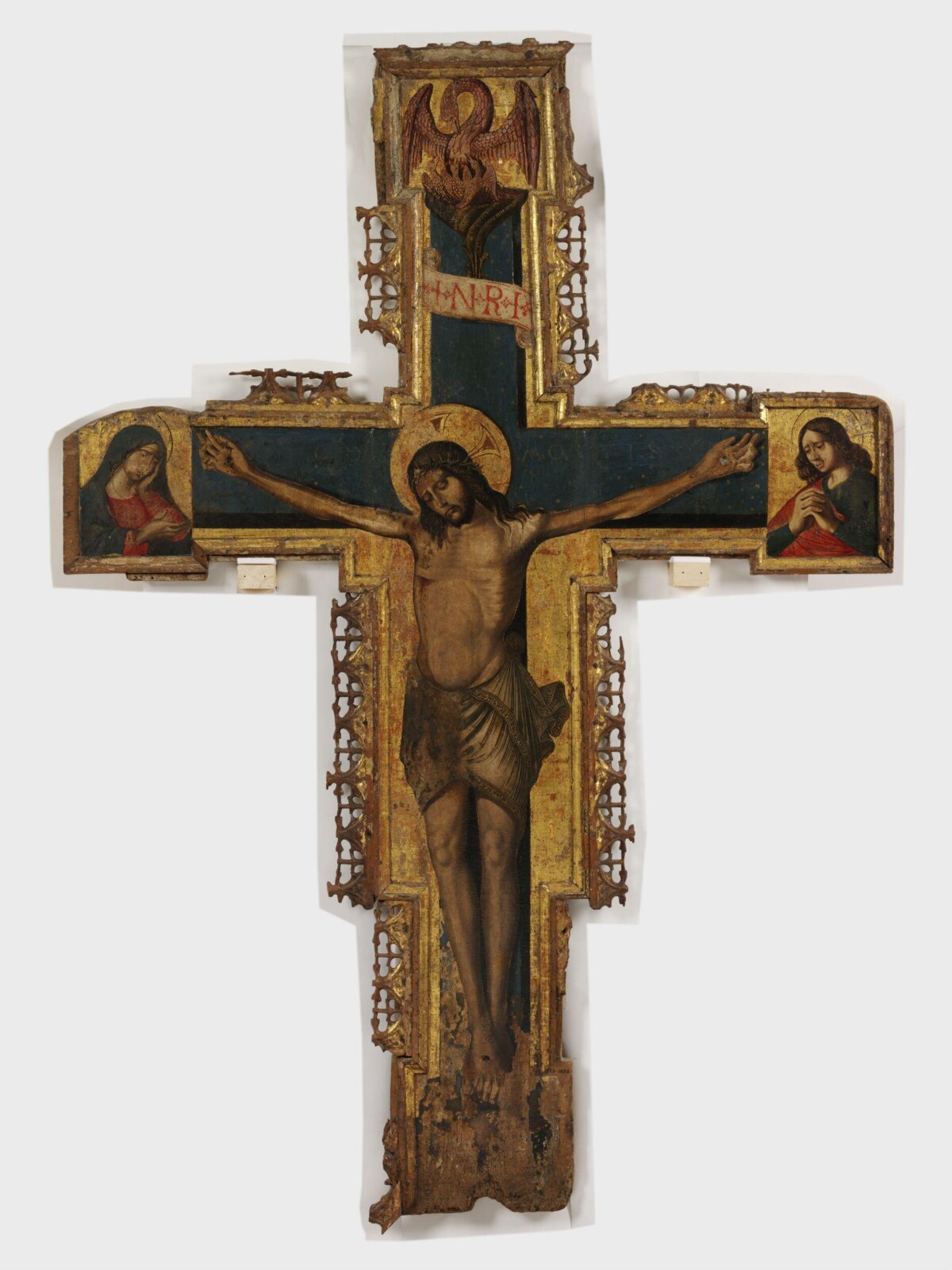
Painted Crucifix
Si può vedere?
Sì, esposta ora
Dove si trova «Painted Crucifix» oggi? Victoria and Albert Museum, Medieval & Renaissance, Room 50b, The Paul and Jill Ruddock Gallery, Londra. Sì, esposta ora. Verificato 25 settembre 2026.

Londra, Regno Unito
SalaMedieval & Renaissance, Room 50b, The Paul and Jill Ruddock Gallery
Aperto· fino alle 22:00
Esposta al pubblico.
- Verificato
- Ultimo cambio di stato
- Fonte
- Il museo
Sul dipinto
Antonio de Saliba (?1466/7 -?1535) nephew of the famous Antonello da Messina (c. 1430-1479), worked primarily in Sicily. Stylistic evidence and the presence of works associated with him in and around Venice suggest however that he also spent some time in the north of Italy. His paintings flaunt their debt to his uncle's style and also incorporate elements introduced by Giovanni Bellini, Cima da Conegliano and Bartolommeo Montagna. Antonio produced numerous paintings for provincial churches, and the majority consist of modernized reworkings of Antonello's prototypes.
Painted Crucifix' such as this were commonly either placed behind the altar or suspended from the chancel arch. The iconography of the Crucifix was dominated by theological expressions of the incarnation and resurrection.
Leggi
On the terminals of 323-1895, Mary and St John each convey a different reaction to and express their grief at Christ's Crucifixion. They are exectued in a style close to that of Antonello. At the top of the crucifix, a pelican pecks at her breast to feed her young with her own blood; a symbol of the sacrifice of Christ on the cross whose body and blood similarly nourishes the celebrant during Mass.
Victoria and Albert Museum
Scheda
- Numero di inventario
- 323-1895
Che cosa raffigura
In catalogo
Fonti
- Victoria and Albert Museum
- Immagine: Victoria and Albert Museum — © Victoria and Albert Museum, London