Amedeo ModiglianiItalia, 1884–1920
Madam Pompadour
Si può ammirare?
Sì, riceve visite

Art Institute of Chicago
Sala391Chicago, Stati Uniti
Esposta al pubblico. Chi lo garantisce è indicato qui sotto.
- Verificato
- Ultimo cambio di stato
- Fonte
- I dati di collezione del museo stesso
About the painting
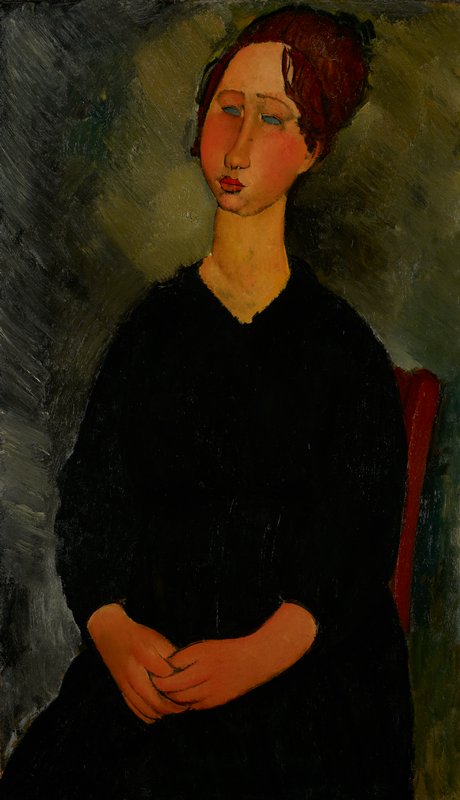
Madame Pompadour è un dipinto a olio su tela (61x50 cm) realizzato nel 1915 dal pittore italiano Amedeo Modigliani conservato nell'Art Institute of Chicago.
La donna ritratta è Beatrice Hastings con la quale Modigliani ebbe una relazione sentimentale. Fu esposto per la prima volta nel 1916 nella mostra organizzata dai pittori Moïse Kisling e Manuel Ortiz de Zárate nell'atelier di Émile Lejeune. Il dipinto mostra parecchie influenze dal cubismo anche se attenuate dai colori sobri e di ridotta varietà cromatica. Il soprannome "Madame Pompadour" fu dato in quanto al pari della nota favorita di Luigi XV la Hastings indossava di frequente cappelli di grandi dimensioni.
In the museum's words
Born of Jewish parents in the Italian coastal town of Leghorn, Amedeo Modigliani settled in Paris in 1906, where he developed friendships with Pablo Picasso , the poet Max Jacob, the sculptor Constantin Brancusi, and other members of the literary and artistic avant-garde, many of whom appear in his portraits. He led a notoriously bohemian life, shortened by a self-destructive use of alcohol and drugs. Modigliani produced his finest paintings between 1914 and his premature death in 1920. Within a limited range of subjects, mainly portraits and nudes, he developed a highly distinctive style of sensitively elongated forms.
Read on
In this portrait, Modigliani's emphasis is on a strong formal structure dominated by the grid in the background and the echoing curves of the sitter's hat, shoulders, and features. There is none of the pathos often associated with his work. The artist seems instead to have invested this portrait with a note of ironic detachment, even humor, reflected in both the title of the painting (which refers to Madame de Pompadour, mistress of King Louis XV of France) and the expression of amused inscrutability worn by the sitter. Were painter and sitter perhaps both amused by the flamboyant hat? Modigliani's skill in rhyming forms, while at the same time keeping us visually interested and slightly off-balance, is evident throughout the picture, which resonates with the lessons of Paul Cezanne, Cubism, and African sculpture.
The sitter for this portrait may well have been Beatrice Hastings, an English poetess who was Modigliani's mistress at the time. Because of the artist's tendency to generalize his sitter's features, however, a comparison of this portrait with others of Hastings is inconclusive.
—Entry, Margherita Andreotti, Art Institute of Chicago Museum Studies, Vol. 20, No. 2, The Joseph Winterbotham Collection at The Art Institute of Chicago (1994), p. 150-151.
This is one of thirty-five works that comprise the Winterbotham Collection. Click here to learn more about the collection.
Art Institute of ChicagoCC BY 4.0
Scheda
- Numero di inventario
- 1938.217
What it shows
In catalogo
Fonti
- Art Institute of Chicago: the museum's own open data · acquisita 7 giorni fa
- Immagine: Art Institute of Chicago — CC0
Nel frattempo, nella vita di Amedeo Modigliani
Tutta la vitaby 1914
Gives up sculpture for painting
By 1914 Modigliani abandons sculpting and focuses solely on painting, a move precipitated by the difficulty of acquiring sculptural materials once the war breaks out, and by his physical debilitation.
1914
Paul Guillaume replaces Paul Alexandre
Paul Alexandre, called up into the army, terminates his contract with the artist, and Modigliani’s new patron becomes the gallery owner and collector Paul Guillaume, who exhibits his work in his gallery.
June 1914
Beatrice Hastings
Modigliani meets the talented and eccentric Englishwoman Beatrice Hastings, a poet and columnist for The New Age, who becomes his companion, muse and favourite model: he devotes 14 portraits to her. The relationship lasts about two years.
1916
Léopold Zborowski, friend and dealer
Modigliani befriends the Polish poet and art dealer Léopold Zborowski and his wife Anna; in the artist’s final years Zborowski is his primary dealer and friend. He lends Modigliani his apartment, supplies models and painting materials, and pays him between fifteen and twenty francs a day.
spring 1917
Meets Jeanne Hébuterne
In the spring of 1917 the Ukrainian sculptor Chana Orloff introduces Modigliani to a 19-year-old art student, Jeanne Hébuterne, who has posed for Foujita. Her conservative, devoutly Catholic family renounces her for her liaison with a Jew, but she soon lives with Modigliani anyway and becomes a principal subject of his art.
3 December 1917
His first solo exhibition — and the police
An exhibition of Modigliani’s nudes opens at Berthe Weill’s gallery in Paris, his first solo show in the city. The gallery stands opposite a police station, and the officers, outraged by the nudes, force the show to close on its opening day.