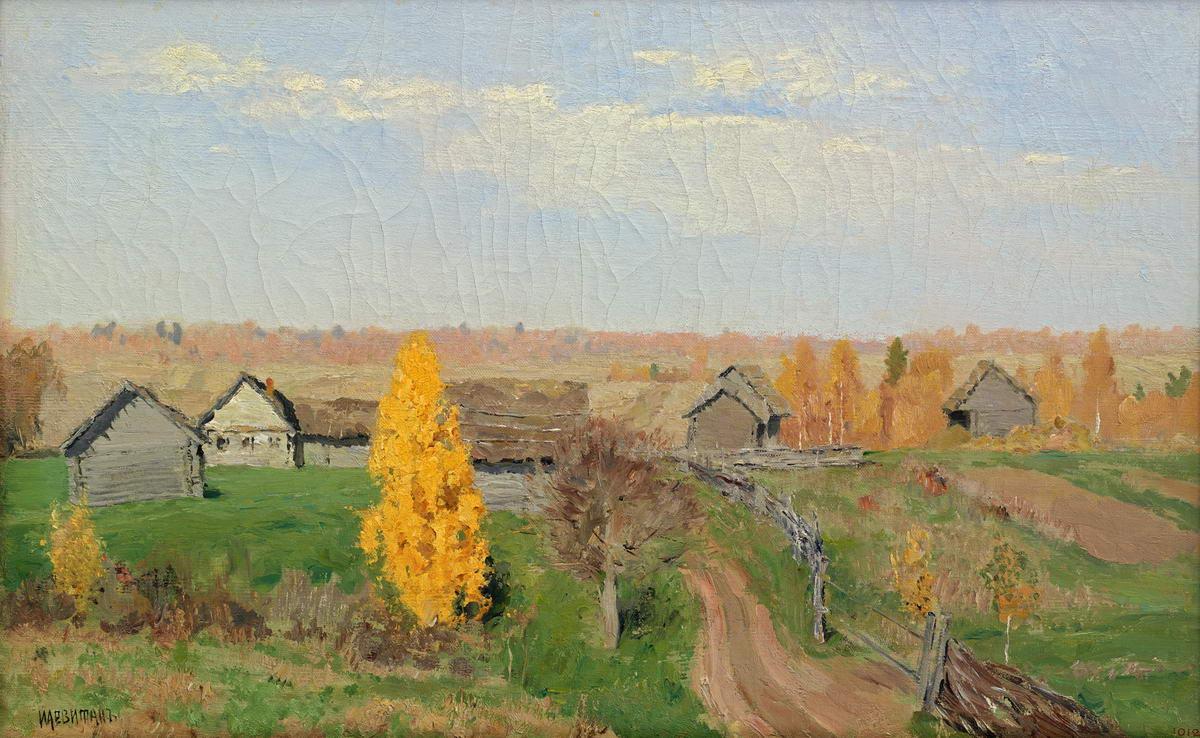
Isaac Levitan1860–1900
Летний день
Si può ammirare?
Non si sa
Abramcevo
Abramcevo, Russia
Il proprietario è noto; non si sa se oggi sia esposta.
- Ultimo cambio di stato
- Fonte
- Il museo
Sul dipinto
Con le parole del museo — in russo
Пейзаж. Этюд. Поляна, покрытая светло-зеленой травой с красноватыми пятнами. На первом плане несколько темных кустиков. Слева поляну замыкает полоса леса. На горизонте цепочка деревьев. Горизонт низкий. Небо светло-голубое с кучевыми облаками. Подписи нет.
Abramcevo
Scheda
- Numero di inventario
- Ж 313
Nel frattempo, nella vita di Isaac Levitan
Tutta la vita1879
Expelled from Moscow after the attempt on the tsar
After Alexander Soloviev's attempt on Alexander II (2 April), a decree is issued forbidding Jews to live in Moscow, and the eighteen-year-old Levitan is expelled; for the next couple of years he lives with his brother, sister and brother-in-law in a small dacha at Saltykovka near Balashikha. A year later, with the money from the sale of his painting “Evening after Rain”, he rents a furnished room on Bolshaya Lubyanka.
1880
Tretyakov buys “Autumn Day” for 100 roubles
The famous philanthropist and art collector Pavel Mikhailovich Tretyakov buys the painting for 100 roubles and will go on to acquire about twenty more of Levitan's works.
by 1883
The school rejects his picture for the medal
By 1883, disillusioned with the school, Levitan submits a landscape for a silver medal that would have made him a classed artist; Savrasov, by then drinking heavily and no longer teaching, writes “silver medal” on the back of the canvas, but the school rejects the painting and Levitan stops attending classes. Korovin repeated gossip that antisemitism played a part in the rejection.
spring 1884
He takes part in a Peredvizhniki exhibition
In the spring of 1884 he takes part in the travelling exhibition of the Peredvizhniki; he will become a member of their Association in 1891.
mid-1880s
His heart disease sharply worsens