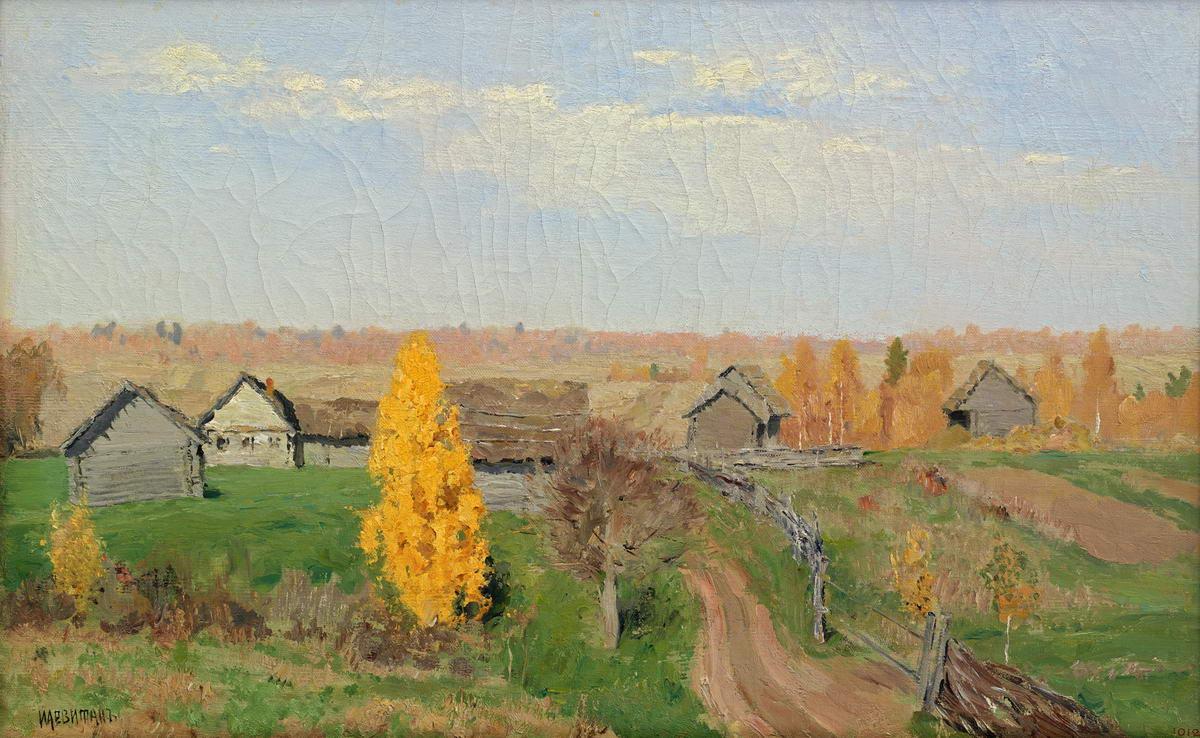
Isaac Levitan1860–1900
После дождя. Плёс
Si può ammirare?
Non si sa

Galleria Tret'jakov
Mosca, Russia
Il proprietario è noto; non si sa se oggi sia esposta.
- Fonte
- Il museo
Sul dipinto
Con le parole del museo — in russo
Поездки Левитана на Волгу занимают центральное место в его творческом становлении и достижении им художественной зрелости. Став источником вдохновения, наполнив душу художника очарованием природы, Волга придала его размышлениям особую глубину и содержательность. Пораженный необозримой ширью водных пространств, степенным величественным течением могучей реки Левитан писал Антону Чехову: « Может ли быть что трагичнее, как чувствовать бесконечную красоту окружающего, подмечать сокровенную тайну, видеть бога во всем и не уметь, сознавая свое бессилие выразить эти большие ощущения…».
Continua a leggere
Проводя по нескольку месяцев в год на Волге, в течение нескольких лет (1887–1890) Левитан, пораженный огромными водными пространствами, жизнью природы этого края, прибрежных городов, исполнял множество этюдов и небольших картин. В них он штудировал полюбившиеся виды при различном освещении, варьировал композиции, менял ракурсы. Художника захватил мотив реки с одинокими, брошенными у берега лодками. Искание, «прощупывание» этой темы воплотилось в большом полотне «После дождя. Плёс». Словно влажной кистью написан омытый дождем волжский день, наполненный сыростью и прохладой. Серое пасмурное небо с прорывами света и подернутая рябью вода передают состояние легкого движения, тревожности. Удивительно тонко мастер разрабатывает передний план полотна, выписывая песчаный берег, лохматые кустарники, гребешки волн и проступающие сквозь воду небольшие камешки.
Богатство палитры в разработке «жизни» неба, в ее слиянности на горизонте со стихией воды – малейшие градации синего, голубого, лазурита, сизого, серого, перламутрового обнаруживают колористический дар Левитана, а созданное полотно по праву можно назвать началом «волжской сюиты» Левитана.
Galleria Tret'jakov
Scheda
- Numero di inventario
- 1480
In catalogo
Fonti
- Galleria Tret'jakov
- Immagine: Galleria Tret'jakov — Museum open access
Nel frattempo, nella vita di Isaac Levitan
Tutta la vita1887
His first trip to the Volga: the river seems dreary
In 1887 he at last fulfils his dream and goes to the Volga, which his teacher Savrasov had painted so movingly (in the early 1880s his sister's illness had prevented the trip). In cold, overcast weather the river disappoints him: it seems to him dreary and dead.
late 1880s – early 1890s
Heads the landscape class at Gunst's school
In the late 1880s and early 1890s he heads the landscape class at the School of Fine Arts of the artist-architect A. O. Gunst.
spring 1888
He discovers Plyos on the Volga
In spring 1888 he sails by steamer along the Oka to Nizhny Novgorod and on up the Volga with the artist Alexei Stepanov and Sofia Kuvshinnikova; to their own surprise they discover the small, quiet town of Plyos and decide to stay on for a while. The three summer seasons there (1888–1890) prove extremely productive: some two hundred works bring Levitan wide fame.
late 1889 – early 1890
His first trip to Western Europe
He visits France and Italy, wanting to get to know modern painting better as shown at the World Exhibition in Paris — probably above all the Barbizon school and the Impressionists. According to Nesterov, in the West he became convinced that the path he had chosen was the right one.
summer 1890
Yuryevets: the idea of “A Quiet Monastery”
In summer 1890 he goes to Yuryevets and, among many landscapes and studies, paints “View of the Krivoozersky Monastery”; this is how the idea of “A Quiet Monastery” is born. The picture made a strong impression on Chekhov.
March 1891
Admitted to the Peredvizhniki Association
In March 1891 he becomes a member of the Association of Travelling Art Exhibitions.