 Albrecht DürerGermania, 1471–1528
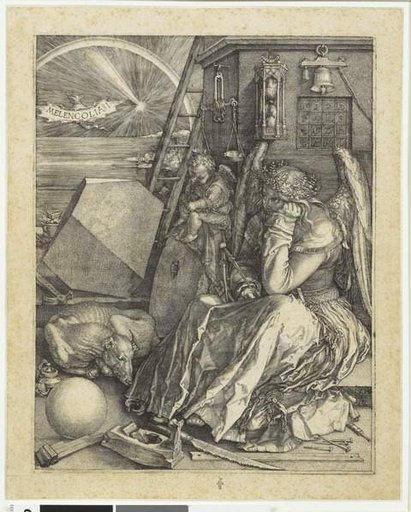
Melencolia I
La Mélancolie
Si può ammirare?
Non si sa
Chantilly, Francia
Il proprietario è noto; non si sa se oggi sia esposta.
- Ultimo cambio di stato
- Fonte
- Il museo
Sull’opera
Melencolia I o Melancholia I è un'incisione a bulino (23,9x18,9 cm) di Albrecht Dürer, siglata e datata al 1514 e conservata, tra i migliori esemplari esistenti, nella Staatliche Kunsthalle di Karlsruhe. L'opera, densa di riferimenti esoterici, tra cui il quadrato magico, è una delle incisioni più famose del norimberghese.
Scheda
- Numero di inventario
- EST 232
Che cosa raffigura
In catalogo
Fonti
- Museo Condé
- Immagine: Museo Condé — © Réunion des musées nationaux - utilisation soumise à autorisation; Ministère de la Culture (France), base Joconde
Nel frattempo, nella vita di Albrecht Dürer
Tutta la vita1507–1528 · Luogo di lavoro
Nuremberg
1512
Emperor Maximilian I becomes his chief patron
From 1512 Emperor Maximilian I was Dürer's chief patron. For him Dürer and his workshop produced the Triumphal Arch, a giant woodcut 295 × 357 cm printed from 192 blocks and modelled on the triumphal arches of ancient Rome.
3 January 1512
Nuremberg's privilege against forgeries
Nuremberg's city council granted Dürer a privilege for the sale of his prints, with penalties for anyone who forged them.
1513–1516
Three years without painting
Complaining that painting did not pay enough to justify the time compared with his prints, Dürer produced no paintings from 1513 to 1516.
1514
Death of his mother
In the year of Melencolia I and St Jerome in His Study, the artist's mother, Barbara Holper, died.
1515
A life pension from the emperor
The perpetually cash-strapped Maximilian could not pay on time and offered to exempt the artist from city taxes, which the Nuremberg Council opposed. At Dürer's request the emperor granted him a life pension of 100 guilders a year from the sums Nuremberg paid into the imperial treasury.
![Madonna and Child [obverse], Albrecht Dürer, c. 1496/1499](https://api.nga.gov/iiif/878db7e6-10ae-4cae-ba5d-6d6f5c413ae8/full/!2400,2400/0/default.jpg)
![Lot and His Daughters [reverse], Albrecht Dürer, c. 1496/1499](https://api.nga.gov/iiif/7565a449-f82a-414b-9bda-c93f55a51b4d/full/!2400,2400/0/default.jpg)