 Auguste RodinFrancia, 1840–1917
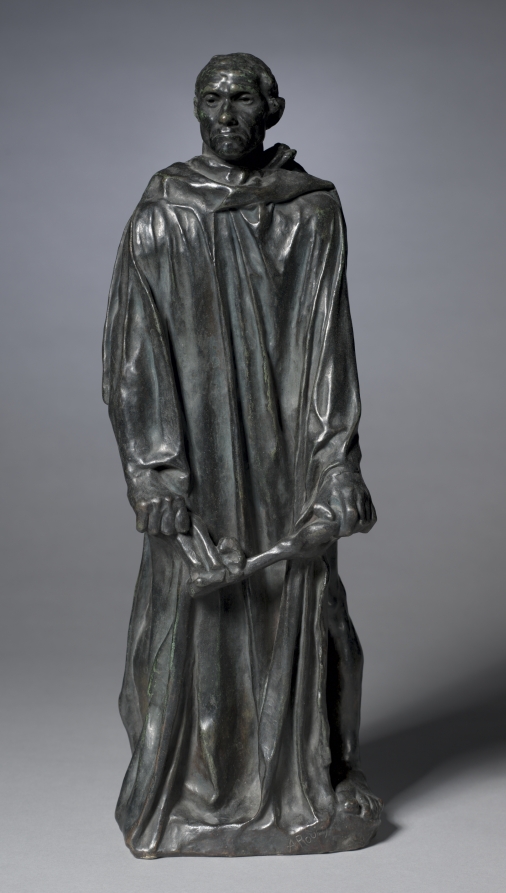
Jean d'Aire
Si può ammirare?
Al momento non riceve

Cleveland Museum of Art
Cleveland, Stati Uniti
Appartiene alla collezione, ma al momento non è esposta.
- Verificato
- Ultimo cambio di stato
- Fonte
- I dati di collezione del museo stesso
About the sculpture
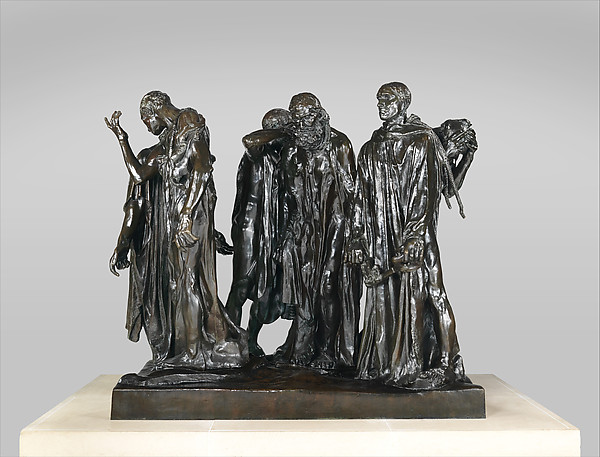
In 1884 Rodin received a commission to create a large public monument honoring six French men who volunteered to be taken prisoner by an English army in exchange for the English releasing the town of Calais from a brutal 11-month siege. This reduced cast depicts one of the volunteers from the monument. Rather than idealized heroes, Rodin portrays the prominent citizens known as burghers as ordinary men experiencing personal confrontations with death. Jean d’Aire faces his fate with stoic resolve. The thick folds of his tunic weigh heavily on his body, as if symbolic of an internal struggle between his willingness to sacrifice his life and a desire to live. His intense glare into space seems to betray the dread and anxiety raging within his mind. Immensely popular as an independent sculpture, Rodin made numerous versions in various sizes.
Cleveland Museum of Art
Scheda
- Numero di inventario
- 1917.723
In catalogo
Fonti
- Cleveland Museum of Art: the museum's own open data · acquisita 7 giorni fa
- Immagine: Cleveland Museum of Art — Museum open access
Nel frattempo, nella vita di Auguste Rodin
Tutta la vita1879–1882
Working at the Sèvres manufactory
Carrier-Belleuse, director of the Sèvres manufactory since 1875, invited Rodin to join him; the work paid well and Rodin stayed until 1882. In 1881, in gratitude, he sculpted a bust of Carrier-Belleuse.
1882
“St. John the Baptist” at the Royal Academy
A bust of St. John the Baptist, a version of the statue bought by the French government, was shown with success at the Royal Academy. A year earlier Henley, who had become editor of the Magazine of Art, had published several articles on Rodin there.
1883
Meets Camille Claudel
Standing in for Alfred Boucher, who was away, Rodin supervised his students' course and met the eighteen-year-old Camille Claudel. She became his assistant, model, lover and creative rival.
1884
Commission for “The Burghers of Calais”
Rodin pursued the commission for a monument to the town of Calais, but instead of a lone hero, Eustache de Saint-Pierre, he conceived six citizens, each with his own emotions. A year later the committee was unimpressed with his progress; Rodin was ready to abandon the project rather than change his design, and the town told him to carry on.
1885
Camille Claudel: assistant and lover
From 1885 Claudel worked as an assistant in Rodin's studio and posed for him, and soon they became lovers. The affair lasted nine years, and Rodin did not break with Rose Beuret, who knew her role as “the other woman”.
1886
Commission for the Victor Hugo monument for the Panthéon
Rodin showed Hugo as a mighty nude titan among three muses; the figure was judged unsuitable for the Panthéon and the project was rejected. In 1890 he removed the muses, and in 1909 the monument was set up in the garden of the Palais-Royal.